


That the Supreme Court overturned the Chevron Deference, a key foundation of modern administrative law for 40 years, in its June 28 ruling in Loper Bright Enterprises v. Raimondo (Loper Bright) was no surprise, although it does not make it any less disruptive. The order follows a steady drumbeat of Supreme Court decisions issued during this term and in recent prior ones curbing the regulatory enforcement capabilities of Executive Branch agencies. But while this is a landmark case and would be expected to lead to a host of new legal challenges, its practical effect might end up being more nuanced. In today’s RBN blog, we revisit the Chevron Deference, why the Court said it had to go, and what it might mean for economic and environmental regulations impacting the energy industry.

Before we get into how the Court made its decision, a couple of observations are in order right at the top, given its importance and potential long-term impact. First, reining in Executive Branch agencies can cut both ways. In the last administration, then President Trump often used executive orders and agency actions to implement his vision of the world, including trying to get the Department of Energy (DOE) to force utilities to run their coal plants regardless of the cost relative to natural gas (see Why Can’t We Be Friends?). That’s the kind of action that could be threatened by this decision. Second, as we’ve written many times regarding the Mountain Valley Pipeline (MVP) saga, federal permitting agencies were consistently receptive to the project, issuing permit after permit, but the U.S. Court of Appeals for the Fourth Circuit repeatedly reversed those decisions (see Rescue Me). In other words, the courts haven’t been very shy about jumping into agency decisions favorable to energy companies. (We’ll explore some of the other implications of the ruling in a bit.)
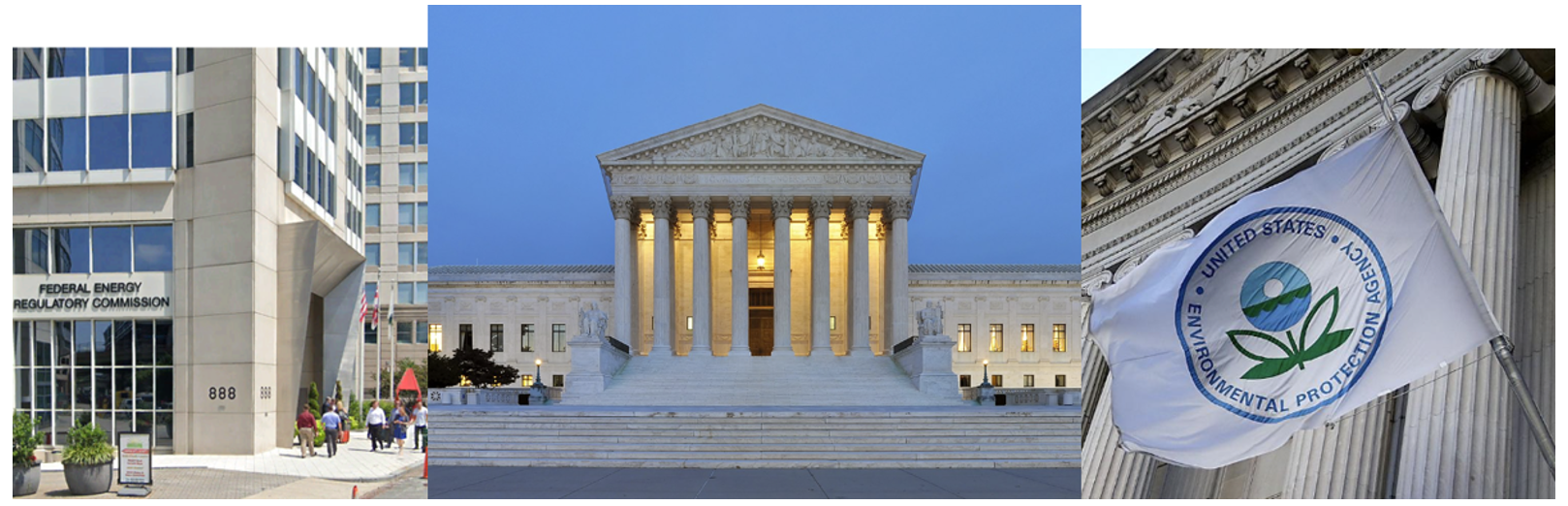
The Supreme Court (Middle), Flanked by the Federal Energy Regulatory Commission (Left) and the Environmental Protection Agency.
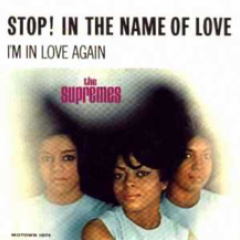
About the song
“Stop! In the Name of Love” was written by the team of Holland-Dozier-Holland and appears as the fourth song on side one of The Supremes’ sixth studio album, More Hits by The Supremes. Motown bassist James Jamerson’s bass lines in the song subtly propel and move the song in unexpected directions while Ross’ vocals deliver the tune’s message with aplomb and authority. The Supremes’ appearance on the Shindig! television show in February 1965, with its choreographed “stop” hand gestures, helped set up the song to become a smash hit. Produced by Brian Holland and Lamont Dozier, it was released as a single in February 1965 and went to #1 on the Billboard Hot 100 Singles chart. It has been certified Gold by the Recording Industry Association of America. Personnel on the record were: Diana Ross (lead vocals), Florence Ballard, Mary Wilson, The Andantes (backing vocals), James Jamerson (bass), Benny Benjamin (drums), Joe Messina (guitar), Johnny Griffith (organ), Jame Gittens (piano), Jack Ashford (vibraphone), and Mike Terry (baritone saxophone).
More Hits by The Supremes contains music by The Supremes recorded between 1964-65 at Hitsville U.S.A. in Detroit. it includes the two #1 hits, “Stop! In the Name of Love” and “Back in My Arms Again.” Released in July 1965, it went to #2 on The Billboard Top R&B and #6 on the Billboard 200 albums charts. Three previously released singles were included on the LP.
The Supremes were an American R&B girl vocal group and one of the most popular Motown groups of the 1960s. The group was formed as The Primettes in 1959 with Diana Ross, Florence Ballard, Mary Wilson and Betty McGlown. The girls met while living at the Brewster-Douglas public housing project in Detroit. They signed with Motown Records in 1961 and became a trio with Ross, Ballard and Wilson in 1962 for their first recordings. They have released 29 studio albums, four live albums, 32 compilation albums, two soundtrack albums, and 66 singles. They have a Grammy Lifetime Achievement Award, are inductees of the Rock and Roll Hall of Fame, Vocal Group Hall of Fame, and have a star on the Hollywood Walk of Fame. Diana Ross left the group in 1970 to pursue a solo career and was replaced by Jean Terrell. The Supremes have had 10 singers pass through the group since its formation. They officially disbanded in 1977 when the last original member, Mary Wilson, left for a solo career. Florence Ballard died in 1976, Mary Wilson died in 2021. Diana Ross continues to act, record and tour. Her last live performance was at London’s Royal Albert Hall in April. She begins her Beautiful Love Performances — Legacy Tour 2024 in Denmark in August.





Comments
I'm really impressed with the quality of your work, your even-handed commentary, and the range of your expertise. Having free access to your daily blogs is a major asset to anyone who wants to stay informed on industry-related matters!
Couldn't have said it better ourselves!