The U.S. Supreme Court will hear oral arguments January 17 in a pair of cases that are poised to capsize the so-called Chevron Deference, a 40-year-old legal doctrine that provides a key foundation for modern administrative law. It’s a big deal – big enough that we’re willing to wade into a little bit of legalese to help make sense of it. So strap in because in today’s RBN blog, we’ll explain what the Chevron Deference is, why it’s worth knowing about, how it applies to two cases that could alter its application, and how a ruling that limits or eliminates the doctrine’s usage and application could transform energy industry regulation.
In observance of today’s holiday, we’ve given our analysts a break and are revisiting a recently published blog on Chevron Deference. If you didn’t read it then, this is your opportunity to see what you missed! Happy MLK Day!

Let’s start with some background. Under our Constitutional system of checks and balances, Congress legislates by passing laws (Article I), the Executive Branch issues regulations to execute and enforce those laws (Article II), and the courts interpret them (Article III). The federal agencies that make up the Executive Branch are often referred to as “creatures of statute.” This means that their authorities to regulate are limited to the powers delegated to them by Congress — no more, no less. But the extent of that delegated authority is not always black and white. Laws are often lengthy and complex, and void of important details. This is largely out of necessity — it would be impossible to craft legislation that addressed every possible situation or future development — but also by design, as Congress has typically operated under the presumption that statutory law should set frameworks and standards, with individual agencies being best equipped to handle the details, given their subject-matter expertise and ability to respond quickly to changing conditions.
The gray area between what Congress intends and what the agency actually does is where the Chevron Deference comes into play.
Way back in 1984, in a case known as Chevron USA v. Natural Resources Defense Council (aka “Chevron”), the Supreme Court considered Clean Air Act regulations implemented by the Environmental Protection Agency (EPA) defining the statutory term “stationary source.” The NRDC had challenged the EPA’s interpretation, which treated all pollution-control devices in a single industrial or power plant as one “stationary source,” which made it easier to install new control equipment without having to recertify the whole thing under much tougher “new source” requirements if the changes weren’t increasing emissions for the plant. The high court approved the EPA’s approach, writing that when a court reviews an agency’s interpretation of the statute it administers, the court must first determine whether Congress “has spoken to the precise question at issue.” If Congress did speak directly to the question, the statutory language must be followed because the courts and agencies must “give effect to the unambiguously expressed intent of Congress.” Thus, if the agency’s interpretation is consistent with that expressed intent, the interpretation is valid. If not, the agency’s interpretation is not valid. This analysis is now called Chevron Step 1 (see yellow star to the lower left in Figure 1 below).
About the song
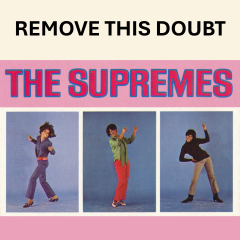
“Remove This Doubt” was written by Holland-Dozier-Holland and appears as the fourth song on side two of The Supremes’ 10th studio album, The Supremes Sing Holland-Dozier-Holland. The song was the B-side of the single “You Keep Me Hangin’ On,” released in October 1966 and reaching #6 on the Billboard Hot 100 Singles chart. “Remove This Doubt” was recorded in January 1965 at Hitsville U.S.A. Studio A in Detroit. Personnel on the record were: Diana Ross (lead vocals), Mary Wilson (backing vocals), Florence Ballard (backing vocals), and The Funk Brothers (instrumentation).
The Supremes Sing Holland-Dozier-Holland was recorded from 1964-1966 at Hitsville U.S.A. Studio A in Detroit with Brian Holland and Lamont Dozier producing. The Funk Brothers provided instrumentation for the tunes and The Andantes provided additional backing vocals on some songs. The album was released in January 1967 and went to #1 on the Billboard Top R&B and #6 on the Billboard 200 Albums charts. Two singles were released from the LP.
The Supremes were an American R&B vocal group and one of the top acts for Motown Records during the sixties. The group was founded in Detroit in 1959 as The Primettes, with Diana Ross, Mary Wilson, Florence Ballard and Betty McGlown. The group changed their name to The Supremes and became a trio after signing with Berry Gordy’s Motown Records in 1962. They released 29 studio albums, four live albums, 32 compilation albums, two soundtrack albums, and 66 singles, selling more than 100 million records worldwide. They won a Grammy Lifetime Achievement Award and are members of the Rock and Roll Hall of Fame, Vocal Group Hall of Fame, and have a star on the Hollywood Walk of Fame. Ten members passed through the group before they officially disbanded in 1977. Diana Ross left for a successful solo career in 1970, with fellow founding members Mary Wilson and Florence Ballard later doing the same. Florence Ballard died in 1976, Mary Wilson died in 2021.