
Prior to 2012 the only U.S. produced crude delivered by pipeline to Houston area refineries came from offshore Gulf of Mexico or onshore Louisiana fields. The majority of supplies were imports delivered by waterborne tanker. But in just three short years between 2012 and 2015, roughly 2 MMb/d of crude pipeline capacity was built or repurposed to deliver surging light shale crude production and heavy crude from Canada into the Houston area. Refiners have adapted quickly to take advantage of new sources of supply. But with much of the newly minted infrastructure underutilized, midstream companies still need to improve pipeline connectivity and storage accessibility to overcome area logistical challenges. Today we review RBN’s latest Drill Down report on Houston crude infrastructure – released today -- and announce RBN’s new infrastructure database and mapping system, called MIDI.
In 2011 average waterborne imports to Houston area ports were 1.7 MMb/d – enough to supply more than 70% of local refinery needs. Since April 2012 when Phase 1 of the Seaway pipeline reversal (150 Mb/d) came online to deliver crude from the Midwest Cushing, OK trading hub to Houston, that position has been largely reversed as multiple new pipelines have come online delivering domestic and Canadian crude to the Houston area – pushing out imports in the process. In July 2015 crude delivered by pipelines developed since 2012 accounted for about 55% of Houston supply and waterborne imports had dwindled to 0.8 MMb/d. Our latest Drill Down report – available exclusively to Backstage Pass subscribers provides detailed analysis of the changing crude supply/demand balance for 9 refineries and two condensate splitters in the Houston area that between them consume about 2.4 MMb/d.
This Drill Down report also highlights the features and functionality of RBN Energy’s new Midstream Infrastructure Database Interface (MIDI) from which a number of the maps in the report are derived. See section below for more information.
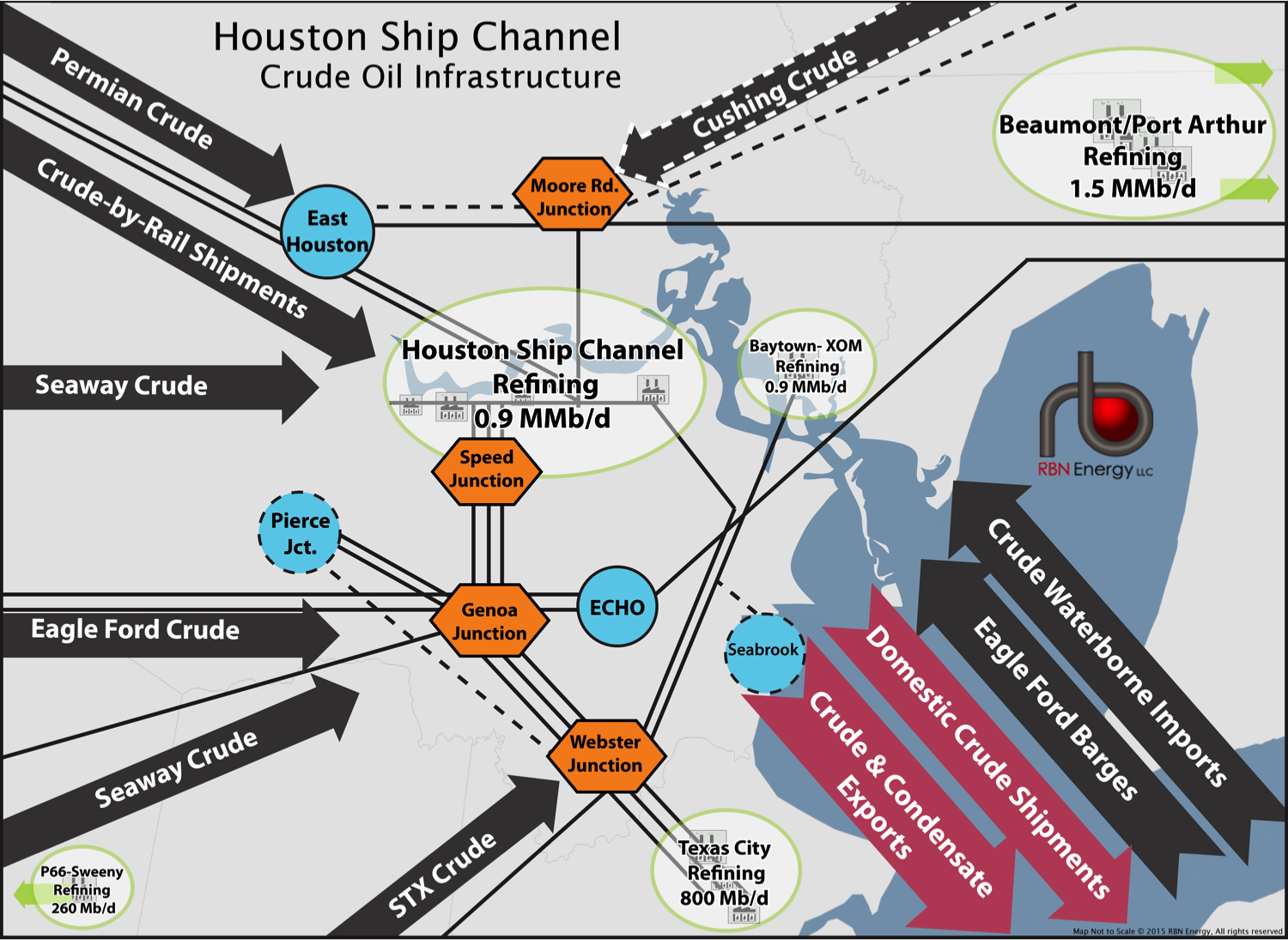
We begin our analysis with a detailed breakdown of the supply and demand for crude to Houston area refineries in summer 2015. The map in Figure #1 below gives an indication of the complex mixture of supplies that area refineries now access. New pipelines deliver crude from the prolific South Texas Eagle Ford, the West Texas Permian and from the Midwest trading hub at Cushing, OK. Crude delivered from Cushing originates from shale production in Oklahoma, North Dakota, the Rockies and the Midwest Anadarko as well as Western Canadian heavy oil sands. Domestic crude is also being delivered to Houston on the water – mostly from the Eagle Ford via Corpus Christi but also from Louisiana. Crude imports continue to make up a significant part of the area crude slate since many of these refineries are configured to process medium and heavy crude. Crude is also leaving the Houston area by ship – some delivered domestically to refineries along the Gulf Coast and growing volumes exported – to Canada or as processed condensate to refineries in Europe and Asia.

About the song
Stairway to Heaven from rock legends Led Zeppelin’s fourth studio album was released in 1971. Composed by Jimmy Page and Robert Plant the song is often rated among the greatest rock songs of all time.