Energy Transfer Partners (ETP) is the nation’s second-largest master limited partnership (MLP), with a market capitalization of $19.6 billion, $39.7 billion in 2015 revenue and $8 billion in 2015 capital investments. ETP’s general partner is Energy Transfer Equity (ETE), whose once-promising merger deal with Williams bit the dust in June. ETP’s extensive holdings include several major interstate and intrastate natural gas pipelines, midstream natural gas services, and natural gas liquids (NGL) pipelines and services; it also holds approximately 27.5% of the limited partner interests and all of the general partner interest in Sunoco Logistics Partners (SXL). With ETP’s size, its huge portfolio of midstream assets, and its high-profile general partner, the MLP was an obvious choice for our Spotlight Report series. Today we summarize Part Two of our ETP Spotlight Report, which focuses on the company’s Midstream and Liquids segments.
First, a few words about Spotlight, which is a joint venture of RBN Energy and East Daley Capital Advisors. With the support of Oil & Gas Financial Analytics, Spotlight provides “deep dives” into the fundamentals that shape the outlook for midstream energy companies. In each report, we “spotlight” a midstream energy firm, typically one operating within an MLP structure, and provide a comprehensive view of the company’s assets and operations. We examine their asset structure to reveal what volumes are flowing, what rates are (and can be) charged, how they are exposed to commodity price risk, how their assets fit together, and what aspects of their operations provide competitive advantages in today’s extremely volatile energy marketplace. This report, which covers ETP’s Midstream and Liquids assets (see the first half of our ETP review here), is the fourth edition of the Spotlight Report series. For more about Spotlight, see the paragraph at the end of this blog.
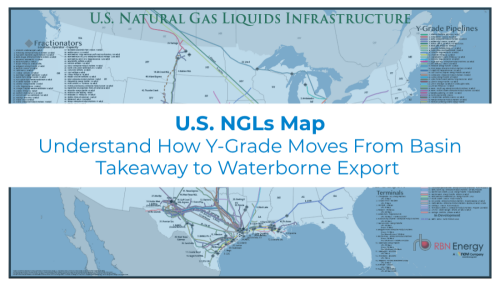
Visualize the infrastructure behind U.S. NGL movement.
The U.S. NGLs Map provides a comprehensive view of the transport, processing, and export networks moving NGLs across the U.S.
With that aside, here’s a brief overview of ETP’s assets, a summary of our findings, and a few examples of the deep-dive details that helped us come to our conclusions. ETP has four major investment segments, listed below. The Interstate Transportation and Storage and Intrastate Transportation and Storage segments were highlighted in Part One of this Spotlight report. In the report released today we focus on Midstream and Liquids Transportation and Services.
About the song
“Two Out of Three Ain’t Bad” is one of the best-known, most-played hits by Meat Loaf. The song, which appeared on Meat Loaf’s 1977 solo album, Bat Out of Hell, rose to Number 11 on Billboard’s Hot 100 list.
[1] Spotlight uses publicly available data, combined with the deep experience of our combined RBN Energy and East Daley Capital teams to perform in-depth analysis that far exceeds the high-level assessments that are in the marketplace today. We get into micro-level details, integrating fundamentals data, market data and company data in a comprehensive model that provides a clearer picture of the company and its prospects. As with all energy fundamental analysis, Spotlight Reports rely on estimates and approximations of volumes, throughputs and fees. No non-public data from the subject company or any other source has been used in the preparation of this report. Spotlight Reports are provided for reference only, and should not be viewed as investment advice. Neither RBN Energy nor East Daley Capital is an investment advisor. The first edition of Spotlight covered ONEOK (OKS), and the second edition covered DCP Midstream Partners (DPM). The third edition covering ETP’s natural gas pipeline assets was published in May 2016. Spotlight is available to RBN Backstage Pass subscribers. Non-subscribers may purchase individual company Spotlight reports separately. For more information about Spotlight, go to rbnenergy.com/spotlight.
[2] The percentages shown for each ETP segment exclude Sunoco Logistics Partners, since Sunoco is excluded from this Spotlight Report analysis. Note that in our Spotlight Reports, we use the conventional measure of company earnings, EBITDA, which means earnings before interest, taxes, depreciation and amortization. EBITDA is essentially net income with interest, taxes, depreciation, and amortization added back to it, and is used to analyze and compare profitability between companies and industries because it eliminates the effects of financing and accounting decisions.