There’s been a lot of discussion lately about the best way to meet the expected increases in U.S. power demand, driven in part by manufacturing growth and the rapid development of large-scale data centers. That has spurred a renewed interest among regulators, industry leaders and the general public in nuclear power. But while traditional reactors are known for their cost overruns and construction delays as much as the massive amounts of carbon-free power they produce, some see a better way forward in the form of small modular reactors (SMRs). Advocates with “uranium fever” say they can be built without many of the problems that accompany their larger cousins and offer a number of potential advantages, including siting flexibility, price and efficiency. In today’s RBN blog, we’ll look at the state of nuclear power in the U.S., examine the potential for SMRs, and discuss the hurdles they face to obtaining the necessary permits and ultimately beginning operation.
The replay of our Fall 2026 School of Energy (September 9 & 10, Houston) is now available online!
Learn from RBN experts, participate in hands-on Excel modeling, connect with industry peers, and gain a stronger understanding of today's interconnected energy markets.
First, let’s start with some basics about traditional nuclear power. A pressurized water reactor (PWR), the most common design in operation, uses uranium pellets to heat water through fission. (Fission occurs when a neutron hits a larger atom, splitting it into two smaller atoms.) As shown in Figure 1 below, the high-pressure hot water is used to boil water in the steam generators and produce steam. The steam is used to spin large turbines that drive electric generators to produce electricity (see dashed red oval). Large nuclear power plants can have an output of more than 1,000 megawatts (MW) and deliver up to 24 million kilowatt-hours (kWh) daily. They are mostly built on site and can cost many billions to construct and operate. Most nuclear plants in the U.S. have large concrete domes covering the reactors to contain any accidental radiation releases. Some have cooling towers and some use water from lakes, rivers or the ocean for cooling, meaning that access to large amounts of water is essential.
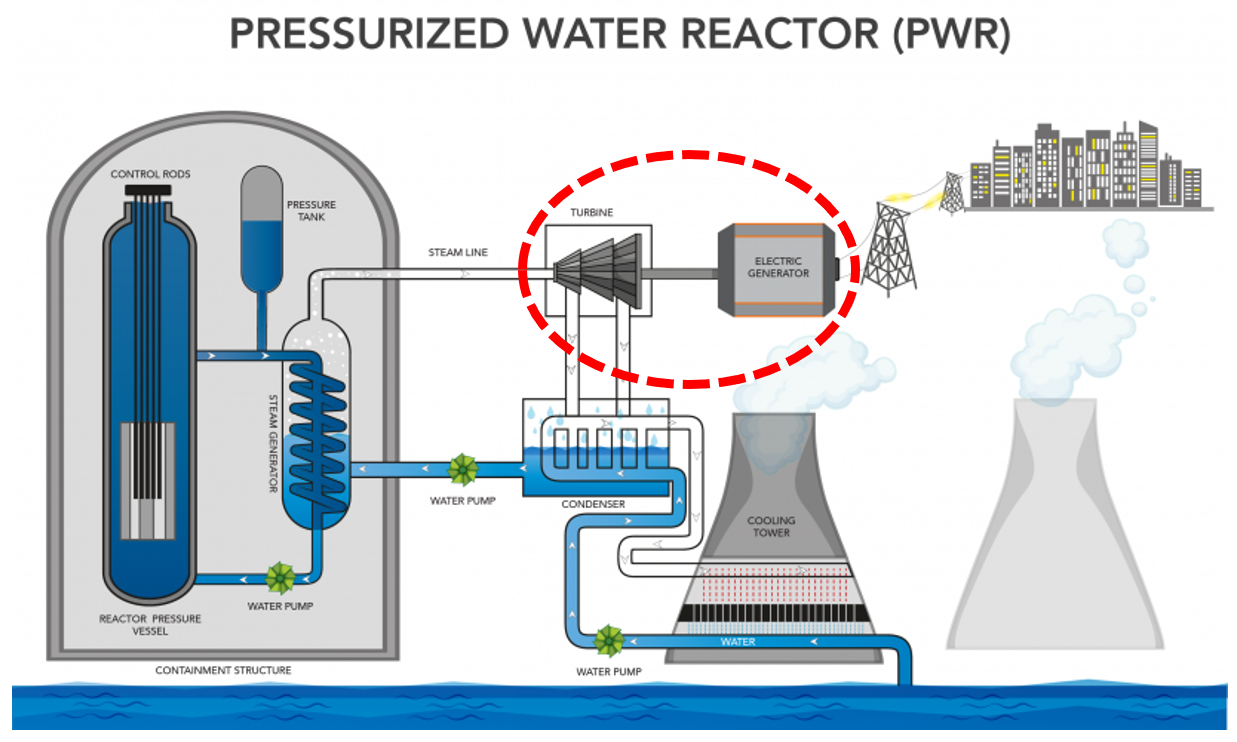
Figure 1. Schematic for Pressurized Water Reactor. Source: Department of Energy
About the song
“Uranium Fever” was written by Penny Britt and released on a 78-rpm single recorded in Nashville, TN, by Elton Britt on RCA Victor in 1955. Penny Britt was Elton Britt’s wife from 1942 to 1958. The song is in a talking blues format and is similar to “Hot Rod Lincoln” by Charley Ryan, also released in 1955. According to the lyrics, the uranium prospector “sold his Cad, bought a Jeep,” and “with a Geiger counter in my hand, was gonna act to stake some government land.” Personnel on the record were: Elton Britt (lead vocals, acoustic guitar) and unnamed musicians. Due to the date and location, it was probably Hank Garland on electric guitar, Harold Bradley on banjo, and Floyd Cramer on piano.
On a side note, the lyrics in “Uranium Fever” reference a “Vernon Pick.” Pick struck it rich with a uranium find in the Utah canyonlands, making him a millionaire and establishing him as the “Uranium King of America.” In the early 1970s Pick built “Walden North” in Lillooet, British Columbia. It was an Apocalypse-proof mansion with workshops with its own hydroelectric plant, two-foot-thick concrete walls, and access by a funicular. After Pick’s death in 1986, all the furnishings were auctioned off and the estate now lies in a vandalized state of disrepair. There are some interesting videos of Walden North in its current condition on YouTube. The culture of Pick and Walden North blends in nicely with the post-apocalyptic videogame series, Fallout. Fallout was created by Tim Cain and Leonard Boyarsky for Interplay Entertainment in 1997 and has been followed by several sequels and a TV show based on the series. It has a retro-futuristic setting influenced by the post-war atomic culture of the U.S. in the 1950s, when the fear of nuclear annihilation was on people’s minds. “Uranium Fever” plays on Diamond City Radio in Fallout 4.
Elton Britt (James Elton Baker) was an American country music singer, songwriter and musician. He was best known for Western ballads and yodeling songs. He released 13 studio albums and 18 singles. His 1942 wartime single, “There’s a Star-Spangled Banner Waving Somewhere,” sold a million discs by 1944 and was certified Gold by the Recording Industry Association of America. It was the first Gold record awarded to a country music artist. Britt died in McConnellsburg, PA, in June 1972 at the age of 58.