For nearly two months -- Since late July -- WTI crude oil prices have averaged $45/bbl, never once closing above the $50/bbl mark. Over the same period, the natural gas price at Henry Hub has averaged $2.70/MMbtu and now languishes $.20/MMbtu lower. Is this a time to be wallowing in misery and self-pity? Absolutely not!! This is the time for midstreamers and producers to reposition their businesses with a laser-like focus on the opportunities that low prices have served up. There are bargains out there in the oil (and gas) patch. If producers are in the right locations, with drilling costs much lower than last year, there is good money to be made. And likewise, opportunities abound for midstreamers to pick up assets at very attractive prices to get that production to market. But to execute such a strategy, you must have a rock-solid understanding of what is really going on in today’s markets for crude oil, NGLs and natural gas. Our goal for the upcoming State of the Energy Markets Conference scheduled for October 28, 2015 in Denver, CO is just exactly that - to give you a rock-solid market knowledge based on hard data and thorough analysis. Today’s blog is an advertorial for the conference.
RBN’s approach to pulling this hard data and analysis together is a bit different than your run-of-the-mill consultancy. For example, we don’t forecast prices. Ever since crude prices crashed last year, we concluded that there are just too many moving parts in the global oil market for us (or anyone else for that matter), to come up with a single view of what will happen to prices over the next few years. So instead, we start with multiple price scenarios – possible trajectories for prices that are plausible, based on what we know now about the market. We don’t consider these scenarios high or low cases, reference cases or any of the other standard nomenclature. A scenario is simply a time series of forward prices that we can use in our modeling methodology to understand market responses.
The RBN methodology is summarized in Figure #1 below. The leftmost box (1) represents the forward price scenarios. RBN’s methodology for assessing crude oil, NGL and natural gas production is scenario based, driven by one or more sets of forward prices. A price scenario (crude oil, NGLs, natural gas) is used to calculate (2) representative producer economics (rates of return).

Figure #1; Source: RBN Energy
Based on those rates of return, we can estimate (3) the response of producers – how many wells will be drilled, how many completed, and what kind of production can those wells be expected to yield. Those numbers, based on information such as type curves (initial production rates and decline curves), producer guidance to investors, and the availability of take-away infrastructure are used to (4) forecast production. Finally the forecast of production volume is used (5) to assess market response, including infrastructure requirements and overall supply/demand implications.
We go through this exercise for both crude oil and natural gas production. NGL production is then estimated based on associated gas production (derived from the crude oil production forecast) and wet gas (using the natural gas production forecast), computing NGL volumes based on the liquids content of the gas (gallons per million cubic feet, or GPM – see How Rich is Rich? ), and the availability of necessary infrastructure (processing, fractionation, pipelines, rail, etc.) to get barrels to market.

About the song
“Rocky Mountain Way” was written by Joe Walsh, Joe Vitale, Rocke Grace and Kenny Passarelli. It appears as the first song on side one of Joe Walsh’s second studio album, The Smoker You Drink, The Player You Get. Released as a single in June 1973, the song went to #23 on the Billboard Hot 100 Singles chart. Walsh said the lyrics came to him as he was mowing the lawn at his Colorado home. “I looked up and there’s the Front Range of the Rocky Mountains and it knocked me back because it was just so beautiful.” The song features Walsh using one of the original talk boxes designed and manufactured by Bob Heil. Walsh gave songwriting credits to all four members of his band Barnstorm, since they helped transform what began as a blues jam in the studio to a fully realized song. The Colorado Rockies Major League Baseball team plays “Rocky Mountain Way” after every home win at Coors Field. The Denver Broncos National Football League team plays Godsmack’s version of the song at home games at Empower Field at Mile High Stadium. Personnel on the Joe Walsh record were: Joe Walsh (lead vocal, guitar, keyboards), Kenny Passarelli (bass, backing vocals), Joe Vitale (drums, percussion, backing vocals), Rocke Grace (keyboards, backing vocals), and Joe Lala (percussion).
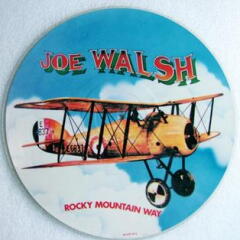
The Smoker You Drink, The Player You Get was recorded between late 1972 and early 1973 at Caribou Ranch in Nederland, CO, and the Record Plant in Los Angeles. Produced by Joe Walsh and Bill Szymczyk, it was released in June 1973. The album went to #6 on the Billboard 200 Albums chart and has been certified Gold by the Recording Industry Association of America. The cover art for the album features a British Sopwith Snipe fighter plane with French colors that appears to be flying upside down as the blue sky is at the bottom and the brown ground is at the top of the illustration. One single was released from the LP.
Joe Walsh is an American guitarist, singer, songwriter and record producer. He started his professional career as the lead singer and guitarist of the James Gang, a rock and roll trio formed in Cleveland, OH, in 1966. He left the band in 1972 to pursue a solo career. In 1975, Walsh joined The Eagles. He released four studio albums with the James Gang and has released five albums with The Eagles so far. As a solo artist, he has released 20 studio albums, one live album, six compilation albums, and eight singles. He has appeared on more than 40 albums by other artists. Walsh continues to record and tour, with six upcoming shows with the James Gang booked in November.