With the rise of U.S. LNG exports in recent years, southern Louisiana has become a focal point for natural gas demand, pulling in gas supply from near and far and all directions. That market was severely disrupted this summer as COVID-19 decimated global LNG demand and hammered the economics of U.S. LNG exports. Pipeline flows into southern Louisiana during those months went from record-breaking highs that pushed the limits of the area’s infrastructure capacity to levels consistent with 2018, when the Bayou State’s LNG export capacity was just 2.65 Bcf/d, compared with 4.9 Bcf/d now. More recently, an active hurricane season has also curtailed exports. But demand for U.S. LNG is rebounding, and as LNG feedgas heads back to its previous highs and beyond, a new flow dynamic is emerging along the Gulf Coast, driven by the 1.35 Bcf/d of new export capacity in Texas that came online this year. Flows between Louisiana and Texas are reversing as an increasing amount of gas is needed on the western side of the Sabine River to feed the Corpus Christi and Freeport LNG facilities. The incremental gas demand and flow reversal will create new challenges and constraints for the region’s pipeline infrastructure as steady exports resume. Flows into Louisiana will be higher than ever, but so will flows out of Louisiana heading west to serve additional LNG demand. Today, we begin a series discussing how LNG demand is changing gas flows along the U.S. Gulf Coast.

Canadian crude output is rising, requiring new export routes. As traditional pathways face constraints, the U.S. Rockies—especially the Guernsey, WY hub—are emerging as key corridors for moving Canadian heavy crude to downstream markets, including the Gulf Coast.
Louisiana has a particularly dense, tangled network of natural gas pipes, so to make sense out of these developments, we need to dissect the state in terms of gas flows and capacity utilization. The only practical way to do that is to carve Louisiana into pipeline corridors that can be used to assess changes in inflows, outflows, and intrastate flows through groups of pipes that serve similar markets from comparable supply sources. Through a careful examination of flows and capacity utilization across these corridors, it is possible to model why the market has developed as it has. Then, by overlaying new pipeline and LNG export projects on the model, you can get a good understanding of how flows and prices are likely to play out in the future. The analysis presented in this series will dovetail with the Some Beach blog series and tie into the subsequent report on the future of Gulf Coast gas markets.
We first introduced RBN’s Louisiana flow model, which is updated weekly as part of the LNG Voyager report, in our Born on the Bayou series. As we discussed in those blogs and in further detail in a Drill Down report titled Down Louisiana Way, we divide Louisiana into three sectors, as can be seen in Figure 1:
- Northwest (in blue) — the location of Haynesville, Bossier, and most Cotton Valley production;
- Northeast (in pink) — the location of the Perryville Hub, the way station for flows coming from the west and the Marcellus/Utica; and
- South (in teal) — an area that has transformed from a supply region (from offshore production) to a demand region (for LNG exports) over the last few years.
We aggregate pipeline flows into and out of these three regions into seven corridors.
About the song
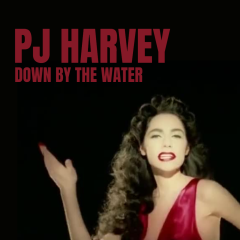
"Down by the Water" was written by PJ Harvey and appears as the seventh track on Harvey's third studio album, To Bring You My Love. Released as the first single from the album in February 1995, the song went to #2 on the Billboard Top Modern Rock Tracks chart and #48 on the Billboard Hot 100 Singles chart. Personnel on the record were: PJ Harvey (vocals, organ), John Parish (percussion), Joe Gore (guitar), Sonia Slany (violin), Jocelyn Pook (viola), Jules Singleton (viola), Sian Bell (cello), and Pete Thomas (string arrangements).
To Bring You My Love was recorded between September and October 1994 at Townhouse Studios in London. Produced by Flood, Harvey, and John Parish, it was released in February 1995. The album went to #2 on the Billboard Top Modern Rock chart and #40 on the Billboard Top 200 Albums charts. Heavily influenced by American blues music, it remains one of Harvey's best-selling albums. Three singles were released from the LP.
PJ (Polly Jean) Harvey is an English musician, singer, songwriter, sculptor, and poet. She has released nine studio albums, one soundtrack album, one EP, three compilation albums, and 23 singles. Harvey has won one Ivor Novello Award and was awarded a Member of the Order of the British Empire (MBE) for services to music in 2013. She has sold over 1.5 million albums in the U.S. Harvey continues to record and tour.