Crude oil exports are hitting record volumes. Geopolitical dislocations, regional capacity constraints, and transport cost aberrations are upending global trade flows. These developments have a direct impact on U.S. export grades, prices, and the utilization of pipelines and terminals. Petroleum product exports have an equally formidable set of challenges. U.S. surpluses of refined products are growing as domestic demand falls and biofuel penetration increases. The impact will translate directly into shifts in flows between PADDs, the repurposing of infrastructure, and more exports from the Gulf Coast. We’ll be exploring these and many more developments at our upcoming conference, xPortCon-Oil 2023, to be held in Houston on June 8, 2023. In this blatantly advertorial blog, we will introduce the major topics to be covered at the conference, who will be participating, and why we believe this will be the most important industry gathering for crude and products markets this year.

Join industry leaders in Calgary on October 29 for market insights, technical presentations, Duvernay inventory analysis, an expert panel, and networking focused on the next chapter of Canadian energy.
As we have covered in several recent blogs, exports are now Calling the Shots in U.S. liquid fuel flow patterns, price differentials, infrastructure utilization and, to a great extent, the winners and losers in crude oil and product markets. We documented how a whopping 60% of crude oil produced in the U.S. is exported, either as crude or in the form of gasoline, diesel, jet fuel or other petroleum products. Of course, this number must be taken in context of the significant volumes of crude and products that are still imported. But the reality is that U.S. net imports are dwindling toward zero — and if you throw NGLs into the liquid fuels balance, the U.S. has been a net exporter of liquid fuels since 2020. We’ve addressed Permian crude flows to Corpus Christi and Houston, how the U.S. will become a leading exporter of renewable diesel and sustainable aviation fuel, the impact of crude flows on infrastructure requirements (driving plans by Enbridge and Enterprise), and what all this has meant for crude pricing mechanisms (Trading in the USA).
Figure 1 puts the crude oil export growth issue in perspective. After the crude export ban to countries other than Canada was lifted at the end of 2015, export growth started off slowly in 2016 and 2017, averaging 230 Mb/d and 800 Mb/d, respectively. But then overseas exports (blue layer) took off, soaring to an average of 2,650 Mb/d from 2019 through 2021. Then, as shown in the right inset, total exports ramped up to average 3,600 Mb/d in 2022 (dashed gray horizontal line) and exceeded 5,000 Mb/d twice so far this year in EIA weekly numbers (yellow stars; 5,600 MMb/d at the end of February and 5,200 Mb/d last week). The trend (red line) is irrefutable.
About the song
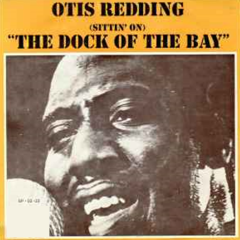
“Sittin’ on the Dock of the Bay” was written by Otis Redding and Steve Cropper. It appears as the first song on side one of Otis Redding's seventh studio album, Dock of the Bay. Redding started writing the lyrics to the song while staying on a houseboat in Sausalito, CA, owned by concert promoter Bill Graham. Redding finished the song with guitarist/producer Steve Cropper at Stax Studio in Memphis in November 1967. Cropper had finished putting the final touches on the recording just three days before Redding died in a tragic plane crash with his touring band, The Bar-Kays, enroute to a show in Madison, WI, in December 1967. Released as a single posthumously in January 1968, the song went to #1 on the Billboard Hot 100 Singles chart and has been certified 3x Platinum by the Recording Industry Association of America. Personnel on the record were: Otis Redding (vocals, whistling), Steve Cropper (guitar), Booker T. Jones (keyboards), Donald Dunn (bass), Al Jackson Jr. (drums), Wayne Jackson (trumpet, trombone), and Andrew Love (saxophone).
The album, Dock of the Bay, was recorded at Stax Studio in Memphis between July 1965 and December 1967. Some of the material on the album dates back to singles released in 1965. It was the first of several posthumously released Redding albums. Produced by Steve Cropper, the LP was issued in February 1968 and went to #1 on the Billboard Hot R&B Albums chart and #4 on the Billboard 200 Albums chart. Six singles were released from the album.
Otis Redding was an American singer and songwriter. He has been called the “King of Soul” and is regarded by many as the greatest male singer in the history of American popular music. Raised in Macon, GA, Redding was influenced by fellow Macon resident Little Richard. He worked for Little Richard and his Upsetters band as a driver and equipment manager before joining Johnny Jenkins’s band as a singer. When Steve Cropper and Stax-owner Jim Stewart heard Redding sing “These Arms of Mine” during a session at Stax Studios, Stewart signed him to his label. He released 10 studio albums, nine live albums, 15 compilation albums, and 48 singles. He is a member of the Rock and Roll Hall of Fame, Songwriters Hall of Fame, Rhythm and Blues Music Hall of Fame and Georgia Music Hall of Fame, and has a Grammy Lifetime Achievement Award. There is a memorial statue of Redding at Gateway Park in Macon. Redding died in a plane crash in December 1967. He was 26 years old.