With multiple energy markets around the world facing natural gas shortages, buyers are clamoring for more LNG. Pre-winter panic-buying has sent global gas prices to record highs yet again in the past couple of days, and even hauled Henry Hub gas futures up to new post-2008 records above $6/MMBtu in after-hours and intraday trading. With the incredible run in global gas prices, U.S. export economics have looked extremely attractive for nearly a year now, and you would think that buyers would be lining up for new liquefaction capacity in the U.S. Well, it has certainly drawn prospective offtakers back to the table. But they are wary of rising export costs and committing to projects long-term given the questionable future for hydrocarbon markets. Additionally, Europe’s rising piped gas imports from Russia and overall declining demand in the region have put long-term prospects for European LNG imports, in particular, on shaky ground. So, access to Asia is more important than ever for new LNG development, a key selling point for projects on North America’s Pacific Coast, both because of proximity to Asian markets and the absence of canal fees or constraints versus the Gulf Coast. There are no LNG export terminals on the Pacific Coast currently, but two projects — LNG Canada in British Columbia and Sempra Energy’s Energía Costa Azul (ECA) LNG in Baja California, Mexico — are under construction and due online mid-decade. Those projects are unlikely to be the last, given the more than $1/MMBtu in cost savings due to shorter voyage times and canal-free access to Asia. In today’s RBN blog, we begin a series looking at the state of LNG development on the North American Pacific Coast.
Back-to-back LNG blogs? We normally like to mix it up when it comes to blog topics. However, the past two days have been anything but normal in the gas markets. Global gas prices were already in the midst of the most epic bull run in modern times, if not ever, with gas prices abroad pushing to new highs all summer and into fall. This has been underpinned by strong global gas demand and a gas shortage in Europe (see It’s Too Late), but now a coal shortage in China has sent the market into another upward spiral as the entire world weighs the impacts of multiple countries facing energy shortages and winter reliability fears. This has sent Asia’s Japan Korea Marker (JKM), Europe’s Dutch Title Transfer Facility (TTF) and the UK National Balancing Point (NBP) to all-time highs yet again this week. The U.S. gas market is tight as well, but it’s not facing the same kind of shortages. Even so, gas prices here have been unable to escape the upward pull. The October Henry Hub gas futures surged nearly 60 cents (11%) on Monday — the biggest single-day gain in nearly three years — to record a new post-2008 high of $5.706/MMBtu, despite little change in domestic fundamentals. Then, in after-hours trading Monday night, the prompt contract blasted past the $6/MMBtu mark and again topped $6/MMBtu in early trading Tuesday before expiring at about $5.84/MMBtu. This, as JKM reached a high-water mark just under $30/MMBtu. The linchpin for these dramatic price moves is of course LNG. Yesterday, in Hear My Train A Comin’, Part 2, we looked at the near-term impacts of rising LNG export capacity on U.S. gas demand, with commissioning for both Sabine Pass Train 6 expansion and the new Calcasieu Pass facility well underway and first LNG exports expected this winter. Next, we shift our focus longer-term to another aspect of the all-important LNG supply picture: the economics of North America’s Pacific Coast vs. Gulf Coast export projects.
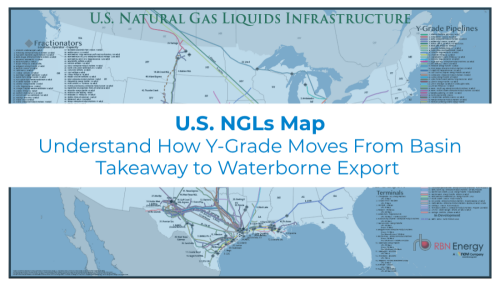
Visualize the infrastructure behind U.S. NGL movement.
The U.S. NGLs Map provides a comprehensive view of the transport, processing, and export networks moving NGLs across the U.S.
Before we dive into why the Pacific Coast is such an attractive location for LNG development, we need to review the basic economics around North American LNG exports. RBN utilizes an export cost model to track the economic viability of delivering U.S. LNG to destination markets. We first introduced this model in Sultans of Swing, where we went through the various costs in detail. Figure 1, below, shows a snapshot of our economic model for exports from the U.S. Gulf Coast (where a majority of exporters are located) to Asia via the Panama Canal, the lowest cost and most popular route for the bulk of U.S. LNG exports to Asia. Note that these costs are based on middle-of-the-road or midpoint assumptions, whereas, in reality, they can vary based on a host of factors and each offtaker’s contract or even individual cargo sales.
About the song
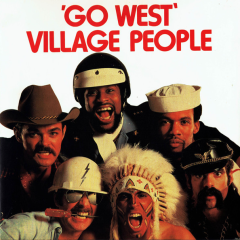
“Go West” was written by Jacques Morali, Henri Belolo and Victor Willis. It appears as the second song on Village People’s fourth studio album of the same name. Released as the first single from the LP in June 1979, it went to #14 on the Billboard Dance Club and #45 on the Billboard Hot 100 Singles charts. Personnel on the Village People record were Victor Willis (lead vocals), Randy Jones, Glenn Hughes, Felipe Rose, David Hodo, Alex Briley (backing vocals), and Gypsy Lane (studio band). In September 1993, Pet Shop Boys released their version of the song as a single from their fifth studio album, Very. It went to #1 on the Billboard Dance Club chart and #25 on the Billboard Hot 100 Singles chart. Personnel on the Pet Shop Boys record were Chris Lowe and Neal Tennant (vocals).
The Village People album, Go West, was produced by Jacques Morali and released in March 1979. It went to #8 on the Billboard 200 Albums chart and has been certified Platinum by the Recording Industry Association of America (RIAA). It would be the last Village People album of new material for Casablanca Records and the last album to feature Victor Willis on lead vocals. Two singles were released from the LP. The Pet Shop Boys album, Very, was released in September 1993 and went to #20 on the Billboard Top 200 Albums chart. It has been certified Gold by the RIAA. Five singles were released from the album.
Village People is an American disco group known for its costuming and clever lyrics. Formed in New York City in 1977 by French record producers Jacques Morali and Henri Belolo, and featuring the vocals of Victor Willis, the group released its debut album in July 1977. They have released 10 studio albums and 34 singles. Twenty-four members have passed through the group since its formation. They still tour with original member Victor Willis on lead vocals, accompanied by Javier Perez, James Lee, J.J. Lippold, James Kwong, and Nicholas Manelick. They are currently on tour in the U.S. through October. They will then embark on an Eastern European tour beginning in November.
Pet Shop Boys is an English synth-pop duo formed in London in 1981 by Chris Lowe and Neil Tennant. They have released 15 studio albums, five live albums, five soundtrack albums, nine compilation albums, four EPs, and 79 singles. This summer they toured parts of Europe, finishing at Warwick Castle in Warwick, England, on August 30.