


RBN expects total Canadian crude production to grow to more than 5 MMb/d by the end of 2019 – an increase of 1.4 MMb/d over 2013. Most of that new production will be heavy bitumen from Western Canada that will find its best market at US Gulf Coast refineries configured to process that type of crude. Trouble is pipeline capacity between the production regions in Alberta and the Gulf Coast is in short supply – a situation made worse by permit delays to the Keystone XL project. A less high profile but just as critical set of projects, parts of which are about to come online expand existing Enbridge and Enterprise pipelines between Canada and Texas. Today we begin a two part series describing the impact of these new systems.
Warning – Naming Confusion
Before getting into the details of the Enbridge pipeline system we’ll start with an important warning about the company’s pipeline naming conventions. They can be very confusing. As far as we can tell – and we’re just guessing here - two different departments in the company are in charge of naming pipelines. The engineering guys use a numerical key system – where every section of the pipeline has a number – such as “Line 3”, “Line 6”, “Line 67” etc (click here for a complete key). Meanwhile the marketing guys (drinking latte?) came up with their own set of “artistic” names for the same pipelines, such as “Lakehead”, Alberta Clipper”, “Southern Access” etc. Anyhoo, the two departments apparently can never find common ground – resulting in both naming conventions being used indiscriminately, which is pretty confusing – so bear with us.
Western Gulf Coast Access System
The Enbridge Western Gulf Coast Access System (WGCAS) consists of three sections of the company’s huge liquids pipeline network (the largest in North America) that are dedicated to delivering various qualities of crude oil from Western and Central Canada and from North Dakota to the US Gulf Coast via the Midwest. The WGCAS is only one part of the Enbridge liquids pipeline system that also delivers crude and refined products to numerous destinations in the US Midwest and Eastern Canada (see the map in Figure #1 below). Section 1 of the WGCAS is part of Enbridge’s “Mainline” system, (indicated by the purple dashed bracket on the map) that has a nameplate capacity of 2.5 MMb/d and originates in Edmonton, AB. There are two sections to the Mainline - the Canadian Mainline north of the Canadian border (light blue on the map) and the US Mainline – aka the Lakehead System - south of the US border (darker blue). Today the Enbridge mainline delivers both light sweet crude from the Bakken in North Dakota and Saskatchewan (aqua arrows) and a mixture of heavy sour bitumen, synthetic and light crude from Western Canada (bright green arrow) into the Chicago, IL region. The Mainline also delivers crude to Eastern Canada from Superior, WI. Section two of the WGCAS runs southwest of Chicago through the Midwest to Cushing, OK (trading hub for the CME NYMEX US crude benchmark West Texas Intermediate - WTI) via the Spearhead pipeline (indicated by the green dashes). Section three of the system continues south from Cushing to Freeport on the Texas Gulf Coast via the Enbridge/Enterprise Energy Partners 50/50 joint venture Seaway pipeline (orange dashed bracket on the map).
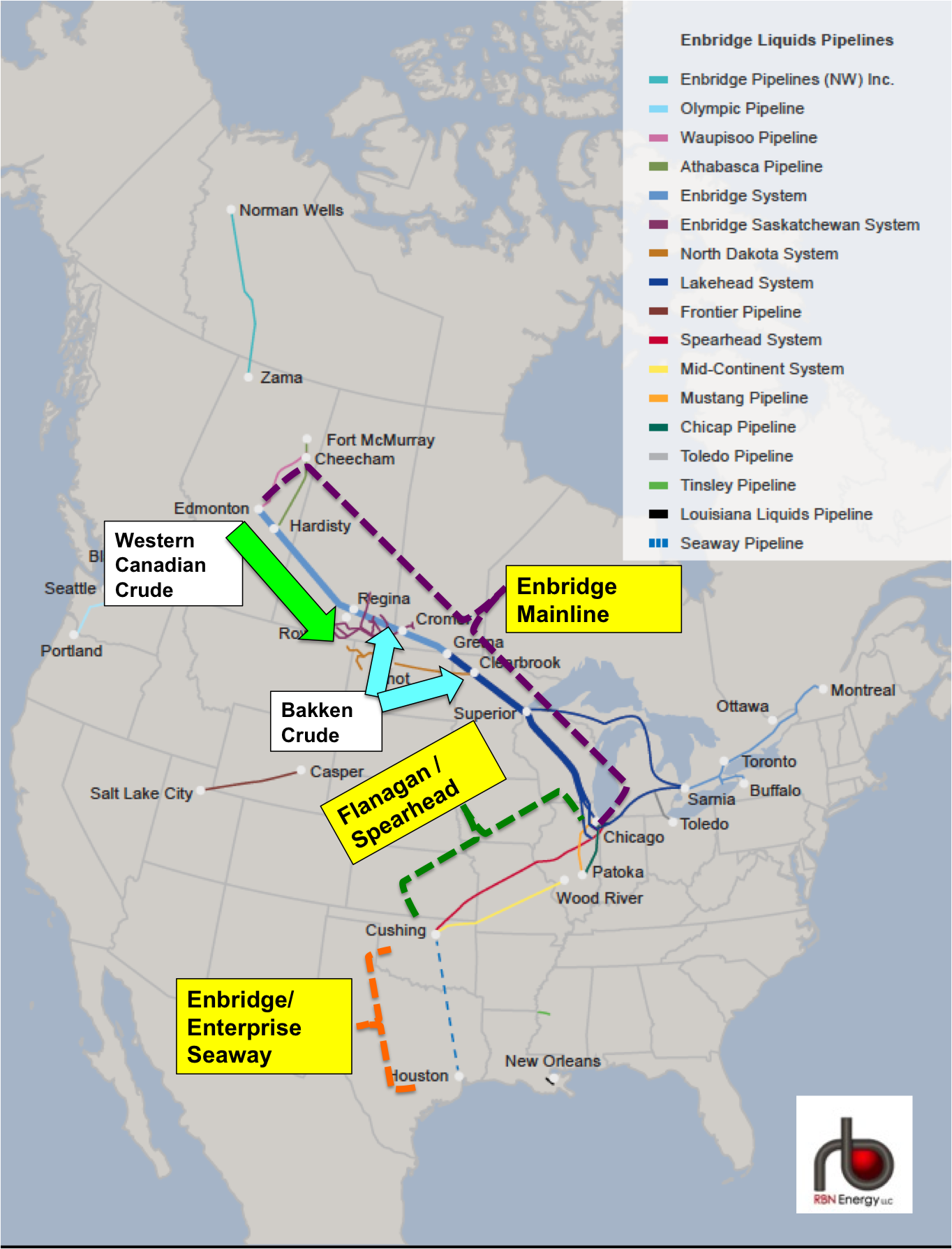
Figure #1
Source: Enbridge and RBN Energy (Click to Enlarge)
With a nameplate capacity of 2.5 MMb/d between Hardisty and Superior on the Mainline, you might wonder why Enbridge is looking to expand this massive pipeline system. There are a number of reasons why. First the Mainline system consists of many different pipelines that were primarily built to carry crude to refineries across the Midwest. Second the Mainline has had to accommodate rapidly expanding crude production from the North Dakota Bakken shale (see The Night They Drove Old Dakota Express Down). Third, part of Mainline capacity is used to carry refined products including condensate materials shipped north from the Chicago area to Edmonton on the Southern Lights Pipeline (see Plains Trains and Diluent Deals). And fourth, various operational issues have restricted the capacity of some pipelines on the Mainline. The net result has been tight capacity amid continued expansion of Canadian crude production looking for a route to market in the US. That tight capacity has been compounded by the delay to the 830 Mb/d TransCanada Keystone XL pipeline from Hardisty to Cushing. And the fact is that Midwest refining demand is now pretty much saturated with Canadian and Bakken crude so shippers need to deliver crude to markets further south – primarily on the US Gulf Coast. All this meant that the WGCAS expansion required addition and expansion both north of Chicago back to Hardisty and south to the Gulf Coast.

About the song
"The Promised Land" is a song by Bruce Springsteen from his 1978 album Darkness on the Edge of Town.






Comments
>> And the fact is that Midwest refining demand is now pretty much saturated with Canadian and Bakken crude
Likely in a few years but not right now. Capline is still delivering ~200kb/d of US Gulf Coast and even some Saudi crudes into Patoka.