Despite the highest natural gas futures prices in over a decade, its use for power generation in the Lower 48 has set records in recent months. This is in part by design: economics and environmental regulation have broadly favored gas-fired plants and pushed into retirement hundreds of coal-fired plants in the last decade or so, reducing price-driven fuel-switching capabilities between the two fuels. However, there’s more to it than that: a tight coal market, marked by low stockpiles, high export demand and record high prices, is limiting gas-to-coal switching even further, making gas burn for power much more inelastic to price. In today’s RBN blog, we take a closer look at this key intersection of the gas and coal markets.
There is no doubt that much of the run-up in natural gas futures prices these days is tied to the strained global LNG market and strong demand for U.S. LNG exports. LNG export terminals ran full tilt this winter and feedgas deliveries posted record highs, as new liquefaction capacity was commissioned and the Ukraine war threatened energy security in Europe and heated up global competition for U.S. cargoes. Producers’ muted response to higher demand and prices hasn’t helped matters. U.S. gas production, while posting strong gains compared with winter 2020-21, peaked in December 2021 before falling off in January and stagnated through the first quarter of 2022, and has yet to return to the pre-pandemic high of 96.2 Bcf/d in November 2019.
Certainly, these factors contributed to tighter balances during the withdrawal season (November through March) and have continued to spur bullish price action in April. However, as we discussed a couple of weeks ago in Runaway Train, a look at the winter-on-winter changes in the Lower 48 supply-demand balance revealed that the biggest driver of demand growth was domestic consumption in the primary sectors — industrial, residential/commercial heating, and most of all, power generation (i.e., power burn), which alone accounted for 44% of the 5.4 Bcf/d year-on-year increase in total Lower 48 demand including feedgas/exports. (LNG feedgas came in second with 32%.) Our NATGAS Billboard models estimate power burn averaged a record 29.2 Bcf/d this winter (Figure 1), with November at the highest level for that month and January setting a record for any winter month at 31.6 Bcf/d. In April to date, power burn is again setting a record pace and has accounted for more than 50% of the total demand growth from the same period last year.
About the song
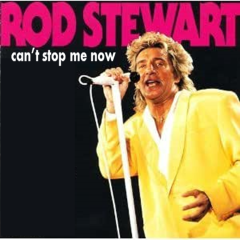
"Can't Stop Me Now" was written by Rod Stewart and Kevin Savigar and appears as the second song on Rod Stewart's 29th studio album, Time. Released as a single in September 2013, the song went to #22 on the Billboard Adult Contemporary Singles chart. Stewart wrote the lyrics to the song as a tribute to his father, Robert Stewart, who according to the singer, was supportive of his son's career from the beginning. Co-writer Savigar, who joined Stewart's band in 1978, also co-wrote the hit songs, "Tonight I'm Yours," and "Forever Young" with Stewart. Personnel on the record were: Rod Stewart (lead, backing vocals), Kevin Savigar (keyboards, programming), Emerson Swinford (guitar), and Sandy Chilla (backing vocals).
Time was recorded between April 2011 and January 2013 at Satinwood Studios in Santa Clarita, CA; The Celtic Place, Sunset Sound, and Bridge Recording in Los Angeles; Echo Beach Studios in Jupiter, FL; and RAK Studios in London. Produced by Rod Stewart and Kevin Savigar, the album was released in May 2013. It went to #7 on the Billboard Top 200 Albums chart. Four singles were released from the LP.
Rod Stewart (Sir Roderick David Stewart) is a British singer, songwriter and record producer. His music career began in London in 1962 when he took up busking on the street with a harmonica. In 1963, he joined The Dimensions, then teamed up with Long John Baldry in 1964. He joined the Jeff Beck Group in 1967. It can be argued that the Jeff Beck Group was the blueprint for Beck's friend and former Yardbird, Jimmy Page's new band, Led Zeppelin. In 1969 Stewart joined The Faces and launched his solo career the same year. As a solo artist he has released 32 studio albums, four live albums, 22 compilation albums and 147 singles and has sold more than 250 million records worldwide. He was inducted into the Rock and Roll Hall of Fame as a solo artist in 1994 and as a member of the Faces in 2012. Stewart was awarded a CBE in 2007 and appointed Knight Bachelor in 2016. He has an Ivor Novello Lifetime Achievement Award, and a World Music Legend Award and is a member of the UK Music Hall of Fame. He continues to record and tour.