The petrochemical industry has a very pronounced business cycle. When margins are low, companies tend to pull back investment, add little (if any) capacity, and implement cost savings. When demand grows, it eventually catches up with supply, creating positive margins and contributing to the upcycle in the industry. At that point, everyone tends to build, setting the industry up for the next downturn. In today’s RBN blog, we’ll explain why we’re in the part of the business cycle where no one builds and how it’s impacting the industry’s bottom line.
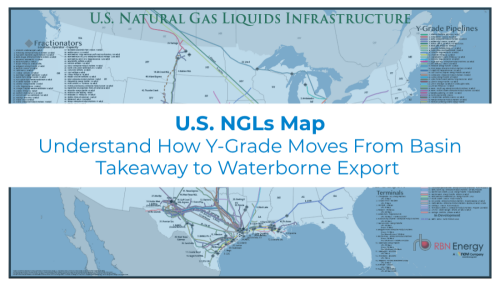
Visualize the infrastructure behind U.S. NGL movement.
The U.S. NGLs Map provides a comprehensive view of the transport, processing, and export networks moving NGLs across the U.S.
The weakness seen in the petrochemical market today is the result of a global overbuild of steam cracker capacity, led by increases in China. China has added roughly 25 million tons per year (MMt/y) of ethylene capacity over the past five years, boosting global cracker capacity by more than 10% during that period. To address that overbuild, capacity rationalizations have begun working their way through the global industry, with 6.3 MMt/y of closures expected in China (with potentially more on the way), 2.7-3.7 MMt/y in South Korea (about 25% of its capacity) and 1.5 MMt/y in Japan. Rationalizations in Europe are also warranted, given the age and feedstock of many of the steam crackers, but regulations tend to make closing plants there difficult.
Ethylene prices and margins have been suffering internationally in the current downturn. Figure 1 below shows ethylene prices in the three major regions: Europe (blue line), Asia (green line) and the U.S. (orange line). As shown in the graph, European and Asian prices tend to run close together, driven by the arbitrage between the two regions. U.S. prices have trended lower than global prices since 2023, when the downturn in margins started to show up, and have moved lower still in recent months. European and Asian prices are also lower, coming down to levels not seen since a downward blip in 2023. The recent downturn more than offsets the broader market upturn that followed the pandemic in 2021-22.

About the song
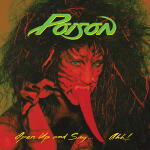
“Every Rose Has Its Thorn” was written by Bret Michaels, C.C. DeVille, Bobby Dall and Rikki Rockett. It appears as the third song on side two of Poison’s second studio album, Open Up and Say ... Ahh! Bret Michaels says he wrote the lyrics to the song after calling his girlfriend in Los Angeles from the road and hearing a male voice in the background. The power ballad was released as the third single from the album in October 1988 and went to #1 on the Billboard Hot 100 Singles chart. It has been certified Gold by the Recording Industry Association of America (RIAA). It is the only #1 single for the band to date. Personnel on the record were: Bret Michaels (vocals, acoustic guitar), C.C. DeVille (lead guitar, keyboards), Bobby Dall (bass) and Rikki Rockett (drums).
Open Up and Say ... Ahh! was recorded in late 1987 and early 1988 at Conway Recorders in Los Angeles with Tom Werman producing. Released in April 1988, it went to #2 on the Billboard 200 Albums chart and has been certified 5X Platinum by the RIAA. Four hit singles were released from the LP.
Poison is an American glam hair/metal band formed in Mechanicsburg, PA, in 1983 by Bret Michaels, Bobby Dall, Rikki Rockett and Matt Smith. After relocating to Los Angeles in 1984, Smith was replaced by guitarist C.C. DeVille. They signed with Enigma Records in 1986 and Ric Browde produced their first album for under $30,000; it went on to sell 3 million copies. They have released seven studio albums, four live albums, seven compilation albums and 30 singles and have sold more than 50 million records worldwide. Seven members have passed through the band since its formation, with Michaels, DeVille, Dall and Rockitt being the main version of the band that fans recognize. That version of the band reunited in 1996 and is still together today. All of the members of Poison have been involved in outside solo endeavors. The band last toured in 2022 on The Stadium Tour with Def Leppard and Mötley Crüe.
"About the Song" -- written by Mickey McMahan , RBN Director of Musicology