In connection with 2016 earnings releases, U.S. exploration and production companies (E&Ps) have announced a surge in capital spending for 2017 after slashing investment by an average 70% from 2014-16. Our “Piranha” universe of 43 E&Ps is budgeting a 42% gain in organic capital outlays with a strong focus on the major U.S. resource plays. Despite crude prices languishing at an average of ~$47/bbl since January 2015, most of the upstream industry has weathered the crisis remarkably well, primarily through the “high-grading” of portfolios, impressive capital discipline, and an intense focus on operational efficiencies. Today we review the overall outlook for 2017 upstream capital spending and oil and natural gas production, and take an initial look at expectations for our group of companies.
How We Got Here
A year ago, E&Ps were still in full retreat, announcing an average 50% reduction in investment from 2015, as we documented in It’s An Uphill Climb To The Bottom. But oil prices rose steadily from early-2016 lows as companies continued to slash costs and increase output per well. Mid-year announcements contained harbingers of change, as we reported in Been Down So Long. Next, we drilled down to look at spending aggregated into three peer groups: oil-weighted, gas-weighted and diversified E&Ps. We noted substantial increases in activity and rising production forecasts for Permian producers in You’ll Go Your Way, I’ll Go Mine. In Different Strokes by Different Folks, we illustrated how the Diversified E&Ps who were targeting the hot Permian and SCOOP/STACK plays had more positive capital spending and production profiles than the rest of that peer group. Finally, we found a more positive outlook for gas prices and found that demand was rekindling activity in the Gas-Weighted E&P peer group in Back in the Saddle Again.

Note that this blog is based on data from our new Piranha! market study. The report is an in-depth assessment of the reconstituted E&P sector covering 43 U.S. E&Ps that are most representative of the U.S. upstream industry. Collectively, these companies produce about half of total U.S. oil and gas output, and have a total enterprise value of over $650 billion. For more information and to see the companies included in our universe, click here to download a preview of the study.
Producers are following through with an even more positive outlook and resultant spending plans in 2017. Figure 1 shows that 2017 guidance from the 43 companies in our universe indicates that capital spending for exploration and development (which excludes acquisitions, land and facilities, capitalized interest, etc.) is expected to rise 42% to $56 billion from $39 billion in 2016. The investment boost, which is larger than most industry analysts projected, is still 32% below 2015 and 58% below 2014 capital spending. The 21 oil-weighted companies account for $8.7 billion, or 52%, of the $17 billion in higher outlays, while the 10 gas-weighted firms have the highest percentage boost. Overall production is expected to increase 3% after a small decline from 2015 to 2016.

About the song
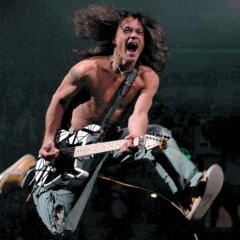
“Jump” was written by Michael Anthony, David Lee Roth, Eddie Van Halen and Alex Van Halen. It appears as the second song on side one of Van Halen’s sixth studio album, 1984. It was a unique direction for Van Halen in that the song was driven by a keyboard riff rather than a guitar. With its refrain of “Might as well jump!”, the song addresses survival, life and love in just over four minutes. Roth dedicated the song to his full-contact karate instructor, Benny “The Jet” Urquidez. Roth’s karate skills are on full display in the music video for “Jump.” Released as a single in December 1983, it went to #1 on the Billboard Hot 100 Singles chart and has been certified Gold by the Recording Industry Association of America (RIAA). It has been used in countless television shows, motion pictures and at sporting events. It remains the most successful single of Van Halen’s career. Personnel on the record were: David Lee Roth (lead vocals), Eddie Van Halen (lead guitar, synthesizer, backing vocals), Michael Anthony (bass, backing vocals) and Alex Van Halen (drums).
1984 was recorded between June and October 1983 at 5150 Studios in Studio City, CA. Produced by Ted Templeman, it was released in January 1984 and went to #2 on the Billboard 200 Albums chart. It has been certified Diamond (10 million sales) by the RIAA. Four charting singles were released from the LP.
Van Halen was an American rock band formed in Pasadena, CA, in 1973 by Eddie Van Halen, Alex Van Halen, David Lee Roth and Michael Anthony. They released 12 studio albums, two live albums, four compilation albums and 56 singles, and have sold more than 80 million records worldwide. They band won an American Music Award, a Grammy Award, four MTV Video Music Awards, and was inducted into the Rock and Roll Hall of Fame in 2007. Eight members passed through Val Halen during its decades-long run. David Lee Roth initially left the band after its 1984 Tour and was replaced by ex-Montrose singer Sammy Hagar. It could be argued that Montrose’s debut album, overseen by Van Halen producer Ted Templeman, was the blueprint for Van Halen’s debut LP. After Hager left the band in 1996, Extreme vocalist Gary Cherone took over vocal duties for one album and a tour before the band took a hiatus from 1999 to 2003. Hager briefly returned to the band for a tour in 2004. Longtime bassist and founding member Michael Anthony was dismissed from the band and replaced by Eddie Van Halen’s son, Wolfgang, in 2006, and David Lee Roth rejoined the band. Eddie Van Halen’s death in October 2020 in Los Angeles at 65 signaled an end to the band he helped start.