The lack of successful projects has long been a thorn in the side of the carbon-capture industry, with a few high-profile cases falling short of expectations for a variety of economic and technological reasons. When looking for a prime example of how a highly touted (and taxpayer-supported) project can still fall short, the Petra Nova facility southwest of Houston, which completed its three-year demonstration period shortly before being shut in 2020, often comes to mind. But now it’s just a few months away from getting another shot, courtesy of its new owner and recovering oil prices. In today’s RBN blog, we look at the impending restart of the Petra Nova project, how falling oil prices overshadowed its technical successes, and its importance to the carbon-capture industry.
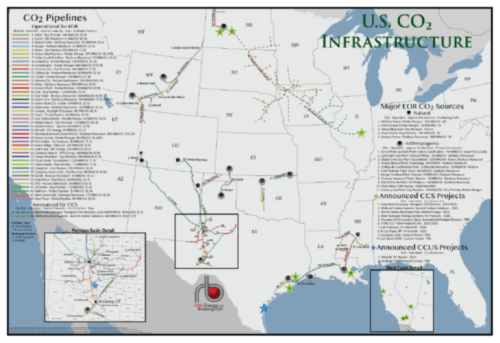
RBN Energy’s US CO₂ Infrastructure map brings together legacy Enhanced Oil Recovery (EOR) assets, as well as announced large-scale Carbon Capture and Sequestration (CCS) and Carbon Capture, Utilization and Sequestration (CCUS) projects, all in our signature concise, accurate, and intelligible style.
Although carbon-capture projects have gained significantly more attention in recent years as environmental, social and governance (ESG) concerns have risen in prominence and governments have begun to focus on ways to decarbonize — including passage of the Infrastructure Investment and Jobs Act (IIJA) and the Inflation Reduction Act (IRA) — the industry itself has significant room for growth. The International Energy Agency’s (IEA) long-term plan to reach net-zero emissions by 2050 rests heavily on advances in clean-energy technology, a shift away from fossil fuels, and the continued electrification of transportation, but about 70% of planned reductions in carbon dioxide (CO2) emissions come from a category it calls Fossil Fuels and Processes, which includes the CO2 emitted in power generation. Whether such goals are plausible is a source of much debate. There’s no doubt, though, that government policies, including those mentioned above, will funnel tremendous resources into advancing carbon-capture technologies.
As we discussed in Way Down in the Hole, Part 4, the costs of carbon capture can vary tremendously, and this is especially true of projects that fall into the power-generation category. Generally speaking, facilities emitting CO2 can be put into two buckets: high-purity and low-purity. For the most part, high-purity sources include processes where the CO2 is highly concentrated in the exhaust stream, making it much easier to separate and capture (such as ethanol and ammonia production or natural gas processing). In low-purity sources, the CO2 is generally a product of combustion — such as a coal- or gas-fired power plant — or commingled with other emissions, making them harder (and more expensive) to separate and capture. That’s where Petra Nova — the first large-scale U.S. project to capture emissions from coal-fired power generation — came into play.
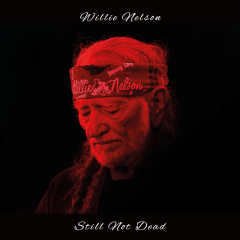
About the song
“Still Not Dead” was written by Willie Nelson and Buddy Cannon. It appears as the eighth song on Willie Nelson’s 66th studio album, God’s Problem Child. The song was released as the final single from the album in April 2017. Nelson said he wrote the song in response to the constant rumors of his death at the age of 84 (he’s 90 now). “I got up two or three times in the last year to read in the paper that I’ve passed away. So, I just wanted to let ’em know that was a bunch of horse----.” In the hilarious video Nelson made for the song, he addresses this situation with scenes shot on his tour bus, in the studio, and in concert. Personnel on the record were: Willie Nelson (lead vocal, lead acoustic guitar), Barry Bales (bass), Fred Eltringham (drums, percussion), Jim “Moose” Brown (piano), Ben Haggard (electric guitar), and Mickey Raphael (harmonica, jaw harp).
God’s Problem Child was recorded in late 2016-early 2017 and released on Legacy Records in April 2017. Produced by Buddy Cannon, it went to #1 on the Billboard Hot Country and #10 on the Billboard 200 Albums charts. It received many positive reviews, with Record Collector giving it four stars, hailing Nelson as a “bona fide legend who has never sounded more alive.” Five singles were released from the LP.
Willie Nelson is an American singer, songwriter, musician, actor, author, and political activist. He was one of the founders of the outlaw country music scene. He started working as a singer and songwriter in the late fifties, securing his first publishing deal with Pamper Music in Nashville in 1960. During that time, he wrote songs that would become country standards, including “Funny How Time Slips Away,” “Crazy,” and “Hello Walls.” He released his debut album, ... And Then I Wrote, in 1962. He has released 98 studio albums, 14 live albums, 51 compilation albums, two soundtrack albums, and 130 singles. He has won eight American Music Awards, five ACM Awards, 10 CMA Awards,15 Grammy Awards, and is the recipient of Kennedy Center Honors, and a Gershwin Prize. He is a member of the Country Music Hall of Fame and the Agricultural Hall of Fame. Nelson has appeared in over 30 films and co-authored several books. He continues to record and tour.