Crude oil production in the U.S. Gulf of Mexico (GOM) is poised for a growth spurt through 2030 even as producers brace for a host of challenges, not least from forecasts that global oil demand will subside in the long term. But while the GOM’s supply accounts for a relatively small portion of total U.S. production, exploration and production companies (E&Ps) haven’t lost interest, in part because the Gulf offers key crude grades in high demand. In today’s RBN blog, we examine what is stoking the renewed interest in developing the GOM.

The replay of our Fall 2026 School of Energy (September 9 & 10, Houston) is now available online!
Learn from RBN experts, participate in hands-on Excel modeling, connect with industry peers, and gain a stronger understanding of today's interconnected energy markets.
Before we dive in, let’s run through the highlights from the previous blog in this series, Riders On The Storm. There, we noted that GOM production has nearly tripled since the Energy Information Administration (EIA) started tracking such data in the 1980s, peaking at just under 2 MMb/d in 2019. This growth stemmed from discoveries in the deeper waters of the Gulf that have more than offset receding production from shallower areas near the coast, a trend that is expected to continue. Still, that ascent hasn’t been a straight line higher, even if the region is considered a steadier oil producer than onshore shale, which is more reactive to market changes. (Offshore production will be a major theme at RBN’s upcoming NACON conference, to be held October 24 at the Royal Sonesta Hotel in Houston. Click here for details.)
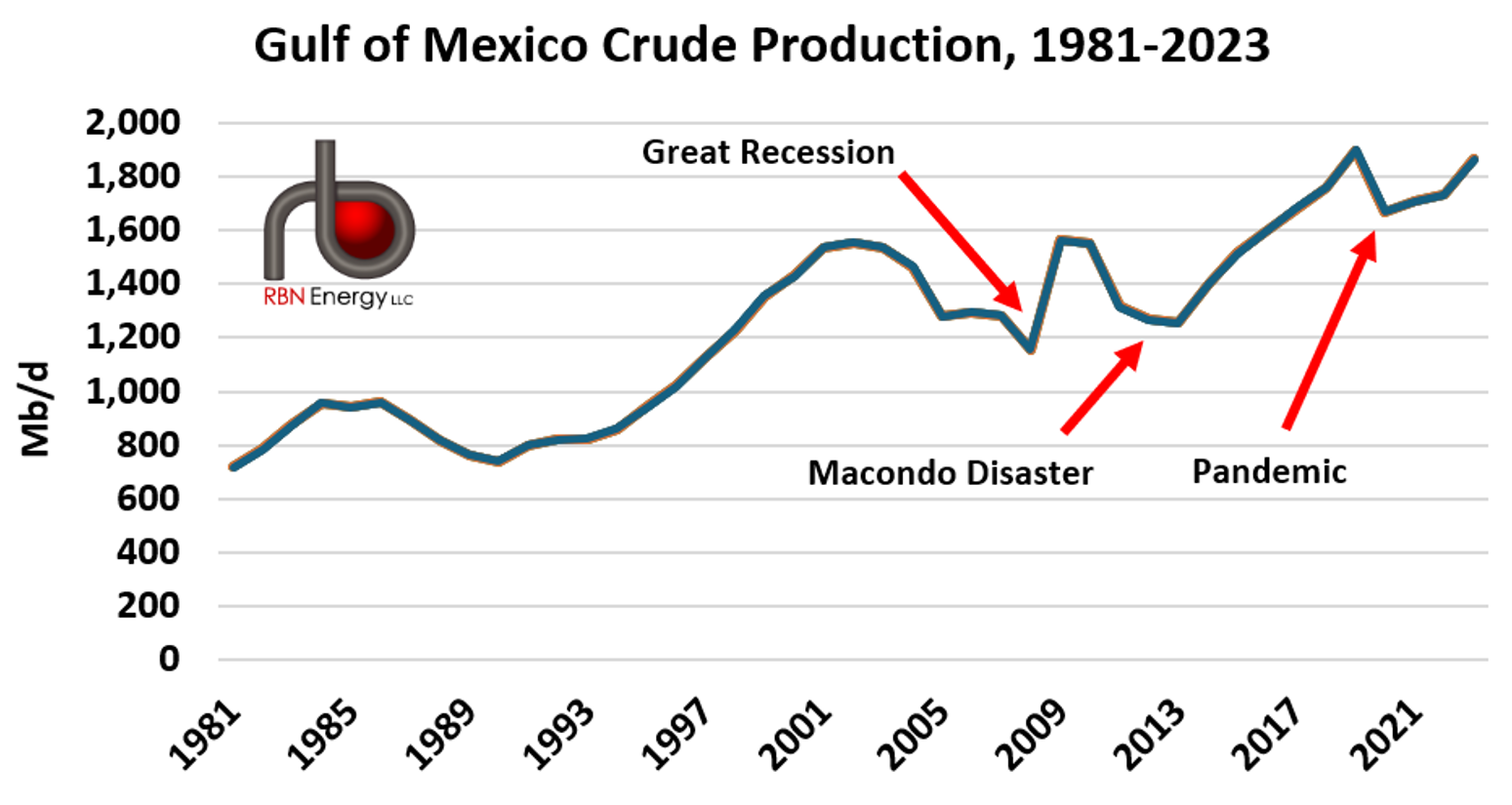
Figure 1. Gulf of Mexico Crude Production, 1981-2023. Source: EIA
Over the decades, many GOM producers have shut wells and deferred or canceled projects, challenged by depressed markets, particularly during periods like the Great Recession, the Macondo disaster and the pandemic (see red arrows in Figure 1 above). Changes in legislation by the U.S. government, which regulates most of the area, have also taken a hit on GOM development. (Note that federal oversight begins about 3.5 miles from the Gulf Coast, except for Texas and Florida, where oversight begins about 10 miles offshore.) Then there’s hurricane season. In some years — like 2005, when five major hurricanes flooded large swaths of Texas and Louisiana, and 2020, when the GOM experienced its busiest Atlantic hurricane season on record — the Gulf has seen an increased number of storms as well as extremely intense weather systems, damaging infrastructure that has sometimes taken months to restore production to pre-storm levels.

About the song
“Take a Chance on Me” was written by Benny Andersson and Bjorn Ulvaeus and appears as the second song on side two of ABBA’s fifth studio album, ABBA: The Album. Released as a single in January 1978, it went to #3 on the Billboard Hot 100 Singles chart and has been certified Gold by the Recording Industry Association of America. Personnel on the record were: Agnetha Faltskog, Anni-Frid Lyngstad (lead vocals), Bjorn Ulvaeus (acoustic, electric guitars, vocals), Benny Andersson (keyboards, synthesizers, vocals), Rutger Gunnarsson (bass), Roger Palm (drums), and Malando Gassama (percussion).
ABBA: The Album was recorded between May and November 1977 at Marcus, Metronome, Glen in Stockholm, and Bohus in Kungalv. Produced by Benny Andersson and Bjorn Ulvaeus, the album was released in December 1977 and went to #14 on the Billboard 200 Albums chart. It has been certified Platinum by the RIAA. Four singles were released from the LP.
ABBA is a Swedish pop group formed in Stockholm in 1972. Their name is an acronym of the first letters of their first names arranged as a palindrome. Their most successful years were from 1974 to 1982. The band has never officially broke up and made their last public concert appearance in December 1982. The group found a new audience and popularity with the 1999 musical Mama Mia, which featured their songs. In 2016, the group performed for a private party in Stockholm. They released their last album, Voyage, in November 2021. ABBA has released nine studio albums, two live albums, seven compilation albums, and 50 singles. They have sold more than 150 million records worldwide. They have won a Brit Award, and a World Music Award, and are members of the Rock and Roll Hall of Fame, and Vocal Group Hall of Fame. The group currently has no plans to record or perform again.