


Californians love their cars. Be it a lemon-yellow Lamborghini whizzing around Los Angeles freeways or a Jeep cruising the Pacific Coast Highway, getting behind the wheel is not just about coming of age — it’s a life goal in the Golden State. California also typically has the costliest gasoline in the U.S. (except when Hawaii holds that title), exacerbated by occasional price spikes and supply squeezes. The state responded in 2023 with a new law — SB X1-2 — designed in part to increase gasoline price transparency and assess potential ways to ensure consistent and affordable supply. In today’s RBN blog, we’ll examine the California Energy Commission’s (CEC) first assessment of the law’s impact.
As the most populous U.S. state, California was #1 in new car sales in 2023 with nearly 1.8 million vehicles sold — ahead of Texas, the second-most populous state, at 1.5 million vehicles. California also is a leader in climate goals and the California Air Resources Board (CARB), its air pollution regulator, in 2022 implemented a rule requiring all new car sales in the state to be zero-emission vehicles (ZEVs) by 2035. (ZEVs are plug-in hybrids, fully electric vehicles and hydrogen fuel-cell electric vehicles.) That’s a lot of electric vehicles (EVs) in a state that is home to more than 39 million people, or about 11% of the U.S. population. In Q1 2024, ZEVs accounted for 102,507 of the new cars sold in California — nearly a quarter of the total — according to CARB.
That said, gasoline continues to fuel most vehicles in the state, with millions of internal-combustion-engine (ICE) cars, SUVs and trucks expected to remain on California’s roads and highways beyond 2035, leaving the majority of motorists susceptible to sudden price spikes. In the months after the Russia-Ukraine war broke out in early 2022, gasoline prices rose across the U.S., but California prices (orange line in Figure 1 below) spiked much higher than the national average (blue line). There weren’t any unplanned outages among the state’s 10 refineries that at that time produced its unique gasoline blend known as California Reformulated Gasoline Blendstock for Oxygenate Blending (CARBOB), which meets the state’s tougher clean air requirements. (With the shutdown of P66’s Rodeo refinery earlier this year, California now has nine refineries in operation; back in 1982, it had 40.) However, unplanned outages stemming from operational issues combined with planned outages while demand was still high coming out of summer in 2022 and — bam! — retail prices surpassed $6 per gallon in September and October that year. Governor Gavin Newsom called on CARB to allow the distribution of winter-blend gasoline with fewer environmental blending restrictions — and therefore cheaper to produce — a month earlier than normal and prices retreated. A year later, prices spiked again amid similar circumstances.
The replay of our Fall 2026 School of Energy (September 9 & 10, Houston) is now available online!
Learn from RBN experts, participate in hands-on Excel modeling, connect with industry peers, and gain a stronger understanding of today's interconnected energy markets.
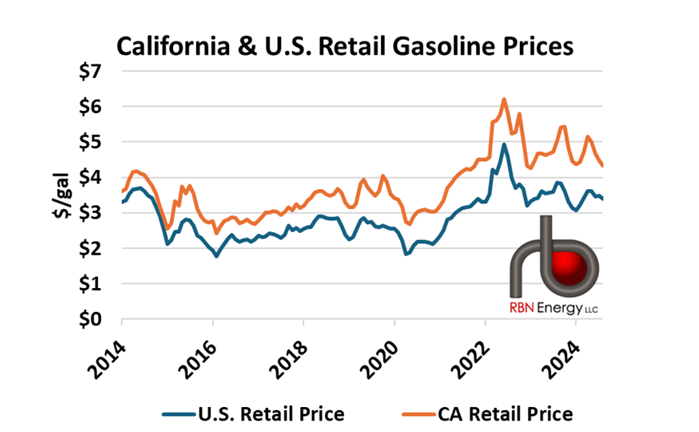
Figure 1. Average California and U.S. Retail Gasoline Prices, 2014-24. Source: EIA
About the song
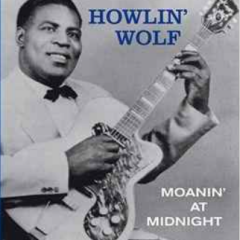
“I Asked for Water (She Brought Me Gasoline)” was written by Chester Burnett (Howlin’ Wolf) and appears as the fourth song on side two of Howlin’ Wolf’s debut album, Moanin’ at Midnight. The song is a raunchy slow blues about a woman with deadly bartending skills. It is based on Tommy Johnson’s “Cool Drink of Water Blues” recorded in 1928. Released as Chess-1632 in 1956 in both 7" 45 RPM and 10" 78 RPM formats, the song was popular on jukeboxes in the South. Personnel on the record were: Howlin’ Wolf (lead vocal, blues harp), Willie Johnson, Otis “Smokey” Smothers (electric guitar), Willie Dixon (bass), Hosea Lee Kennard (piano), and Earl Phillips (drums).
Howlin’ Wolf’s debut album, Moanin’ at Midnight, comprises songs previously released as singles covering eight years from 1951-59. The songs were recorded at Memphis Recording Service (later known as Sun) in Memphis, with Sam Phillips producing, and at Chess Records in Chicago with Leonard and Phil Chess producing. Released in 1959, the LP was a great introduction of Howlin’ Wolf’s music to a wider audience. Sam Phillips said of Howlin’ Wolf: “Whatever you heard come out of his mouth, it had that magic charm. This is where the soul of man never dies.”
Howlin’ Wolf (Chester Arthur Burnett) was an American blues singer, songwriter and musician. Born in White Station, MS, in June 1910, he became the protege of the legendary blues guitarist and singer Charley Patton in the 1930s. By the 1940s Wolf had become a popular blues artist in the Mississippi Delta region. After serving in the U.S. Army during World War II, he settled in Chicago in 1952 and signed with Chess Records. He recruited guitarist Huber Sumlin to join him in Chicago. Sumlin’s guitar solos on Wolf’s records influenced many guitarists, including Eric Clapton and Keith Richards. During the blues revival in the 1960s, he found a new audience and popularity. The Rolling Stones featured him as a guest on the popular television show Shindig! in 1965. He released 29 studio albums and 65 singles. He has a Grammy Hall of Fame Award and is a member of the Rock and Roll Hall of Fame and Blues Hall of Fame. In 1972 he was awarded an honorary Doctor of Arts Degree from Columbia College in Chicago. Howlin’ Wolf died in Chicago in January 1976 at the age of 65.





Comments
CA gasoline is still much more restrictive than non CA gasoline due to the predictive model which basically requires a lower T50 and T90. For refineries not configured to produce this, it can be expensive to make and might require a costly change in overall product slate. You are correct that benzene and sulfur are not that different than a lot of non CA gasoline. The CA regulations also make it a little tricky to certify and import in my opinion.
Figure 1 in the blog suggests that the state is misdiagnosing the problem. While the difference between CA prices and national average prices widen during the spikes, the most noteable trend is that the price differential between CA and the national average prices is steadily and materially widening. So, CA gasoline is just getting more expensive all the time. CA's solution seems to be to pile more regulation on top of the existing rules, but it would probably be much more successful to align their rules with other states with similar requirements and create a bigger pool of gasoline supply and refineries that could serve the state. CA's problem is a lack of competition and it can probably only be solved by increasing supply competition.