Enbridge/DTE Energy’s 1.5-Bcf/d NEXUS Gas Transmission pipeline saw its first natural gas flows this week, as the Federal Energy Regulatory Commission (FERC) approved partial service on the project, opening another nearly 1 Bcf/d of capacity from Appalachia’s Marcellus/Utica producing region to the Midwest. NEXUS marks the last big westbound takeaway project from the Northeast, except for the remaining pieces of Energy Transfer’s (ETP) Rover Pipeline. It also marks the escalation of gas-on-gas competition in the Midwest market, where U.S. Midcontinent and Canadian gas supplies are also battling it out for market share. Today, we take a closer look at the NEXUS project and its potential implications for the Northeast and Midwest gas markets.
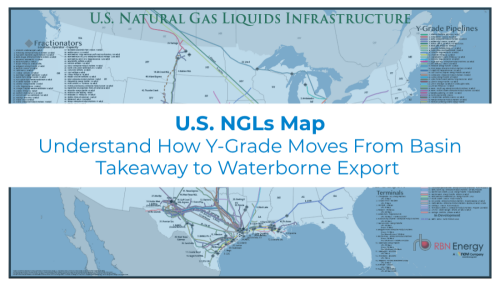
Visualize the infrastructure behind U.S. NGL movement.
The U.S. NGLs Map provides a comprehensive view of the transport, processing, and export networks moving NGLs across the U.S.
The Northeast natural gas market’s fall expansion season is well under way. Earlier this month, Williams/Transco’s Atlantic Sunrise achieved full completion by launching service for its design capacity of 1.7 Bcf/d starting gas day October 6 (see Part 1 of Waiting on the World to Change for a look at early flows on Atlantic Sunrise). That same week, TransCanada/Columbia Gas Transmission was given the nod by FERC for partial service on both its Mountaineer Xpress and WB Xpress projects. Since then, FERC also gave the greenlight to NEXUS to begin service on the greenfield portions of the pipeline, and over the past weekend, the new line began to post its first flows. There is a lot more to come with NEXUS, as the project reaches full completion and capacity commitments kick in. Today, we provide an update on the project and its potential market effects, including what early flows look like.
The NEXUS project as shown in orange in Figure 1 below is a joint venture of Enbridge and DTE Energy that involves a combination of 255 miles of greenfield mainline pipeline and leased capacity on existing third-party systems to move Appalachian gas supply to consuming markets in northern Ohio, southeastern Michigan, as well as the Dawn Hub in Ontario.
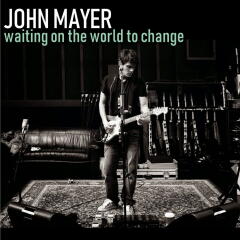
About the song
"Waiting on the World to Change" was written by John Mayer and was the first single from his third studio album, Continuum. It was released in 2006 and went to #2 on the U.S. Billboard Hot 100 Singles chart, and #1 on the U.S. Billboard Adult Contemporary Tracks chart. The single has sold more than two million digital downloads to date in the U.S.
Continuum was recorded between November 2005 and July 2006 at Village Recorder in Los Angeles, Royal Studio in Memphis, and Avatar & Right Track/Sound on Sound in New York City. The record was produced by Steve Jordan and John Mayer and was released in September 2006. Personnel on the album were: John Mayer (lead vocals, guitar), Pino Palladino (bass, backing vocals), Steve Jordan (drums), Rick Peterson (keyboards, backing vocals), and Roy Hargrove (horns). Continuum reached #2 on the U.S. Billboard 200 chart and has sold more than three million copies worldwide.
John Mayer is an American singer-songwriter, guitarist, and record producer. He has released seven studio albums, won seven Grammy Awards, and sold over 20 million albums worldwide.