Enbridge’s 2.8-MMb/d Mainline system from Alberta to the U.S. Midwest has been running close to full, as have the other crude oil pipelines out of Western Canada. The Mainline is a unicorn among these pipes, however, in that none of its capacity — zilch — is under long-term contract. Instead, under Enbridge’s almost nine-year-old Competitive Tolling Settlement (CTS), shippers each month submit nominations stating the volumes of crude they would like to transport the following month on various elements of the Mainline system, then hope they get what they need when the available capacity is divvied up. In an effort to give producers and refiners the pipeline-capacity certainty they say they want — and to optimize the efficiency of the Mainline’s operation — Enbridge has been working with shippers on a CTS-replacement plan that would commit as much as 90% of the capacity on the pipeline system to shippers who enter into long-term contracts. Today, we continue this blog series with a look at how the prospective “priority access” capacity-allocation system is shaping up, how it might affect planned pipeline projects, and how it may facilitate the transport of a lot more crude from Alberta to the U.S. Gulf Coast.
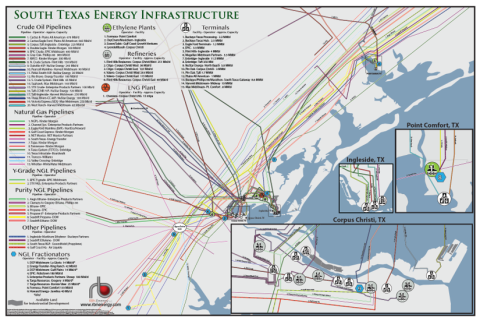
RBN Energy’s South Texas Energy Infrastructure Map brings together all the pieces of the critical and complex puzzle of the greater Corpus Christi region. Spanning from Point Comfort, TX to Corpus Christ, TX and south of the Agua Dulce natural gas hub, the map details the processing, transportation and export facilities in RBN Energy’s classic clear, concise and easy to comprehend style.
As we said in Part 1, it’s been an interesting few years for the Western Canadian crude oil market. Since 2010, Western Canadian Sedimentary Basin (WCSB) production has increased by two-thirds — from ~3 MMb/d to ~5 MMb/d — with virtually all of the incremental output available for export. Pipeline capacity from the WCSB to the U.S. has been rising too — from ~2.7 MMb/d nine years ago to ~4 MMb/d now, including about 2.8 MMb/d on the Enbridge Mainline (yellow capacity line in Figure 1) — but not quickly enough to keep up with production gains. (The medium-blue bars in the chart show average annual flows on the Mainline at the U.S.-Canada border from 2013 through 2017; the dark-blue bars show average quarterly flows in 2018.) Shortfalls in pipeline takeaway capacity led to super-wide price differentials between Western Canadian Select (WCS; the region’s benchmark price for heavy-sour blend) and West Texas Intermediate (WTI), which more than covered the cost of rail transport and spurred a big rebound in crude-by-rail (CBR) activity. In late November 2018, Alberta’s provincial government announced a plan to add thousands of tank cars to the regional fleet in 2019-20 to enable still more crude to be moved by rail. A few days later, in early December, the government stepped in again, mandating a nearly 9% crude-oil production cut (starting January 1, 2019). That move quickly shrank the WSC-WTI spread to the point that it brought into question whether CBR costs could still be justified; from what we’ve heard from traders and earnings calls, CBR volumes for at least a few companies fell in January. (In response to the much smaller spread, the Alberta government late last month pulled back on its mandated production cuts for February and March.) Amid these market gyrations, TransCanada and Canada’s federal government continue to face headwinds in their respective efforts to build the Keystone XL pipeline and the Trans Mountain Expansion (TMX) project — there are no firm dates for when that new takeaway capacity will come online.
What a roller-coaster. Add to this uncertainty the fact that none of the capacity on the Enbridge Mainline’s myriad pipeline segments — Lines 1, 2, 3, 4, 5, 6, 7, 10, 11, 14, 61, 62, 64, 65, 67 and 78 (did we forget any?) — is under long-term contract, so all of it is up for grabs each month. As WCSB production rose and takeaway pipelines filled up in the past few years, shippers — typically producers, refiners and/or marketers — have indicated they want the higher degree of confidence that long-term capacity contracts provide.
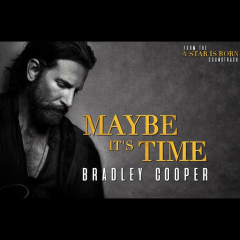
About the song
"Maybe It's Time," written by Jason Isbell and sung by Bradley Cooper, is the seventh cut from the 2018 soundtrack of the hit movie “A Star is Born.” The song was recorded at The Village West in Los Angeles, and mixed at Electric Lady Studios in New York City. It was produced by Bradley Cooper, Benjamin Rice and Lady Gaga. Bradley Cooper had asked record producer Dave Cobb to help him craft and find songs for the movie’s soundtrack. Cobb was working with Jason Isbell in the studio and asked him to write a song to submit for Cooper. When Cobb flew to L.A. and met with Cooper and Lady Gaga for a writing session, he played them Isbell's "Maybe It's Time." They both felt that it fit Cooper's movie character of Jackson “Jack" Maine perfectly, so it became the staple song of the movie. Cooper had been working with musician Lukas Nelson (Willie Nelson's son) for about a year before production started on the A Star is Born soundtrack album to hone his guitar and vocal skills. Lukas Nelson and his band, "Promise of The Real," appear in the movie as Jack Maine's backup band. "Maybe It's Time" went to #93 on the Billboard Hot 100 chart.
The soundtrack album of “A Star Is Born” features the movie's stars, Bradley Cooper and Lady Gaga. The music on the LP contains elements of blues, rock, country and pop. It was released in October 2018, and went to #3 on the Billboard Soundtrack Albums chart and #37 on the Billboard Top 200 Albums charts.
Bradley Cooper is an American actor, director, and producer. He has appeared in a long list of movies, with some of the better-known including “The Hangover” and its two sequels; “Silver Linings Playbook”; and “American Sniper.” He has received four Oscar nominations for his acting –– three for leading roles (including “A Star Is Born”) and once in a supporting role. He also has been nominated for Oscars for co-producing “A Star Is Born” and for helping to write the movie’s screenplay.