For the first time ever, a Very Large Crude Carrier (VLCC) carrying Bakken crude has sailed from the Gulf of Mexico to Asia, and more may follow. With the startup of the Dakota Access Pipeline set for June 1, Bakken producers are only days away from gaining easier, cheaper pipeline access to the Gulf Coast, and are looking for new markets. Asian refineries are willing to pay a premium for Bakken-type crudes, and want other types of U.S. crude as well. And every 18 hours or so, a VLCC arrives at the Louisiana Offshore Oil Port—the only U.S. port capable of handling the mammoth vessels—offloads crude and leaves LOOP empty because the port is currently an import-only facility. Today we consider the potential for transporting more light, sweet crude to Asian refineries on VLCCs, either via ship-to-ship transfers or by reworking LOOP to enable exports.
This past Sunday (May 14, 2017), the Greek-flagged Maran Canopus, an 1,100-foot-long VLCC capable of carrying more than 2 million barrels (MMbbl) of crude, completed a weeks-long journey from off the coast of Louisiana to Malaysia. According to our friends at ClipperData, before the Maran Canopus left the Gulf of Mexico, she received ~600 Mbbl of Bakken crude as well as ~1 MMbbl of Mars Sour crude (and other crude as well). A smaller Aframax-class vessel, the ADS Oslo, loaded the Bakken oil at Enterprise Products Partners’ Beaumont, TX, marine terminal and transferred her cargo to the VLCC in deeper waters. The Mars Sour crude (which was produced from deepwater wells in the Gulf) was loaded onto two ships—the very same ADS Oslo at Royal Dutch Shell’s Sugarland marine terminal in St. James, LA, and another Aframax-class ship, the Eagle Texas, at NuStar Energy’s nearby St. James marine terminal —which transferred their cargoes to the Maran Canopus too. (Mercuria Energy Trading is listed as the shipper on the export bill.) We understand from ClipperData that this is only the second time that Bakken crude has been exported out of the Gulf of Mexico —the first was a much smaller volume (~174 Mbbl) that was shipped out of the Gulf to Rotterdam (in the Netherlands) in April 2016.
About the song
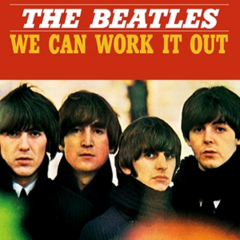
“We Can Work It Out” was written by Paul McCartney and John Lennon. It appeared as a double A-side single backed with “Day Tripper” that was released in December 1965. It went to #1 on the Billboard Hot 100 Singles chart and has been certified Gold by the Recording Industry Association of America. The song was recorded in two takes at EMI studios in London during the sessions for the Rubber Soul album. It was earmarked to be the non-album double A-side single to be released at the same time as the LP. A promotional film of the song with The Beatles was shot at Twickenham Film Studios in London with Joe McGrath directing. Personnel on the record were: Paul McCartney (lead vocal, acoustic guitar), John Lennon (Mamborg harmonium, bass, backing vocals), George Harrison (acoustic guitar, backing vocals), and Ringo Star (drums, percussion).
Rubber Soul was the album The Beatles were working on during the recording of “We Can Work It Out” and “Day Tripper.” Recorded between October-November 1965 at EMI studios in London with George Martin producing, it was The Beatles’ sixth studio album. Released in December 1965, it went to #1 on the Billboard 200 Albums chart and has been certified 6x Platinum by the RIAA.
The Beatles were an English rock band formed in Liverpool in 1960. Consisting of John Lennon, Paul McCartney, George Harrison, and Ringo Starr, they are regarded as the most influential band of all time. They released 17 studio albums, five live albums, 51 compilation albums, 36 EPs, and 63 singles. They have sold over 600 million records worldwide, making them the best-selling music act of all time. They are members of the Order of the British Empire (MBE), the Rock and Roll Hall of Fame, UK Music Hall of Fame, Vocal Group Hall of Fame, and have won one Academy Award, seven Grammy Awards, a Grammy Lifetime Achievement Award, 15 Ivor Novello Awards, one MTV Video Music Award, and three World Music Awards. Paul McCartney was knighted by Queen Elizabeth II in 1997. After the group’s breakup in 1970, all four band members went on to successful solo careers. John Lennon was murdered in December 1980. George Harrison died in November 2001. McCartney and Starr continue to record and tour as solo artists. There is rumor of a new Beatles track being released: a 1978 John Lennon composition called “Now and Then” being recreated by Paul McCartney using artificial intelligence to include all four of The Beatles on it. It is unknown if George Harrison’s “Sue Me, Sue You Blues” will be the flip side.