


Here at RBN, we have an often repeated view that the flood of oil and gas being produced from unconventional plays will change everything we once knew about energy markets (see Top Ten Energy Prognostications for 2014). One such fundamental change is that the U.S. is now producing more natural gas, NGLs and some grades of crude oil than we can use (except for the past three weeks of Polar Vortex weather, of course). Consequently the U.S. has shifted from a position of hydrocarbon shortage to one of surplus. That is great news. But just down the road there are potential problems developing – distortions in the markets. Some of those surplus products can be exported, some can’t. The rules regarding exports of these hydrocarbon products that we are living with today were all put on the books during the decades of shortage. When you look closely at what those rules really say, you’ve got to scratch your head. Today we begin a series to examine those rules.
For example, the rules state that whether a particular hydrocarbon can be exported depends on:
• The shape of its molecules
• How those molecules were processed
• The temperature at which those molecules were processed
We’re calling these rules the ‘Molecule Laws’. Currently, we count at least six of these Molecule Laws on the books covering natural gas, natural gas liquids, crude oil and petroleum products. And let’s be clear, this really isn’t a list of laws readily accessible in the statute books. Instead it is a hodge-podge of rules, policies, regulations, procedures and a few laws administered by a variety of government agencies including the Department of Energy (and its independent regulatory agency the Federal Energy Regulatory Commission), the State Department, and Department of Commerce.
What these “laws” tell us is that there are almost no export restrictions on certain of these hydrocarbons, a few restrictions on some and still others are almost totally prohibited. These rules made no difference when there was nothing to export. But now, with all this production coming on, they make a big difference. Consequently the media, the public and even policy makers are beginning to pay attention. As thinking on these matters evolves, the entire energy value chain will watch very closely to see how all this plays out. In this blog series, we will take a look at the impact of surging production in each of the three hydrocarbon markets we are focused on, and how these federal export policies impact those markets.
Inside the Beltway
This blog and its title The Molecule Laws are based on a presentation given by Rusty Braziel at a recent workshop at the Center for Strategic & International Studies (CSIS). His presentation was summarized in a CSIS posting and covered by other media in attendance. Notably, the CSIS summary was picked up by Senator Lisa Murkowski of Alaska in a subsequently released white paper entitled “Energy 20/20 - A Vision for America's Energy Future”. In her keynote speech to the Brookings Institution describing the paper, the Senator highlights some of the most incongruous parts of the law and calls for Washington to make changes.
One other note regarding this series. Here at RBN, we generally go out of our way to separate ourselves from policy issues. Our expertise is in markets and we will continue to look at these issues through the lens of a market participant. However, some policy issues may inadvertently sneak into this series. Sorry ‘bout that.
Current State of the Union
To get a sense of how the Molecule Laws are impacting the markets for crude oil, natural gas and NGLs, we need to start with just how significant production increases in those markets have been. The three graphs below illustrate that point.
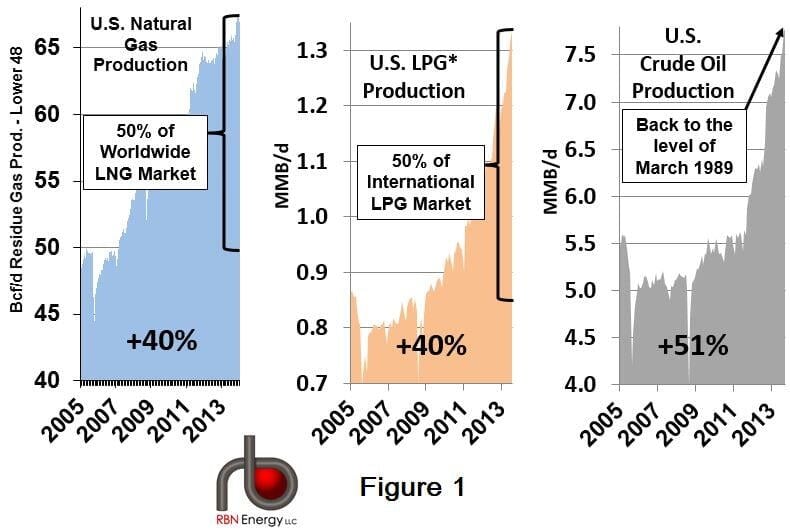
Source: Bentek/EIA | *LPG = Propane and Butane, part of the NGL family |

About the song
"I Fought the Law" is a song written by Sonny Curtis of the Crickets and became popularized by a cover by the Bobby Fuller Four, which went on to become a top-ten hit for the band in 1966 and was also recorded by the Clash in 1979. The Bobby Fuller Four version of this song was ranked No. 175 on the Rolling Stone list of the 500 Greatest Songs of All Time in 2004, and the same year was named one of the 500 "Songs that Shaped Rock" by the Rock and Roll Hall of Fame. [Wikipedia]







Comments
Good morning. I believe it is actually the DOE that makes the determination of public interest for LNG exports to non-FTA countries.