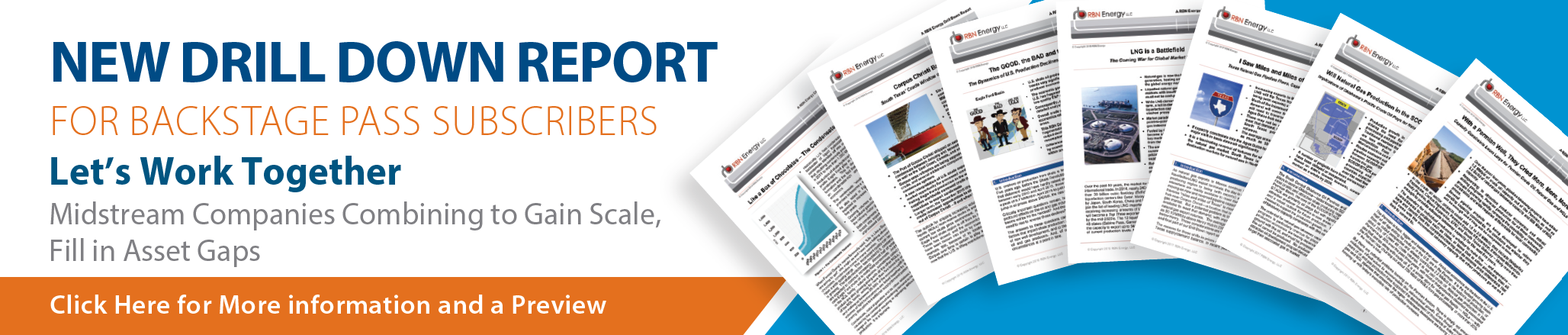
Ongoing M&A activity in the upstream portion of the oil and gas industry has garnered a lot of attention, most recently regarding ExxonMobil’s planned $64.5 billion acquisition of Pioneer Natural Resources. But there’s also been a lot of consolidation in the midstream space as the companies that gather, process, transport, store and export hydrocarbons seek to gain the scale, scope and synergies they think they will need to succeed in an increasingly competitive industry. In today’s RBN blog, we discuss highlights from our newly released Drill Down report on the major midstream deals of 2022 and 2023 to date.
There are many reasons why large midstream companies might want to get bigger, either by acquiring smaller midstreamers or merging with near-equals. For many, buying another company and its set of assets gives the acquiring firm entrée to — or additional scale in — an important and/or growing production area or two. For others, an acquisition or merger enables them to provide the full range of well-to-consumer or well-to-water midstream services — say, gas processing plants, NGL pipelines to Mont Belvieu, fractionators and NGL export capacity.
It will surprise no one to hear that many of the midstream deals announced over the past couple of years involved the acquisition of companies with extensive holdings in the all-important Permian, which is by far the U.S.’s top crude oil production area and also a major supplier of natural gas and NGLs. Of course, the Permian has been a leading hydrocarbon supplier for decades, but constant improvements in horizontal drilling and well-completion techniques — not to mention an increasingly sophisticated understanding of the rock and resources below ground — since the mid-2010s has transformed the West Texas/southeastern New Mexico play into an unrivaled production powerhouse.
Ever-increasing production spurred demand for midstream infrastructure — including gathering systems (for crude, associated gas and produced water), gas processing plants, takeaway pipelines (for crude, natural gas and NGLs), storage facilities, fractionators, and export terminals — and a sometimes frenetic build-out the likes of which the oil and gas industry hadn’t seen in generations. While a significant portion of the midstream development over the past eight to 10 years was undertaken by large publicly held companies or master limited partnerships (MLPs) like Enterprise Product Partners, Energy Transfer, Targa Resources, ONEOK and Magellan Midstream Partners, many other important projects were developed by privately held midstream companies backed by private equity.
Now, with many publicly held companies looking to gain further scale and scope — and many private-equity-backed midstream companies looking to cash in on their well-timed, well-planned developments or combine with other privately held firms to improve their synergies (and maybe make themselves even more attractive M&A targets in the future) — it could be argued that conditions for large-scale midstream M&A have never been better.
About the song
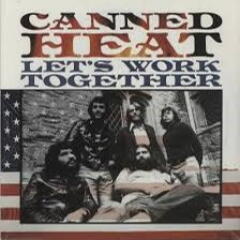
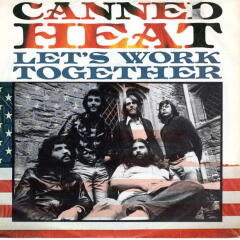
“Let’s Work Together” was written by Wilbert Harrison and appears as the sixth song on side one of Canned Heat’s fifth studio album, Future Blues. Harrison originally wrote the song as “Let’s Stick Together,” with the same melody and different lyrics. He released a single of it on Fury Records in 1962. In 1969 he re-worked the song with new lyrics, now titled, “Let’s Work Together.” Recorded in October 1969 at Juggy Sound Studio in Los Angeles, and featuring Harrison on vocals, guitar, harmonica, and percussion, the song was released as a single on Sue Records in December 1969 and went to #32 on the Billboard Hot 100 Singles chart. Due to the success of Harrison’s version, Canned Heat waited until August 1970 to release their version as a single. It went to #26 on the Billboard Hot 100 Singles chart. Personnel on the record were: Bob Hite (vocals), Alan Wilson (slide guitar), Harvey Mandel (rhythm guitar), Larry Taylor (bass), and Fito de la Parra (drums).
Future Blues was recorded in May and June 1970 at Village Recorders in Los Angeles with Skip Taylor and Canned Heat producing. It was the only Canned Heat studio album with Harvey Mandel on lead guitar, who had replaced original guitarist Henry Vestine, who left the band shortly before their appearance at Woodstock. Mandel and bassist Larry Taylor left the band to join John Mayall’s group shortly before Future Blues was released. Singer, harpist, and slide guitarist Alan Wilson committed suicide in September 1970 before the album’s release. Singer Hite and drummer de la Parra had to replace three band members to continue touring and performing as Canned Heat before the album’s release. The album was released in December 1970 and went to #59 on the Billboard 200 Albums chart. Three singles were released from the LP.
Canned Heat is an American blues-rock band formed in Los Angeles in 1965 by blues aficionados Bob Hite and Alan Wilson. They took their name from a 1928 Tommy Johnson song titled “Canned Heat Blues.” Discovered by the Los Angeles management team of John Hartmann and Skip Taylor, they released their debut album, Canned Heat, on Liberty Records in July 1967. They have released 17 studio albums, 11 live albums, 20 compilation albums, three collaborative albums, and 19 singles. Fifty-one members have passed through the band since its formation. Canned Heat continues to tour under the leadership of longtime drummer Fito de la Parra, along with Dale Spalding, Rick Reed and Jimmy Vivino. Alan Wilson died in September 1970 at the age of 27, Bob Hite died in April 1981 at the age of 38, Henry Vestine died in October 1997 at the age of 52, and Larry Taylor died in August 2019 at the age of 77.