With many years gone by and many millions of dollars spent, the deepwater crude oil export projects under development along the U.S. Gulf Coast are finally getting close to receiving their regulatory green light. These projects have sparked commercial and wider market interest because of the many benefits they may provide — including the ability to fully load the biggest tankers, the Very Large Crude Carriers (VLCCs) capable of taking on 2 MMbbl, which could contribute to lower per-barrel shipping costs. In today’s RBN blog, we kick off an offshore oil terminal series, starting with the case for constructing at least one of the export projects.
Crude Oil Permian provides detailed analysis of the fundamental drivers impacting the Permian Basin crude oil market including weekly data, analysis and market intelligence updates of: Permian crude oil supply and demand, pipeline outflows and capacity, prices, and infrastructure updates.
To say the U.S. crude oil market has undergone a transformation over the last 15 years would be an understatement. The Shale Revolution has allowed producers to unlock volumes that were unimaginable to many not long ago, especially in the champion of U.S. production areas — the Permian Basin. As U.S. production volumes grew (stacked bars in Figure 1), refineries started consuming their fill (solid-blue segments of stacked bars). But even as production kept growing and refineries became satiated, U.S. crude oil exports were largely limited to Canada, causing concern at the time that the shale renaissance could hit a wall. Then, in June 2014, the U.S. government opened the door for processed condensate — and eventually crude oil in December 2015 — to be exported (solid-gray segments of stacked bars). As we’ve blogged about frequently (See May Exports Be With You), export volumes took off and are expected to continue growing along with U.S. production throughout the 2020s, eventually stressing the ability of existing export terminals along the Gulf Coast to keep up.

Figure 1. U.S. Crude Oil Production, Volumes Refined and Volumes Exported. Source: RBN
About the song
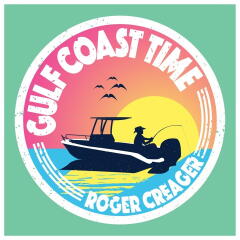
“Gulf Coast Time” was written by Roger Creager and Trent Williamson. It appears as the second song on Roger Creager’s 2015 six-song EP of the same name. The song describes enjoying the simple things in life like fishing and navigating his boat along the shores of Copano Bay west of Rockport, TX. Released on Fun All Wrong Records in September 2015, the EP went to #41 on the Billboard Country Albums chart. Personnel on the record were: Roger Creager (lead vocals, acoustic guitar), Allen Huff (keyboards, accordion, backing vocals), Bryce Clark (lead acoustic guitar), Stormy Cooper (bass), Jason Broussard (drums), and Aleph Yonker (fiddle, electric lead guitar, backing vocals).
Roger Creager was born and raised in Corpus Christi, TX. Much like Jimmy Buffet, he enjoys being outdoors, frosty beverages, fishing, scuba diving, and piloting his airplane to different locales. He released his first album, Having Fun All Wrong, in 1998. He has released seven studio albums, one EP, and 12 singles. He is also one half of the country duo Dos Barrachos (Two Drunks), with Kevin Fowler. The two decided to create the duo after a songwriting and libation-filled trip to Mexico. The first single from their album was a cover of the Merle Haggard and Clint Eastwood song, “Barroom Buddies,” which originally appeared in the Clint Eastwood film Bronco Billy. Creager continues to record and tour and will be appearing solo and with Dos Barrachos in March and April. Dos Barrachos will be headlining The Cain’s Ballroom in Tulsa in March during the 2024 Bassmasters Classic tournament in Northeastern Oklahoma.