


Anyone who’s shopped for a home is well-aware of the relationship between location and valuation. The same holds true for oil and gas producers accumulating a portfolio of real estate underlain by the most promising oil and gas formations. Recently, the most desirable neighborhood has been the Permian Basin, which has seen more than $70 billion in M&A transactions since mid-2016. While the entire U.S. E&P sector has returned to profitability, Permian players have generated the highest production growth, the best margins, and the most substantial profits and cash flows. There’s a catch, though: production growth in the Permian has led to serious takeaway constraints. Today, we discuss how the impact of these constraints is reflected in a company-by-company analysis of quarterly results.
How We Got Here
This is the fourth and final blog in this series. In Part 1, we said that the U.S. exploration and production sector performed admirably compared with year-ago results. The group of 44 E&P companies we’ve been tracking reported $22 billion in pre-tax operating profits in the first half of 2018, over three times the $6.2 billion they reported in the first six months of 2017. They also posted over $51 billion in operating cash flow, up from $39 billion a year ago. Although these companies are on pace to garner $30 billion in free cash flow in 2018 as a whole, our group of 44 E&Ps continued to exercise financial discipline, raising their 2018 capital spending guidance by only $3.9 billion, or 5%, over their initial guidance for the year to $68.1 billion, which is 10% higher than their 2017 investment.
In Part 2, we analyzed capital investment and forecast production growth by peer group and company. We revealed that the Oil-Weighted E&Ps reported the largest mid-year increase in capital spending: $2.3 billion to $28.1 billion, or 9% higher than their original 2018 guidance and 19% higher than 2017 outlays. Fifteen of the 17 companies in the group expect to increase production in 2018, with total output rising 11% to 1.37 billion barrels of oil equivalent (Bboe). The Diversified E&Ps, in turn, will increase capital outlays by 10% to $29.9 billion in 2018, but the impact of major divestitures by several companies in the group will leave output flat with the previous year. The total capital spending by the Gas-Weighted E&Ps increased by 2.7% over its previous 2018 guidance, but total capital investment will still be 7% lower than 2017. However, total production for the gas-focused group is still expected to increase by 10%. In Part 3, we did a deep dive into the industry’s bottom line by analyzing second-quarter versus first-quarter 2018 results by peer group. In today’s blog, we drill down further into each peer group to analyze the company-specific results that underlie industry trends.
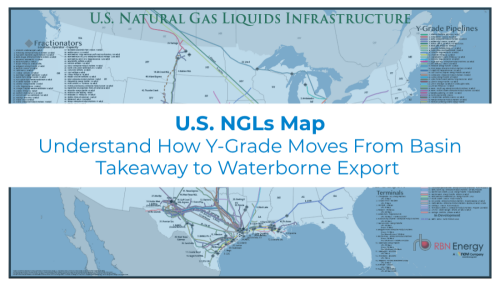
Visualize the infrastructure behind U.S. NGL movement.
The U.S. NGLs Map provides a comprehensive view of the transport, processing, and export networks moving NGLs across the U.S.
Oil-Weighted Peer Group
The Oil-Weighted Peer Group earned $5.3 billion in pre-tax operating profits in the second quarter of 2018 (blue rectangle in Figure 1), 7% less than the $5.7 billion earned in the prior quarter, but nearly three times the $1.9 billion earned a year ago. All but one (Oasis Petroleum) of the 17 companies in the peer group were profitable. Revenues were just $0.25/boe higher than the first quarter of 2018 at $45.09/boe (red rectangle) despite NYMEX and Cushing oil prices increasing about $5/bbl to nearly $68/bbl. Permian producers, however, did not participate in this upside, as basis differentials there exploded from $0.40/bbl to over $8.00/bbl in the second quarter of 2018. Natural gas, which accounts for 25% of the peer group’s production, also continues to be a headwind for Permian Basin producers due to pipeline takeaway constraints, which resulted in prices at a significant discount to the Henry Hub benchmark. For example, Diamondback Energy’s average second-quarter 2018 realized oil price fell 2% to $55.53/bbl from the previous quarter while its average gas realization dropped 31% to $1.57/MMBtu — 45% lower than the $2.85 NYMEX price. Diamondback did remain the only Permian player to realize over $50/boe in revenues because gas represented just 12% of its total output. The company’s very low lifting costs of $7.97/boe (yellow rectangle) propelled it to a pre-tax operating profit of $29.58/boe, the highest in the peer group, but that result was down 3% from the previous quarter. The impact of dramatically wider gas differentials also resulted in lower realizations and lower profits for Permian producers with a gas mix of more than 20% of total output, such as Energen, Laredo Petroleum, and Pioneer Natural Resources.

About the song
“Big Machine” was the third track on Contraband, the 2004 debut studio band by American hard rock band Velvet Revolver. Velvet Revolver formed when Guns N' Roses musicians Slash (guitar), Duff McKagan (bass) and Matt Sorum (drums) combined to play at a benefit concert for fellow musician Randy Castillo in 2002. They decided to form a band and recruited guitarist Dave Kushner, who had previously played with Suicidal Tendencies, Wasted Youth, and Dave Navarro. They also recruited lead singer Scott Weiland, who had been lead singer for Stone Temple Pilots. Velvet Revolver won a 2005 Grammy Award for Best Hard Rock Performance for its single “Slither” from the same album. The group released a second album, Libertad, in 2007, but recorded no further albums after Weiland left the band to return to Stone Temple Pilots in 2008.







Comments
1. Article very hard to read with lack of paragraphs. E.g. under diversified E&P, there is a 600 word wall of text. Normal essays have 100-200 word paragraphs. Writing on the Web or in newspapers usually has even shorter paragraphs. Massive walls of text on the screen are a turnoff. There is a huge amount of detailed content in your articles. But if you can't organize it into a good structure that is pleasant to read it becomes hiding your light under a bushel.
2. If you are going to compare companies on profitability why not use % margin? You have an absolute metric and then a % per BOE instead.
3. Note, comparing to BOE is prone to give very bad inferences as it is normal for a barrel of gas to be worth about a third of a barrel of oil. So, you are really not comparing profitability versus volume when you mix companies with differing % gas.
In reply to 1. Article very hard to read by g p
Chemgeek:
1) We fixed the formatting issue earlier today.
2)We'll consider adding a margin type metric when we evaluate 3Q/18.
3) I agree. This is why we segregate the companies the way we do (ie; oil-weighted, diversified and gas-weighted).
Thanks for your comments.