With ever-increasing volumes of Permian crude oil being exported and the recent inclusion of WTI Midland in the assessment of Dated Brent prices, the issue of iron content — especially in some Permian-sourced crude — is coming to the fore. This has become such a point of emphasis for exported light sweet crude because many less complex foreign refineries do not have the ability to manage high iron content adequately. Iron content that exceeds desirable levels could have far-reaching repercussions, from sellers facing financial penalties for not meeting the quality specifications to marine terminals being excluded from the Brent assessment if they miss the mark. It’s a complicated issue, with split views on what causes the iron content in a relatively small subset of Permian oil to be concerningly high — and how best to address the matter. In today’s RBN blog, we look at iron content in crude oil, why it matters to refiners, how it affects prices, and what steps the industry is taking to deal with it.
When Iron Man was introduced to the Marvel Cinematic Universe (MCU) in 2008, the character was a revelation to casual superhero fans who may have known of him but relatively little about the character’s potential. Yet, the first Iron Man movie helped jump-start what was arguably the most successful movie franchise in history and Marvel Studios followed up the movie’s success by fleshing out even more previously little-known comics. Similarly, albeit in a totally different ballpark, contaminants in the oil and gas production stream like mercaptans, iron, and sulfur are familiar to those in the industry though perhaps not well-understood. And unlike the heroes of movies, these contaminants have more in common with Ozzy’s Iron Man, filling “victims full of dread.”
In the first blog in this series, O Captain, Mercaptans, we discussed some of the sources of mercaptans (naturally occurring contaminants in crude oil and natural gas), the methods used to treat crude oil containing high levels of it, and various approaches midstream companies use to manage or prevent the receipt of the contaminated crude oil. Today, we turn our attention to iron. While other metals such as vanadium and nickel are concerns for heavier crude oil, iron content seems to be a primary challenge for the light crudes produced in the Permian Basin.
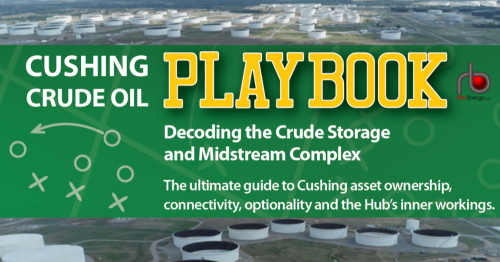
To truly understand Cushing — what it does and how it works — you need to know the hub’s assets and how they fit together. RBN’s Cushing Crude Oil Playbook provides the first one-stop, comprehensive guide to the hub’s assets.
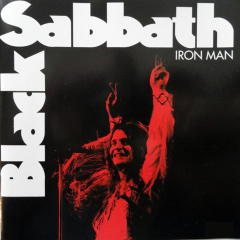
About the song
“Iron Man” was written by Tony Iommi, Geezer Butler, Ozzy Osbourne, and Bill Ward. It appears as the fourth song on side one of Black Sabbath’s second studio album, Paranoid. The song was developed around Tony Iommi’s guitar riff. It was initially called “Iron Bloke” because Ozzy Osbourne said the guitar riff sounded “like a big bloke walking about.” The lyrics were composed by Geezer Butler about a self-fulfilling apocalyptic prophecy envisioned by a man who travels to the future. Osbourne’s voice was processed through a ring modulator to get the effect used for his recitation of “I am Iron Man” at the beginning of the song. Released as a single in October 1971, it went to #52 on the Billboard Hot 100 Singles chart. The song was used in the end credits of the 2008 film Iron Man and Tony Stark, the alter-ego of Iron Man, wears a Black Sabbath T-shirt in the 2012 film The Avengers. Lyricist Butler says he had not been aware of the Marvel Comics superhero when he originally wrote the song. Personnel on the record were: Ozzy Osbourne (vocals), Tony Iommi (guitars), Geezer Butler (bass), and Bill Ward (drums).
Paranoid was recorded in two days in June 1970 at Regent Sound in London and mixed at Island Studios in London, with Roger Bain producing. Most of the songs on the record were developed from onstage improvisational jams while touring. The song “War Pigs” was originally titled “Walpurgis,” but the record label rejected that title because it sounded “too Satanic.” Wait ... a Black Sabbath song sounding too Satanic? Surely, they jest! Released in September 1970, the album went to #12 on the Billboard 200 Albums chart and has been certified 4x Platinum by the Recording Industry Association of America. Two singles were released from the LP.
Black Sabbath was a British heavy metal band formed in Birmingham, England, in 1968 by Tony Iommi, Bill Ward, Geezer Butler, and Ozzy Osbourne. They are one of the original purveyors of heavy metal music. They have released 19 studio albums, eight live albums, 13 compilation albums, three EPs, and 37 singles. They have sold more than 70 million records worldwide. They have a Grammy Lifetime Achievement Award and were inducted into the UK Music Hall of Fame in 2005, and the Rock and Roll Hall of Fame in 2006. Twenty-six members have passed through the band since its inception, with Tony Iommi being the only original member along for the full ride. Iommi, along with original members Ozzy Osbourne and Geezer Butler, did their final tour as Black Sabbath, titled The End, in 2017. There are no plans for a reunion.