Clean hydrogen’s supporters often tout its growth potential, boosted in no small way by the billions of dollars in federal subsidies that will soon go toward supporting the buildout of an extensive series of regional hubs across the U.S. Clean hydrogen has its share of detractors, too, who question how much of a fixture it can become in the U.S. energy mix and wonder about its reliance on all those federal subsidies. But there’s one thing just about everyone seems to agree on — nobody likes the seemingly ubiquitous hydrogen color scheme, with arguments that it is too simplistic, has become too politicized, and puts the industry’s focus on the wrong things. In today’s RBN blog, we look at the limitations of the hydrogen color scheme, the risks of relying on it too extensively, and how the new tax credit for clean hydrogen puts the focus on carbon intensity (CI) instead.
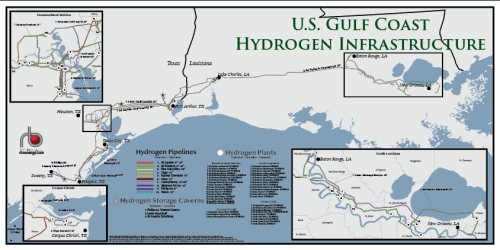
RBN’s U.S. Gulf Coast Hydrogen Infrastructure Map lays out the pipelines and merchant hydrogen plants that make up the gulf coast market, providing an unprecedented snapshot of the region’s hydrogen infrastructure network.
We’ve written a lot about hydrogen’s emergence over the past couple of years, from our initial series where we tried to make sense of the increased buzz around the fuel, to our dive into the long history of U.S. hydrogen markets, to our review of the different hydrogen production pathways, to an examination of its long-term growth potential and the development of several regional hubs in the U.S. In addition to the long-established hydrogen markets, hydrogen advocates like to tout its long-term potential for any number of uses, including as fuel to help decarbonize boilers in industrial processes, as a transportation fuel, and as an energy storage system for intermittent renewable power.
Hydrogen also gets attention because it can be produced in several different ways from a number of different fuels, including coal, natural gas, nuclear power and renewables. But while the hydrogen that is ultimately produced by each method is identical — hydrogen is hydrogen, after all — each method has its own environmental impact and its own CI score. To differentiate one type of hydrogen from another, which has become increasingly important in recent years as policies emerge to reduce or eliminate greenhouse gas (GHG) emissions, a color scheme has emerged (see Figure 1 below). While at best the scheme is far from perfect, it’s worth at least reviewing the rainbow of varieties.
About the song
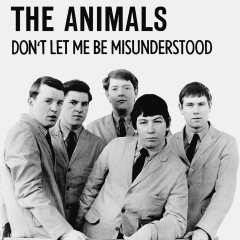
“Don’t Let Me Be Misunderstood” was written by Bennie Benjamin, Horace Ott, and Sol Marcus for Nina Simone, who recorded the first version of the song in 1964. British rock band The Animals released their version of the song as a single in January 1965 and it went to #15 on the Billboard Hot 100 Singles chart. It appeared as the first song on side two of The Animals’ third U.S. studio album, Animal Tracks. The song has been covered by many artists, including Santa Esmeralda, whose disco version went to #1 on the Billboard Club Play Singles chart, and Elvis Costello, whose version went to #22 in Ireland and #33 in the U.K. Bruce Springsteen has credited the song’s riff for the inspiration for his song, “Badlands.” Personnel on The Animals’ record were: Eric Burdon (lead vocals), Hilton Valentine (guitar, backing vocals), Alan Price (keyboards, backing vocals), Chas Chandler (bass, backing vocals), and John Steele (drums, percussion).
Animal Tracks was recorded in London between July 1964 and June 1965 with Mickie Most producing. The U.S. version was a hodgepodge of recent hit singles with songs left over from the band’s two previous album sessions. It bore very little resemblance to the U.K. version, which featured R&B covers. It would be the last album for original founder and keyboardist Alan Price, who left the band to pursue a solo career. Released in the U.S. in September 1965, three previous Top 20 hits were featured on the LP. The U.K. version of the album went to #6 on the U.K. Albums chart.
The Animals are a British rock band formed in Newcastle in 1962 by Alan Price, Eric Burdon, Hilton Valentine, Chas Chandler and John Steele. Their first major hit was “House of the Rising Sun” in June 1964. Twenty-three members have passed through the band since its formation. Original bassist and early Jimi Hendrix manager Chas Chandler died in 1996. Guitarist Hilton Valentine died in 2021. Singer Eric Burdon still fronts a touring version of The Animals with six other musicians. The Animals have released five studio albums in the U.K., three in the U.S., six compilation albums, five EPs, and 25 singles. After Eric Burdon moved to Los Angeles in 1967, the group became Eric Burdon and the Animals, and achieved continued success as a psychedelic band. The Animals were inducted into the Rock and Roll Hall of Fame in 1994.