There’s a lot of nitrogen out there — it’s the seventh-most common element in the universe and the Earth’s atmosphere is 78% nitrogen (and only 21% oxygen). And there’s certainly nothing new about nitrogen in the production, processing and delivery of natural gas. That’s because all natural gas contains at least a little nitrogen. But lately, the nitrogen content in some U.S. natural gas has become a real headache, and it’s getting worse. There are two things going on. First, a few counties in the Permian’s Midland Basin produce gas with unusually high nitrogen content, and those same counties have been the Midland’s fastest-growing production area the past few years. Second, there’s the LNG angle. LNG is by far the fastest-growing demand sector for U.S. gas. LNG terminals here in the U.S. and buyers of U.S. LNG don’t like nitrogen one little bit. As an inert gas (meaning it does not burn), nitrogen lowers the heating value of the LNG and takes up room (lowers the effective capacity) in the terminal’s liquefaction train. Bottom line, nitrogen generally mucks up the process of liquefying, transporting and consuming LNG, which means that nitrogen is a considerably more problematic issue for LNG terminals than for most domestic gas consumers. So as the LNG sector increases as a fraction of total U.S. demand, the nitrogen issue really comes to the fore. In today’s RBN blog, we’ll explore why high nitrogen content in gas is happening now, why it matters and how bad it could get.

The Natural Gas Master Class is a one-day online event focusing on understanding flow analysis, interpreting pipeline data and forecasting future flows. This course is designed to equip you with the knowledge and skills to effectively analyze the complexities of natural gas markets, flow analysis, and pipeline modeling. Join us online
October 21 | Online
In observance of today’s holiday, we’ve given our analysts a break and are revisiting our recent blog on nitrogen and its impact on LNG feedgas. If you didn’t read it then, this is your opportunity to see what you missed. Happy Thanksgiving!
Let’s start with the basics. Figure 1 shows how nitrogen gets from the wellhead to the LNG terminal, with the numbers in the graphic matched to each bullet below. This is a generalized example, but is most reflective of Permian-Midland gas production, a significant portion of which makes it to the Texas Gulf Coast.
- Wellhead-level nitrogen content varies significantly across geography and geology. One well might have a nitrogen content of 1% while another down the road might have 5% or higher. The percentages shown are representative of wells in higher nitrogen areas of the northern Midland Basin.
- Wells with a wide variety of nitrogen content feed common gathering systems, which in effect become the first line of defense in the nitrogen-mitigation process. Higher-nitrogen gas is blended with lower-nitrogen gas to yield a gas mix that generally reflects the average nitrogen content in the area covered by the gathering system.
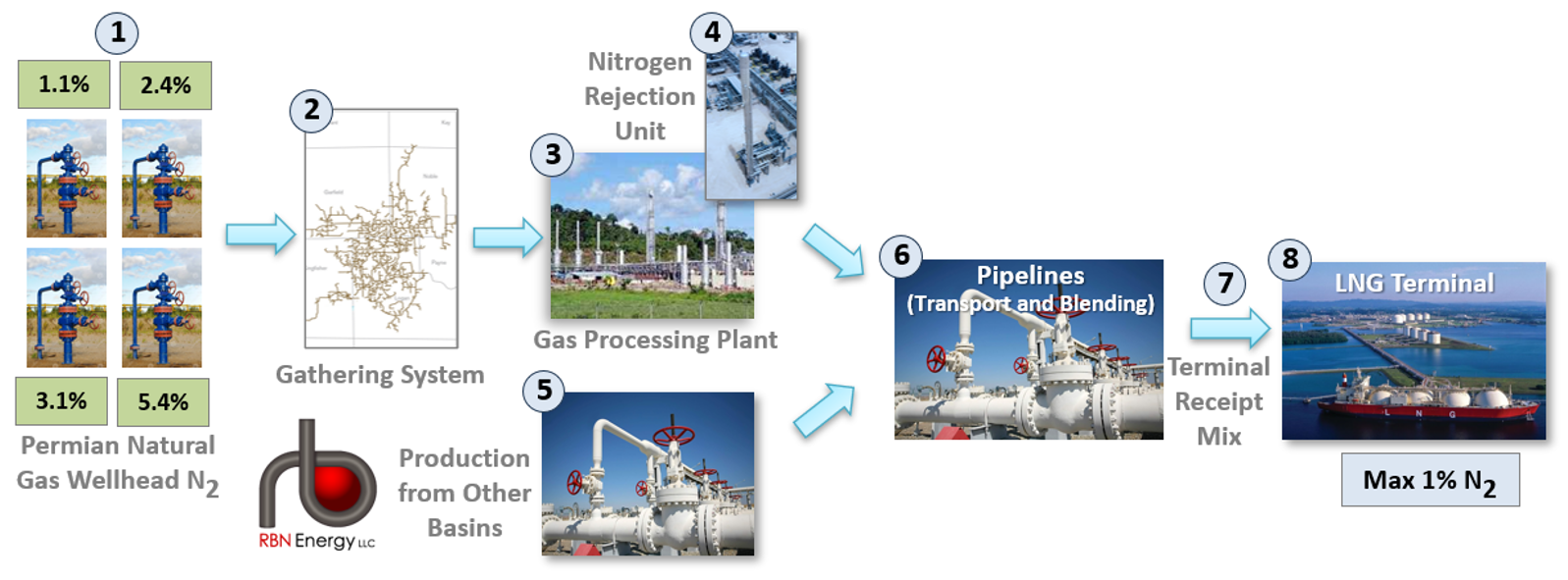
Figure 1. Nitrogen Flow from Wellhead to LNG Terminal. Source: RBN
About the song
“It’s a gas gas gas” is refrain at the end of each verse of “Jumpin’ Jack Flash,” written by Mick Jagger and Keith Richards. The tune was released as a non-album single by The Rolling Stones in June 1968. Produced by Jimmy Miller, the song went to #3 on the Billboard Hot 100 Singles chart. It is the band’s most-performed live song — they have played it more than 1,100 times in concert. A live version first appeared on The Rolling Stones’ album Get Yer Ya-Yas Out in 1970 and has appeared on six live albums since. It was also performed in The Rolling Stones Rock and Roll Circus, a movie released in 1968.
The song’s title comes from Mick Jagger’s gardener, Jack Dyer, whom Jagger referred to as Jumpin’ Jack. Recording of the song began during the sessions for The Rolling Stones’ Beggars Banquet album in 1968. The unique guitar sound on the recording was accomplished by using two acoustic guitars, one tuned to open D and the other utilizing Nashville high-string tuning. Both guitars were then plugged into a Phillips cassette recorder and played back through an extension speaker. Personnel on the record were: Mick Jagger (lead, backing vocals, maracas), Keith Richards (lead guitar, acoustic guitar, bass, backing vocals), Bill Wyman (Hammond organ), Brian Jones (rhythm guitar), Charlie Watts (drums), Ian Stewart (piano), and Jimmy Miller (backing vocals).
The Rolling Stones are an English rock band formed in London in 1962. Eight members have passed through the band since its formation. The band still includes founding members Mick Jagger and Keith Richards. Ronnie Woods joined them in 1974 after the departure of guitarist Mick Taylor. Brian Jones died in 1969. Bill Wyman retired from the band in 1993. Bassist Darryl Jones has toured and recorded with the band since Wyman's departure. Charlie Watts died in 2021. The Rolling Stones have released 30 studio albums, 33 live albums, 29 compilation albums, three EPs and 121 singles. The band has won one Billboard Music Award, 11 Grammy Awards, three MTV Video Music Awards, and two World Music Awards. The Stones were inducted into the Rock and Roll Hall of Fame in 1989 and the UK Music Hall of Fame in 2004. They continue to record and tour. Their latest album, Hackney Diamonds, will be released October 20.