June was somewhat of a game-changer for the 2016 U.S. natural gas market. Summer weather finally arrived and U.S. consumption, particularly from power burn, was at record highs, as were exports to Mexico. Meanwhile, production volumes sagged, flattening and even declining versus year-ago levels in recent weeks. The market response to all of this was swift. The CME/NYMEX Henry Hub prompt futures contract ripped nearly $1.00 higher over the last five weeks to flirt with the $3.00/MMBtu mark. In fact, the U.S. natural gas market was behaving downright giddy — a bit like it the oversupply problem was ancient history. That is, until yesterday. On Tuesday the market returned from the long, holiday weekend to higher production, weaker temperature-adjusted demand and the likelihood of higher storage injections than previously expected. The resulting price action led the August contract to whipsaw back down more than 20 cents from Friday to a settle of $2.764. So where do the fundamentals really stand? Today, we provide an update of the supply/demand balance this summer to date, what’s driving the volatility and the potential risks to prices in July trading.
This is our latest update on the fundamental factors influencing the natural gas market — in particular the supply/demand balance. At the beginning of May in Carry That Weight, we recapped the storage picture going into the start of summer 2016, which indicated the likelihood of a record inventory balance by the end of injection season. Back then, prices were $1/MMBtu lower — and at 17-year lows in fact — weighed down by the enormous storage surplus. Also, the market was still nervously awaiting the first signs of the requisite tightening that needed to happen — either through a production slowdown, a big demand response to the lower prices, or both, as well as how the weather wild-card would factor in. Then, all that abruptly changed as June delivery contracts kicked in. A couple of weeks ago, in Part 1 of What’s Going On we examined the bullish fundamental shift that occurred in June. And in Part 2, we took a closer look at the biggest driver behind that shift: gas demand for power generation (power burn). Now with the first three months of the gas storage injection season — including June, one of the hotter months — under our belt, we revisit the supply and demand data to see where the market balance now stands, in particular compared to last year. Our analysis is based on daily supply/demand data from the NATGAS Billboard report (our joint report with IAF Advisors).
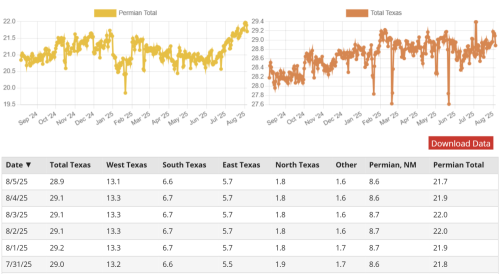
The NATGAS Production Tracker - Texas provides a DAILY update of natural gas production in Texas the New Mexico side of the Permian Basin. Quickly and easily view today’s supplies in the Lone Star state and download the full historical table when you need it.
Supply
On the supply side, we start with the biggest component — U.S. dry gas production. With producers operating on bare-boned budgets and a skeleton rig fleet, production volumes this summer to date (April 1 to June 30) have struggled to maintain the 73-Bcf/d average levels seen in the first quarter of 2016. Rig counts are down 50% from last year’s already depleted fleet. (Baker Hughes puts the U.S. rig count at 431 as of July 1, 2016, compared to 862 in the same week last year and 1,666 in the five-year average.) On top of the slowed drilling activity and the usual temporary maintenance-related curtailments that occur in the second quarter, there’s been a string of one-off or weather-related events that have disrupted production operations. Starting in April, heavy rains and related flooding in Texas disrupted operations and curtailed production. Then on April 29 (2016), Spectra Energy’s Texas Eastern (TETCO) pipeline experienced a rupture and explosion along its Penn-Jersey leg, which shut-in about 300 MMcf/d of Marcellus production for a number of days. (By May 10, partial capacity on the line was restored, and pipeline flow data from our friends at Genscape indicates any affected production receipts eventually returned on that line or found alternative routes.) Between the lower rig count, Texas flooding, maintenance and the TETCO outage, total U.S. production remained suppressed below 73 Bcf/d at an average 72.7 Bcf/d in April and a notch lower than that at 72.6 Bcf/d in May. Then, in June, two more big events occurred, again knocking off more production. The first was another bout of major flooding last week, this time in West Virginia, where production receipts fell 0.7 Bcf/d to an average 2.8 Bcf/d in the week ended June 24 (2016), down from about 3.5 Bcf/d earlier in June, according to Genscape flow data. (West Virginia volumes have since recovered to 3.4 Bcf/d over the July 4th weekend). The second was another explosion — this time at Enterprise’s gas processing plant in Pascagoula, MS, in the early morning hours of Tuesday, June 28 — that shut in nearly 0.5 Bcf/d of offshore Gulf of Mexico production volumes. With the plant offline, Destin Pipeline was initially unable to deliver gas from any of its offshore receipt points. Starting late June 29, Destin began rerouting as much as 350 MMcf/d from those receipt points to the Viosca Knoll Gathering System (VKGS). But that option came with a catch — VKGS cannot receive the retrograde condensate liquids in the gas stream and the Destin line can only accumulate so much of that stuff. As of a July 4 notice, Destin has about another week or two of being able to reroute some of the affected production before it reaches its liquids limit. Between the Pascagoula outage and West Virginia flooding, U.S. natural gas production fell to a six-month low of 70.7 Bcf/d on June 28 and averaged 71.7 Bcf/d in the last week of June. Notably, last week was also the first time this year that production fell below year-ago levels on a weekly average basis. On a monthly basis, June ended up averaging 72 Bcf/d, down 0.6 Bcf/d from the previous month (May 2016) and up just 0.3 Bcf/d from June 2015. That compares to a year-over-year increase of over 2.0 Bcf/d in first quarter 2016. In other words, production in April–June has not only declined from earlier this year but also flattened considerably versus last year.
So what does all that mean for how the supply side of the balance equation is shaping up this summer? Table 1 provides a year-over-year comparison of market supply components for this summer to date (from April 1, 2016 to June 30, 2016).

About the song
“What's Going On” is the title of the single from the 1971 album of the same name by Motown artist Marvin Gaye. It was written after Four Tops member Renaldo Benson, along with fellow Motown songwriter Al Cleveland, wrote the first version of the song that was given to Marvin Gaye for consideration. Gaye loved the tune but rearranged it and added a new melody, sharing in the songwriting credits on the song.
When Gaye played the song to Motown label head Barry Gordy, he hated it, saying the song was too political to be a hit. Motown executives Harry Balk and Barney Ales disagreed with Gordy's appraisal and helped Gaye record the song and put out the single. It immediately became a smash hit, going to #1 on the Hot Soul Singles chart and #2 on the Billboard Top 100 chart. Barry Gordy was stunned by the success of the single and gave Gaye the green light to record and produce a complete album. The album was recorded between June 1970 and May 1971 and became the first Marvin Gaye album to reach Billboard's Top Ten in the Top LP category, and peaked at #6, staying on the charts for a year.
Marvin Gaye helped to shape the sound of Motown in the sixties with a string of hit singles. What's Going On was a revolutionary departure from focusing on hit singles to shifting toward an album-oriented consciousness with a recurring social theme. Marvin Gaye died in 1984 at the age of 44, fatally shot by his father at their Los Angeles home. Among his many awards is a Grammy Lifetime Achievement Award, induction into the Rock and Roll Hall of Fame, and a star on the Hollywood Walk of Fame.