


Which is true, A or B? (A) Data center demand to power AI applications is the most transformative force to hit energy markets in years, or (B) This is one of the most overhyped, inflated narratives ever. We hear a constant stream of announcements, promotions and proclamations from developers, tech giants, utilities and politicians, many predicting a revolutionary surge in electricity and gas demand that will change everything. At the same time, others warn of a speculative bubble destined to pop. As we discuss in today’s RBN blog, sorting out which side is closer to reality is one of the most important questions facing U.S. energy markets.
Tackling that question for the U.S. as a whole is a huge challenge, one fraught with all sorts of data quality and analytical obstacles, and we’ll eventually get there. But fortunately, there is a much smaller problem we need to solve for our energy modeling business, namely, what will happen to power demand in Texas and Louisiana. And, most important for our models, how much additional natural gas will be needed to fuel the generation required to meet that demand.
That’s a data series that we need for the Arrow Model, our proprietary analytical framework built to assess the Texas and Louisiana natural gas markets. The model carves up the region into pipeline “corridors” (aka arrows) that are used to assess changes in the region’s inflows, outflows and flows within each state via groups of pipes that serve similar markets from comparable supply sources.
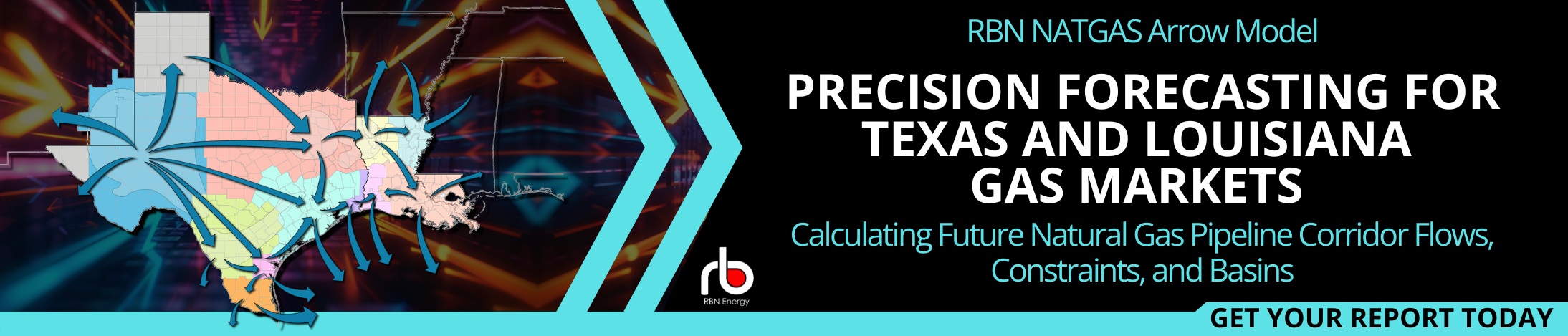
The most significant model drivers are Permian and Haynesville gas production and LNG feedgas demand, but the model must consider everything that impacts Texas/Louisiana gas, including production from other basins, demand in each subregion (11 of them), pipeline capacity constraints, new infrastructure construction and, of course, in-region demand. And that’s our Arrow Model challenge when it comes to data centers. For the model to accurately assess demand, we must estimate how much demand growth data centers will bring over the next few years.
Therein lies the problem. There are a massive number of announced data center projects, some real and some no more than press releases. Many seem to be “agreements to agree in the future if a deal materializes,” to quote one of our good friends who tracks this stuff. So we had to figure out a process to separate the wheat from the chaff — the genuine projects from the smoke-and-mirrors publicity.
We tackled the problem with a four-step process (see Figure 1 below). Step 1 was to develop a “bottoms-up” database of all publicly acknowledged projects. We compiled publicly available information on data center projects across Texas and Louisiana, sourced from public announcements, government filings and other online resources. Through this research, we generated a list of approximately 50 unique data center projects and 70 unique phases of development — meaning projects that have more than one phase that has been announced.
About the song
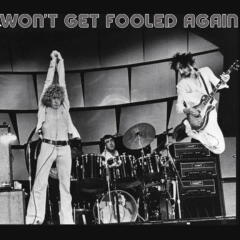
“Won’t Get Fooled Again” was written by Pete Townshend and appears as the fourth song on side two of The Who’s fifth studio album, Who’s Next. Townshend originally wrote the song as a closing number for his unfinished rock opera, Lifehouse. The lyric at the end of the song, “Meet the new boss, same as the old boss,” was inspired by an incident at Woodstock where Townshend chased Abbie Hoffman off the stage for grabbing a microphone and preaching his agenda to the crowd during a break in The Who’s performance. On the song, Townshend played a 1959 Gretsch 6120 guitar (given to him by Joe Walsh) through a Fender Bandmaster amp. (We guess you could ask Jimmy Page about the magic of 1959 American guitars that had previously been owned by Walsh — the 1959 Sunburst Gibson Les Paul that Page that used in Led Zeppelin was bought from Walsh.) Townshend would use that combination of guitar and amp for many future Who recordings. Released as a single in June 1971, “Won’t Get Fooled Again” went to #15 on the Billboard Hot 100 Singles chart. It has been used in many television shows and motion pictures. On a sad note, it was the last song drummer Keith Moon played live with the band before his untimely passing in September 1978. Personnel on the record were: Roger Daltry (lead vocals, scream), Pete Townshend (guitars, synthesizer, organ, backing vocals), John Entwistle (bass) and Keith Moon (drums, percussion).
Who’s Next was recorded between April and June 1971 at Olympic Studios in London and on The Rolling Stones Mobile Studio outside of Stargroves, Mick Jagger’s manor home in East Woodhay, England. Production was handled by Glyn Johns and The Who. The front album photo shot by Ethan Russell was an irreverent nod to the monolith used in the 1968 motion picture, 2001: A Space Odyssey. The album was released in August 1971 and went to #4 on the Billboard 200 Albums chart. It has been certified 3X platinum by the Recording Industry Association of America. Three singles were released from the LP.
The Who are an English rock band formed in London in 1962 as The Detours. Their classic lineup from 1964-78 was Roger Daltry, Pete Townshend, John Entwistle and Keith Moon. The Who have sold more than 100 million records worldwide. They have released 12 studio albums, 16 live albums, 27 compilation albums, four soundtrack albums, four EPs, and 58 singles. They have a Grammy Lifetime Achievement Award and are members of the Rock and Roll Hall of Fame and the UK Music Hall of Fame. Eight members have passed through the group since its formation. Founding member Keith Moon died in 1978 and John Entwistle died in 2002. Roger Daltry and Pete Townshend continue with various musicians to record and tour as The Who.




Comments
Awesome analysis including the bit about the Who.