Chesapeake Energy’s announcement yesterday that it has filed for Chapter 11 bankruptcy protection is only the latest sign of how much the seismic economic shocks from the pandemic-triggered demand destruction have roiled the U.S. E&P sector. With equity prices plummeting to historic lows, oil and gas producers have focused their efforts on shoring up their balance sheets and share prices, by tightening their belts going into 2020, reducing capital expenditures by an average 14% in order to boost free cash flow and increase shareholder returns. So, it’s no surprise that the industry has aggressively battened down the hatches operationally and financially, mothballing rigs, suspending completions, shutting-in producing wells, slashing dividends, and suspending share repurchase programs. First-quarter 2020 earnings releases and investor calls provided a clear picture of the dimensions of the cost-cutting by the 41 U.S. E&Ps we track. But continued uncertainty about the course and duration of the COVID-19 pandemic, the pace of economic recovery, and the outlook for commodity prices have triggered reluctance on the part of oil and gas executives to issue production guidance for the remainder of 2020 and beyond. Today, we review the current capital expenditure reductions by U.S. E&Ps and piece together clues on their impact on oil and gas production.
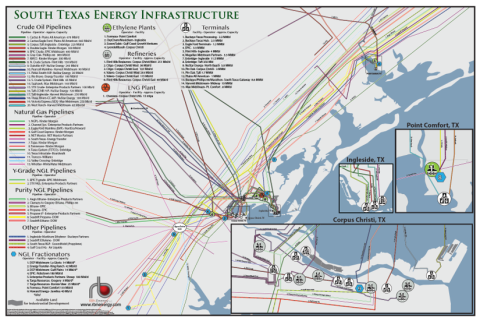
RBN Energy’s South Texas Energy Infrastructure Map brings together all the pieces of the critical and complex puzzle of the greater Corpus Christi region. Spanning from Point Comfort, TX to Corpus Christ, TX and south of the Agua Dulce natural gas hub, the map details the processing, transportation and export facilities in RBN Energy’s classic clear, concise and easy to comprehend style.
We begin with a quick look at how we got here. Back in December 2019, in Can’t Afford to Love You, we outlined the new, cautious approach to capital investment that E&P companies already had adopted after the price crash of 2014-15 sent the industry to the brink of insolvency. Total investment by the 41 companies we monitor plunged from $131 billion in 2014 to a low of $40 billion in 2016 (see Figure 1) as E&Ps prioritized portfolio rationalization over expansion and cash flow above growth. Once oil prices started to recover, capital investment rebounded to $77 billion in 2018, but that was still little more than half the 2014 level. With the prospect for lower commodity prices, producers cautiously trimmed capital spending by 7% in 2019 to $72 billion and by another 14% to $62 billion going into 2020. But, as we pointed out three months ago in Paint It Black, oil and gas companies began shaving their original 2020 capex guidance further with the onset of the pandemic, and the latest guidance issued before the quarter-end reports suggested about a 25% decline in investment from 2019 levels.
Now, after all the first-quarter 2020 earnings reports are in, total 2020 investment by our 41 E&Ps has been reduced to $38 billion, which is 48% lower than 2019, down nearly 40% from the original 2020 guidance, and a 10-year low. Given that first-quarter drilling and completion outlays were largely in line with original 2020 budgets — that is, some $15 billion of the originally planned $62 billion had already been spent by March 31 — investment for the remainder of the year could be as low as $7 billion to $9 billion per quarter. As you would expect, the Oil-Weighted and Diversified peer groups were the most affected by the oil price and demand plunge, and they responded with 44% and 41% reductions, respectively, from their original 2020 guidance (bar to far right in Figure 1). Gas-Weighted producers, which had originally slashed 2020 capital budgets by 29% in response to record low gas prices, reduced their investment by an additional 14% due to the impact of the pandemic on the liquids portion of their output.
About the song
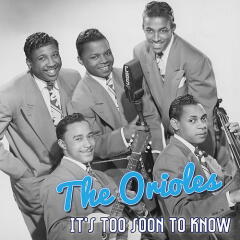
"Too Soon to Know" was written by Deborah Chessler (Shirley Reingold), and would be the first single released by The Orioles. Chessler was managing a vocal group in Baltimore called The Vibranaires that became The Orioles. After a successful appearance on the Arthur Godfrey Talent Scouts television show, she was able to secure The Orioles a record deal with Jerry Blaine's Natural Records label. The Orioles released "Too Soon to Know" in August 1948, and by November, it went to #1 on the Billboard R&B charts and #13 on the pop charts. The doo-wop song is considered by some to be the first rock and roll song to become a hit. It has been covered by Pat Boone, Ella Fitzgerald, Etta James, and Linda Ronstadt. Personnel on the record were: Sonny Til (lead tenor), Alexander Sharp (high tenor), George Nelson (baritone), Johnny Reed (bass vocals, upright bass), and Tommy Gaither (guitar).
The Orioles were an American R&B vocal group formed in Baltimore in 1946. They are often credited with being one of the earliest vocal groups that created the doo-wop sound. They made three studio albums, 15 compilation albums, and 55 singles. The Orioles, with the original five members, are members of the Rock and Roll Hall of Fame, and the Vocal Group Hall of Fame. A staggering 31 members have passed through the ranks of The Orioles since its inception. The band continued touring with various members until 2005. Original member and featured vocalist, Sonny Til died in 1981. Tommy Gaither died in 1950, George Nelson in 1959, Alexander Sharp in 1970, and Johnny Reed in 2005.