You may not know it by the look of the S&P E&P stock index, which has been flirting with record lows in recent weeks, but exploration and production companies are continuing to defy the industry’s legendary boom-and-bust cycles by pumping out increasing volumes of crude oil and natural gas while slashing spending. Some types of E&P companies have fared better than others in this lower-price environment. How are they continuing to generate substantial production growth under sharply lower capital investment programs? Today, we update our analysis of capital expenditures and production growth based on the second-quarter results of the 43 U.S. oil-focused, gas-focused, and diversified producers we track.
As we noted in Part 1, the Shale Revolution unlocked vast, low-cost oil and gas reserves, unleashing soaring production and transforming the U.S. from a major oil and natural gas importer to a rising exporter. But this turnaround also triggered a substantial decline in oil prices and a bear market in natural gas that forced producers to undergo major strategic transformations. E&Ps revamped their portfolios, selling off non-core, high-cost assets to focus on high-return core properties, embraced fiscal discipline by cutting capital spending to live within cash flow, and prioritized shareholder return by instituting dividend and stock repurchase programs. Despite these efforts, investors have remained skeptical of energy equities, sending the S&P E&P stock index close to all-time lows. However, as we’ve demonstrated in our first-quarter discussion in Surprise, Surprise and most recently in Part 1 of this series, E&Ps’ profitability has remained relatively stable, even increasing in the case of oil-weighted producers, and these companies are largely operating within cash flow.
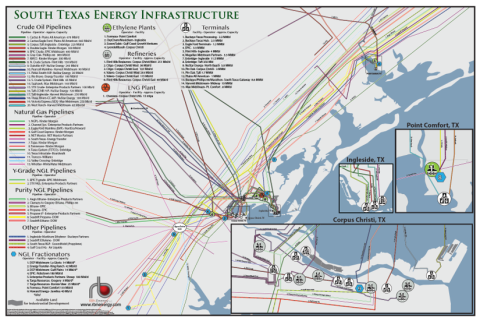
RBN Energy’s South Texas Energy Infrastructure Map brings together all the pieces of the critical and complex puzzle of the greater Corpus Christi region. Spanning from Point Comfort, TX to Corpus Christ, TX and south of the Agua Dulce natural gas hub, the map details the processing, transportation and export facilities in RBN Energy’s classic clear, concise and easy to comprehend style.
As Figure 1 shows, despite a lackluster capital spending profile, oil and gas production (orange line) for our universe of 43 companies continues to rise. Output has grown 17.5% since 2014, while capital spending (blue bars) has decreased to 50% of that year’s level. The production growth is especially remarkable considering the E&Ps we track divested more than 14 billion boe (barrels of oil equivalent) of reserves over the same period. As reflected in the second-quarter 2019 updates, the 43 companies have cut their drilling and completion expenditures by over 12% from the previous year but are guiding towards a 5% increase in total output for 2019 as a whole. Capital spending habits, however, are not uniform, as each peer group has its distinctive features. The Oil-Weighted E&Ps, primarily Permian producers, have reduced capital spending by a more modest 37% since 2014. That investment resulted in a 23% gain in production over that same time period. The Diversified E&Ps, primarily multi-basin companies that have gone through significantly more dramatic portfolio restructuring, slashed capex by 60% from the $70 billion spent in 2014, yet that resulted in 2018 production being only 3% less than the 1.9 billion boe produced in 2014. Moreover, their output last year was 4% higher than the trough in 2017. The Gas-Weighted E&Ps have slashed capex by 45% since 2014, but managed to grow production nearly 60% between 2014 and 2018.
About the song
“Don't Stop Believin’” was written by Journey members Steve Perry, Jonathan Cain and Neal Schon. The song appears as the first song on side one of Journey’s seventh studio album, Escape. It was recorded at Fantasy Studios in Berkeley, CA, and produced by Kevin Elson and Mike Stone. Released as a single in October 1981, the song went to #9 on the Billboard Hot 100 Singles chart. It has sold more than 7 million digital downloads in the U.S., placing it in the Top 10 of digital song downloads. It has been certified Platinum by the Recording Industry Association of America (RIAA). Personnel on the record were: Steve Perry (lead vocals), Ross Valory (bass, backing vocals), Jonathan Cain (keyboards, backing vocals), Neal Schon (guitars, backing vocals), and Steve Smith (drums, percussion).
Escape was recorded between April and June 1981 and released in July 1981. It went to #1 on the Billboard 200 Albums chart and has yielded four Top 20 hit singles. It has been certified Diamond (10 million copies sold) by the RIAA. It was the first album with keyboardist Jonathan Cain, who replaced founding member Gregg Rolie.
Journey is an American rock band formed in San Francisco in 1973. Eighteen members have passed through its ranks since its formation. They have released 15 studio albums, five live albums, 11 compilation albums, a soundtrack album, two EPs and 52 singles, and have sold more than 100 million records worldwide. Journey was inducted into the Rock and Roll Hall of Fame in 2017. The current iteration of the band, featuring longtime members guitarist Neal Schon and keyboardist Jonathan Cain, is joined by vocalist Arnel Pineda, bassist and backing vocalist Todd Jensen, keyboardist and backing vocalist Jason Derlatka, and drummer and backing vocalist Deen Castronovo. They continue to record and tour.