Midstreamers developing natural gas takeaway capacity out of the Permian have understandably focused on pipelines to the Gulf Coast — and along the coast to LNG export terminals and other big gas consumers. But don’t forget the Desert Southwest, where demand for gas-fired power is soaring. Energy Transfer recently committed to building a 516-mile, 1.5-Bcf/d expansion to its Transwestern Pipeline system from West Texas to the Phoenix area, and hinted that it might double the project’s capacity due to the high level of interest. In today’s RBN blog, we discuss Energy Transfer’s aptly named Desert Southwest Project, what drove its quick progress to a final investment decision (FID), and what other westbound projects out of the Permian might still happen.

RBN’s Arrow Model shows seven gas-pipeline corridors out of the Permian, four of them toward the Gulf Coast and the others to the Midcontinent, Central Mexico and the West. Of the roughly 19.3 Bcf/d of gas flowing out of the Permian this month, 67% (12.9 Bcf/d) is heading east toward the Gulf; only 13% (2.6 Bcf/d) is headed west toward Arizona and California. The vast majority of those westbound flows are on two pipeline systems: Energy Transfer’s Transwestern system (dark-blue lines in Figure 1 below), whose mainline takes a more northerly route through New Mexico and Arizona, and Kinder Morgan’s El Paso Natural Gas system (EPNG; light-purple lines), which has both northern and southern mainlines and more spurs and alternate pathways than you can shake a stick at. Both systems also pick up gas volumes from the San Juan Basin in northwestern New Mexico. Both systems also feed gas into other pipeline systems in Southern California, and EPNG feeds gas into pipelines in northwestern Mexico.
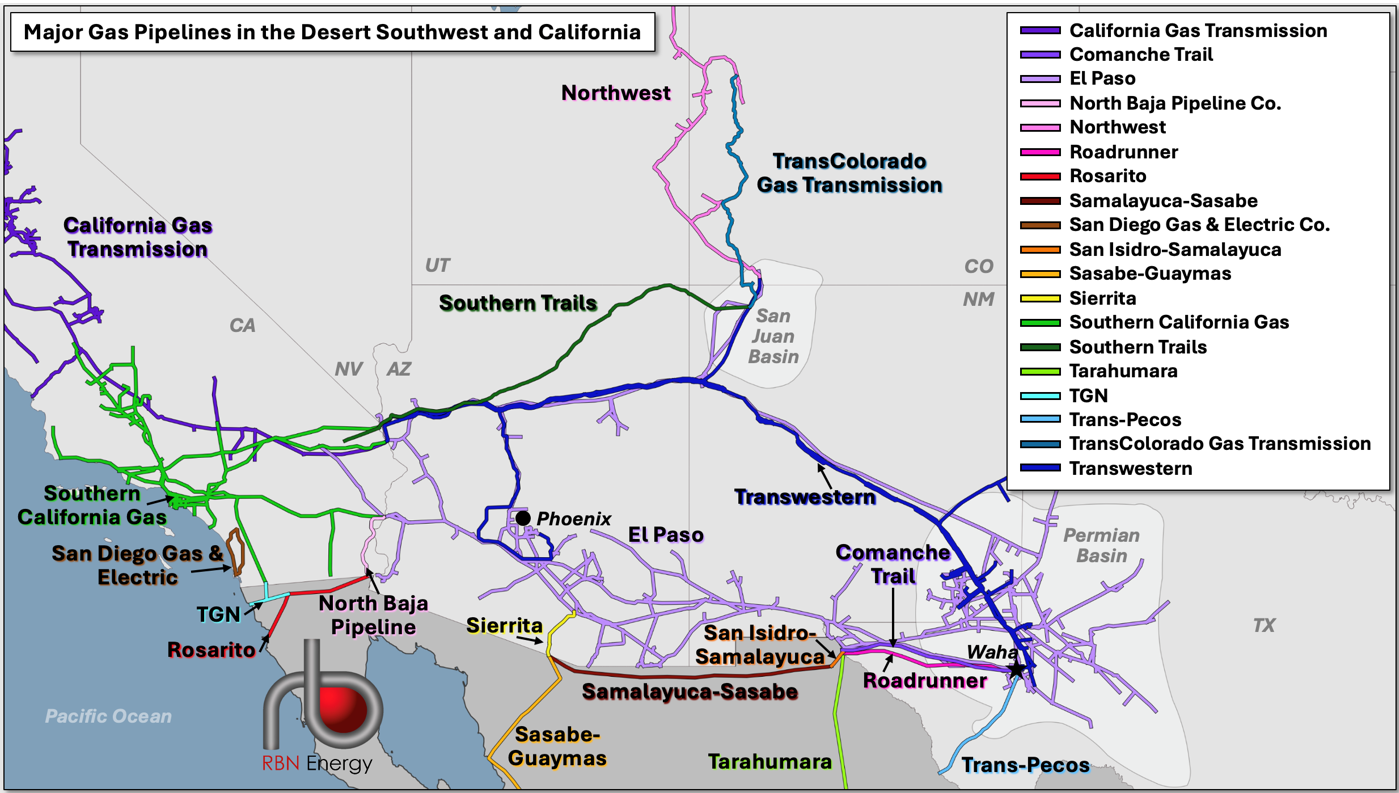
Figure 1. Major Gas Pipelines in the Desert Southwest and California. Source: RBN
Historically, both pipelines were driven by the very large loads in California, to the point that, at least on EPNG, the Desert Southwest shippers were simply known as “East of California.” The Transwestern and EPNG systems have each undergone a number of expansions over the past quarter-century, mostly — as you might expect — to help accommodate rising gas demand in fast-growing Arizona and Mexico and, to lesser degrees, New Mexico and California. But as we’ll get to next, those expansions — a couple of MMcf/d here and there — are nothing compared to what Energy Transfer and Kinder Morgan have each been pursuing the past couple of years, and what Energy Transfer recently committed to building.
About the song
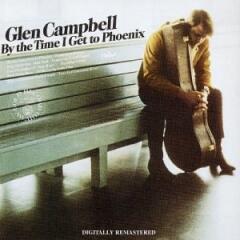
“By the Time I Get to Phoenix” was written by Jimmy Webb and appears as the first song on Glen Campbell’s seventh studio album of the same name. The song was originally recorded by Johnny Rivers in 1965. The song was written by Webb about his breakup with his girlfriend, Susan Horton, who was also the subject of his song “McArthur Park.” Released as a single in October 1967, it went to #2 on the Billboard Hot Country Singles chart and #26 on the Billboard Hot 100 Singles chart. It has been certified Gold by the Recording Industry Association of America (RIAA). It won Grammy Awards for Best Vocal Performance Male and Best Contemporary Male Solo Vocal Performance in 1967. In 2004, it was inducted into the Grammy Hall of Fame. Personnel on the record were: Glen Campbell (vocals, guitar), James Burton (guitars), Joe Osborn (bass), Jim Gordon (drums) and Al De Lory (string arranger and conductor).
The album By the Time I Get to Phoenix was recorded at Capitol Studios in Hollywood and produced by Al De Lory and Nick Venet during the summer of 1967. Released in November 1967, it went to #1 on the Billboard Country Albums chart and #15 on the Billboard 200 Albums chart. It won a Grammy Award for Album of the Year in 1968. It has been certified Platinum by the RIAA. Two singles were released from the LP.
Glen Campbell was an American country music musician and actor. A charter member of the Los Angeles wrecking crew elite group of session musicians, he had a series of hit records in the 1960s and ’70s and was the host of The Glen Campbell Goodtime Hour on CBS for four years. Campbell released 65 studio albums, four soundtrack albums, seven live albums, 127 compilation albums and 116 singles and has sold more than 45 million records worldwide. He appeared in 11 motion pictures. Campbell has won five Grammy Awards, a Grammy Lifetime Achievement Award, 10 ACM Awards, three American Music Awards and three CMA Awards and is in the Country Music Hall of Fame. He died in Nashville in August 2017 at 81.