In May 2019, the first-ever propane unit train from the Bakken to Mexico reached its destination, and since then, three more of these 100-car, single-commodity “bulk” trains have made the same trip. Facilitating these shipments by Twin Eagle Liquids Marketing is Marathon Petroleum Corp.’s (MPC) unit train-loading terminal in Fryburg, ND, which was initially set up to load crude oil but was recently expanded to handle propane too. And soon, the terminal in Torreón, Mexico, that has been receiving these unit trains will have a new loop track too, enabling producers and marketers to take full advantage of the bulk transport option. Today, we look at the economics and challenges of this relatively new propane export route.
As we discussed in Part 1, Mexico’s need for propane — widely used for cooking and heating water — is on the rise, even as local supply has been dwindling. That’s boosted propane imports to the country, including from the U.S. and Canada in recent years. While most of those imports come to Mexico via ship (~52% or 83 Mb/d in 2018) or are trucked across the U.S.-Mexico border (33 Mb/d or 21%), a good portion (29 Mb/d or 18%) of it is railed in. [Only 14 Mb/d, or less than 10%, of it was transported via pipeline last year, owing to the limited pipeline capacity and routes available to reach key markets in interior Mexico.]
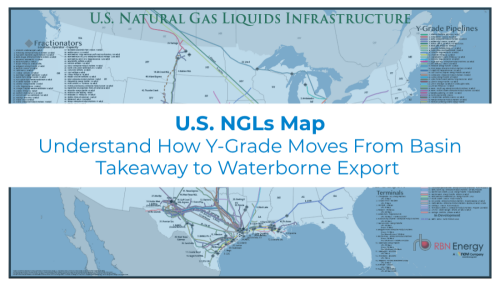
Visualize the infrastructure behind U.S. NGL movement.
The U.S. NGLs Map provides a comprehensive view of the transport, processing, and export networks moving NGLs across the U.S.
So, rail shipments from the U.S. to Mexico certainly aren’t new. What is new, at least as of May this year, is that propane is now being regularly railed in bulk to Mexico via 100-car unit trains with dedicated locomotives that are capable of moving upwards of 70 Mbbl at a time (30,000 gallons or ~700 bbl of LPG per tank car). NGL producers and marketers have long explored — and in a number of cases employed — the unit-train option. But the limited availability of propane supply as well as unit-train terminal infrastructure has kept propane rail shipments largely restricted to manifest shipments (shipping a few tank cars at a time on mixed-goods trains) — with few exceptions. Infrastructure changes in the Bakken have changed that. Earlier this year, MPC — a leading producer in the Bakken — completed an expansion of its Fryburg crude oil unit-train terminal to accommodate propane. Additionally, Andeavor Logistics (now part of MPLX, the midstream-focused master limited partnership MPC formed in 2012) has converted a segment of the BakkenLink crude oil pipeline to NGL service, increasing deliveries of mixed NGLs to Marathon’s Belfield processing and fractionation complex, which serves the terminal. These changes then enabled Twin Eagle — the marketer in the propane shipments — to move propane supply from Fryburg to Mexico. Next, we consider the economics of those shipments.
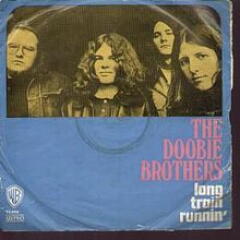
About the song
"Long Train Runnin'" was written by Doobie Brothers band member Tom Johnston. The song appears as the second track on The Doobie Brothers third studio album, The Captain and Me. The song features Johnston on lead vocals and the rhythm guitar groove that propels the song. Although uncredited on the album, bay area blues harpist Norton Buffalo performed the harmonica solo on the tune. "Long Train Runnin'" evolved out of an instrumental jam tune the band had been performing live called "Osborn." As they were going through song ideas for their third album, producer Ted Templeman liked the groove on it and persuaded Johnston to come up with words and a melody for it. It was released as the first single from the album in March 1973, and went to #8 on the Billboard Hot 100 chart.
The Captain and Me was recorded at Warner Bros. Studios in North Hollywood between late 1972 and early 1973, with Ted Templeman manning production duties. It was released in March 1973, and went to #7 on the Billboard Top 200 Albums chart. Two singles that hit the top 20 were released from the album. Personnel on the record were: Tom Johnston (vocals, guitar, synthesizer, harmonica), Pat Simmons (vocals, guitar, synthesizer), Tiran Porter (bass, backing vocals), John Hartman (drums, backing vocals), and Michael Hossack (drums, congas, cymbals, timbales).
The Doobie Brothers are an American rock band formed in San Jose, CA, in 1970. They have been active for nearly five decades, with 29 different touring and recording members passing through its ranks during that time. The Doobie Brothers were featured on the debut of Don Kirshner's Rock Concert show in 1973. They have released 14 studio albums, five live albums, nine compilation albums, and 36 singles to date. They have won two Grammy Awards and were inducted into the Vocal Group Hall of Fame in 2004. The Doobie Brothers still record and tour to this date. The band, featuring long-time members Tom Johnston, Pat Simmons, and John McFee, are on tour with Santana through September. They are assisted on the road with five additional touring members, including Bill Payne (Little Feat) on keyboards.