


After a three-year hiatus, winter returned to the U.S. natural gas market this year in the form of a “Bomb Cyclone” and more than a week of frigid temperatures. The cold weather pushed Henry Hub prices above $6/MMBtu and East Coast prices higher than $100/MMBtu on some days. This winter, the pain wasn’t just confined to New England. Prices at Williams’ Transcontinental Gas Pipeline (Transco) Zone 5, which includes the Carolinas, Virginia and Maryland, hit all-time highs on January 5. Exports from Dominion’s Cove Point terminal in Maryland are only just getting started so it’s not liquefied natural gas (LNG) exports from the East Coast that are driving prices higher. Instead, it’s gas’s increasing role in winter power generation that has been putting pressure on East Coast gas pipeline deliverability. Today, we begin a series explaining why prices have been so high on very cold days this winter and why more price spikes may be ahead.
This winter, eastern gas prices have set records at some hubs and spiked near record highs at many others. Prices at Algonquin Citygate and Transco Zone 5 (yellow and blue lines, respectively, in Figure 1 below) ran up to more than $100/MMBtu on January 5, and to $24/MMBtu during the week prior. These price spikes have been driven by an increasing call on gas for power generation across the eastern U.S. On the coldest days, such as we saw when the Bomb Cyclone hit, the demand for gas as a generation and heating fuel exceeds pipeline capacity to deliver it, which begins a cascade of dominoes that results in skyrocketing prices.
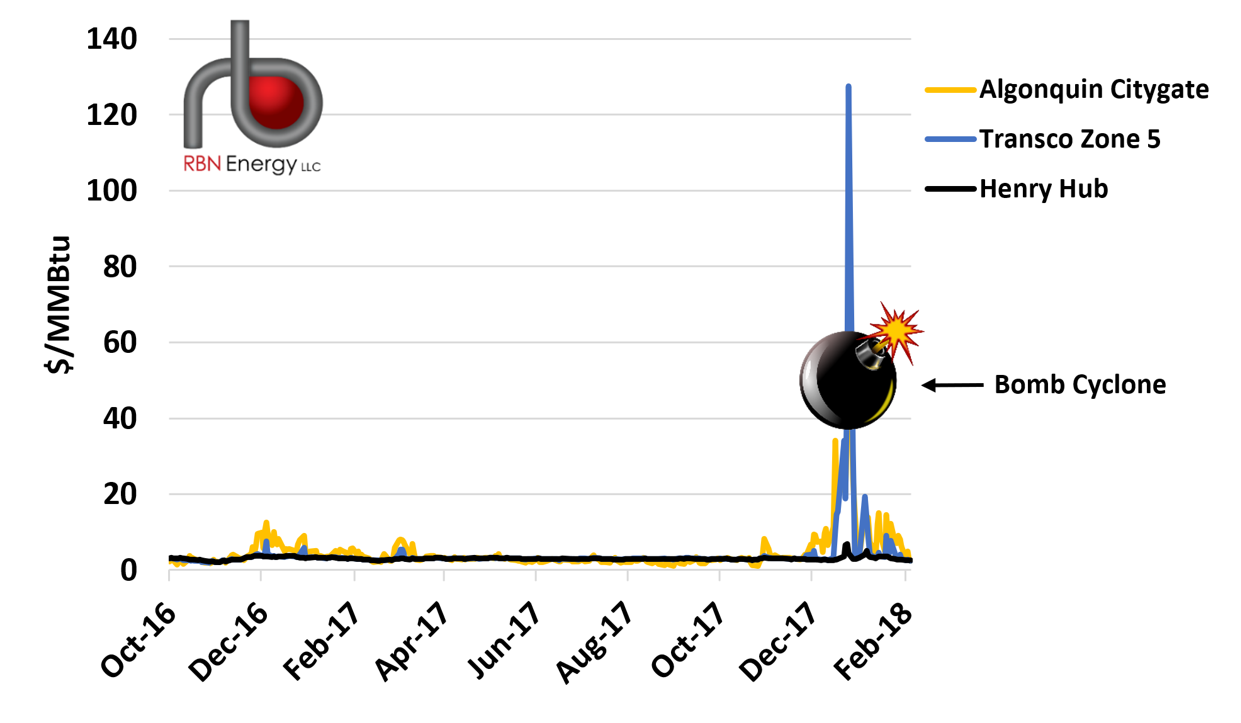
Figure 1. Eastern Gas Prices. Sources: NGI, RBN
The way the power sector works, the cheapest marginal generation sources are tapped first. We’ve covered power plant dispatch in detail in the past (See Talkin’ ‘Bout My Generation, Part I), but the basic concept goes like this: the least expensive power sources run constantly and cover around-the-clock baseload demand, the next tranche of generators cycle up and down with daily demand, and finally the higher-cost “peakers” are fired up at times of peak demand.
Renewable and nuclear power plants are the cheapest and run when they are available, so fossil generation must swing on or off (or “dispatch” in technical terms) according to the market’s sometimes volatile need for electricity. As we covered in Talkin' 'Bout My Generation, Part II, generators choose which fossil-fired plants to run based on economics: the cheapest ones dispatch first. However, cheapest in power terms isn’t the same as cheapest in per-Btu terms, because gas combined-cycle plants are more efficient at converting Btus to electricity than coal plants. Therefore, for example, gas is competitive with coal at per-Btu prices 30-50% higher than coal. Further, coal generators have the blessing and curse of no liquid spot market, meaning that coal contracts are bilateral and have a wide range of delivered costs. In the Eastern Transco Corridor, for example, data from the Energy Information Administration (EIA 923 data) shows that most 2017 coal deliveries had costs in the $2.60-3.40/MMBtu range.
About the song
“You Dropped a Bomb on Me” is an electrofunk song performed by The Gap Band; it was released in 1982 on producer Lonnie Simmons's label, Total Experience Records. The tune, which was written by Lonnie Simmons, Rudy Taylor and Charlie Wilson, reached #2 on the Billboard R&B charts, #39 on the dance charts and #31 on the Billboard Hot 100. In addition to the single release, the song was featured on the band's 1982 album, Gap Band IV. A notable feature of the song is its use of a synthesizer to imitate the whistling sound of a bomb dropping. This is first heard immediately before the first verse, and throughout the song from the fourth chorus onward.






Comments
Great article. Just checking on the units on the oil burn is the 50 million gallons rather than barrels?