Last year’s $1 trillion-plus infrastructure law calls for the U.S. Department of Energy (DOE) to invest up to $8 billion over five years to support the development of four or more U.S. hydrogen hubs. It’s a safe bet that the DOE will determine that at least one location along the Gulf Coast is worthy of its support — and maybe even a couple, given the extent of existing hydrogen supply, demand and midstream infrastructure already in place in Texas and Louisiana in particular. We’d also be willing to wager that California will be another beneficiary of the federal government’s hydrogen-hub largess. Not only does the nation’s most populous state have extraordinary potential for clean-hydrogen development, its public and private sectors have been aggressively pursuing climate-friendly energy alternatives for decades. In today’s RBN blog, we examine the various efforts underway to develop hydrogen-related infrastructure — and hydrogen demand — in the Golden State.
While there’s no certainty as to how the energy transition will play out over the next two or three decades, it seems clear that the shift to a lower-carbon economy in the U.S. and around the world will be an “all of the above” kind of thing, involving everything from wind, solar and nuclear power to battery storage, electric vehicles and fuel cells — and don’t forget hydrocarbons. The U.S. shift toward increasing natural gas usage has had by far the most significant impact on decarbonization up to now. Beyond that, the impact of hydrocarbons on the climate can be reduced by blending with renewable fuels or other means — or mitigated (partially or even fully) with carbon offsets and carbon sequestration, as we discussed in a recent Drill Down Report.
Then there’s low-carbon or clean hydrogen, the focus of our Gulf Coast Highway blog series. In Part 1, we looked at the provisions of the Infrastructure Investment & Jobs Act of 2021 that are designed to propel the hydrogen market forward. In addition to the $8 billion in support for new hydrogen hubs we mentioned in the introduction to today’s blog, the new law sets aside an additional $1 billion to back efforts to reduce the cost of producing clean hydrogen from water via renewables-powered electrolyzers to $2/kilogram (from the current $4-plus/kg) by 2026, and another $500 million to help advance equipment manufacturing technologies and techniques for clean-hydrogen processing, delivery, storage, etc. (The federal government’s first Energy Earthshots initiative, announced in July 2021, seeks to bring the cost of clean hydrogen down to $1/kg within a decade. The recently passed Inflation Reduction Act [IRA], which we detailed in Name Game, includes the new 45Z hydrogen production tax credit, which will be worth up to $3/kg, depending on the lifecycle greenhouse gas [GHG] emissions rate at the facility.) We also discussed the criteria the DOE will use in selecting the hydrogen hubs it will invest in, including feedstock diversity, end-use diversity, geographic diversity, and the potential to create jobs. Then, in Part 2 and Part 3, we detailed hydrogen-hub plans under development in the Houston and Corpus Christi areas, respectively.
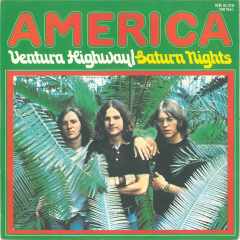
About the song
“Ventura Highway” was written by Dewey Bunnell and appears as the first song on America’s second studio album, Homecoming. It was released as a single in September 1972 and went to #3 on the Billboard Easy Listening chart and #8 on the Billboard Hot 100 Singles chart. Bunnell has said that the song has a “Go West, young man” vibe in the lyrics. The “alligator lizards in the air” line refers to the shapes of clouds he observed while he was a kid. The “purple rain” line in the lyrics is up to conjecture as to whether Prince was inspired after hearing it. In other fun facts, there is no such thing as Ventura Highway, it is a reference to Pacific Coast Highway 1 that runs up the coastline from Los Angeles to Ventura. (There is a Ventura Freeway, though.) Personnel on the record were: Dewey Bunnell (vocals, guitar), Gerry Beckley (vocals, guitar), Dan Peek (vocals, guitar), Joe Osborn (bass), and Hal Blaine (drums, percussion).
Homecoming was recorded in 1972 at The Record Plant in Los Angeles, with America producing. Released in November 1972, it went to #3 on the Billboard 200 Albums chart. It has been certified Platinum by the Recording Industry Association of America. Three singles were released from the LP.
America is a British-American folk-rock band formed in London in 1970 by Dewey Bunnell, Gerry Beckley, and Dan Peek. The trio met as sons of U.S. Air Force personnel stationed in London, where they first performed live. They are known for their tight vocal harmonies and acoustic guitar sound. The band has released 23 studio albums, 11 live albums, 22 compilation albums, and 47 singles. They won a Grammy Award for Best New Artist in 1973, were inducted into the Vocal Group Hall of Fame in 2006 and received a star on the Hollywood Walk of Fame in 2012. Dan Peek left the band in 1977 and died in July 2011. The band has continued as a duo, performing live with various touring musicians. America continues to record and tour.