In just a few days, President-elect Trump will return to office, determined to fulfill his many campaign promises, including his high-profile commitment to ease the regulatory burden on oil and gas producers so they can “drill, baby, drill.” Significantly ramping up production would likely bring down consumer prices for gasoline, diesel and other fuels — a noble goal — but it would also be at odds with the conservative, financially disciplined strategies that now guide many oil majors and oil-focused E&Ps. With the prospects for “drill, baby, drill” uncertain at best, and the correlations between oil prices, rig counts and production volumes less reliable than they used to be, how can we develop a production forecast? In today’s RBN blog, we explain what we do — oh, and we share our forecast with you, for free!

Crude Oil Permian provides detailed analysis of the fundamental drivers impacting the Permian Basin crude oil market including weekly data, analysis and market intelligence updates of: Permian crude oil supply and demand, pipeline outflows and capacity, prices, and infrastructure updates.
We released RBN’s Top 10 Prognostications for 2025 a couple of weeks ago, and #1 on our list was “Chill, Baby, Chill – Trump’s 2025 Energy Goals Face New Industry Realities.” We pointed out that while the incoming president promisedto get oil-patch workers “pumping, fracking, drilling and producing like never before,” delivering on such ambitions is far easier said than done. Unlike President Trump’s first term, when he oversaw a 3-MMb/d increase in oil production (before COVID erased a third of that growth), the mid-to-late 2020s present a markedly different landscape. The era of wildcatters and private companies driving rapid production growth has given way to dominance by far more disciplined, financially conservative oil majors.
These large players are motivated to maintain financial discipline, prioritizing shareholder returns over aggressive production expansion that, if pursued by many or most E&Ps, would lead to a glut of supply, lowering prices and hurting bottom lines. We concluded, “There will be a lot of talk, but for 2025, we are going to stick with our production outlook for a relatively modest 3%, 400-Mb/d increase in crude oil production, and a 2%, 1.9-Bcf/d increase in dry gas production. It’s growth, but nothing crazy. We are rooting for you, President Trump, but the world out there has changed and it’s hard to imagine it changing back.”
What’s changed exactly? A lot of things. For one, there’s been a slew of upstream M&A activity the past couple of years — enough to fill two Drill Down reports (click here for the first and here for the second, which was posted last month.) As a result, the average U.S. producer is considerably larger now than it was back in 2020, and therefore more able and willing to take a big-picture “portfolio” approach to its drilling plans — i.e., rather than respond to mercurial market fluctuations, they operate under long-term plans that take into account wider supply-demand balance dynamics.
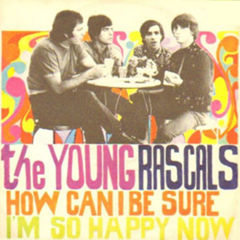
About the song
“How Can I Be Sure” was written by Felix Cavaliere and Eddie Brigati and appears as the fifth song on side one of The Young Rascals’ third studio album, Groovin’. It was the most successful Rascals single with Eddie Brigati as lead vocalist. The song featured a waltz tempo and French cabaret feel. The lyrics were inspired by Felix Cavaliere’s girlfriend at the time, Adrienne Buccheri. Cavaliere has stated the reason The Rascals felt emboldened to do such a song was the success The Beatles had with “Michelle” and “Yesterday.” Released as a single in August 1967, it went to #4 on the Billboard Hot 100 Singles chart. Dusty Springfield, David Cassidy, Lainie Kazan and Lesley Gore also recorded the song. Personnel on the record were: Eddie Brigati (lead vocal, percussion), Felix Cavaliere (acoustic grand piano), Gene Cornish (bass), Dino Danelli (drums, percussion), King Curtis (saxophone), Hubert Laws (flute), and David Nadien, Donna Tecco and Marti Jane Short (strings).
Groovin’ was recorded in 1967 at A&R Studios in New York City and produced by The Young Rascals. It’s the last album on which the band used The Young Rascals moniker. Beginning with their next LP, Once Upon a Dream, the band is referred to as The Rascals. The album was released in July 1967 and went to #5 on the Billboard 200 Albums chart and has been certified Gold by the Recording Industry Association of America. Three singles were released from the LP.
The Young Rascals (The Rascals) are an American rock band formed in Garfield, NJ, in 1965. Founding members Felix Cavaliere, Eddie Brigati and Gene Cornish met while performing in Joey Dee’s backup band, The Starliners. They added Cavaliere’s drummer friend, Dino Danelli, and became The Young Rascals. Danelli would become the role model for Keith Moon of The Who. The group has released nine studio albums, five compilation albums and 24 singles. They are members of the Rock and Roll Hall of Fame and Vocal Group Hall of Fame, and Cavaliere and Brigati are members of the Songwriters Hall of Fame. Ten members have passed through the group since its formation. Founding vocalist Eddie Brigati left the group in 2013 and drummer Dino Danelli died in 2022. Original members Cavaliere and Cornish still perform with touring musicians as The Rascals and have a series of dates on the East Coast in February.