It might seem crazy to talk about expanding crude oil and diluent pipeline systems between Canada and the U.S. amid what could escalate into an all-out trade war between the two nations. However, Enbridge, one of the largest pipeline operators in the world, is doing just that — actively planning and investing in pipeline expansions for its Mainline, Express-Platte and Southern Lights systems that would help move an ever-rising tide of Canada’s oil sands crude to market in the years ahead. We examine Enbridge’s plans in today’s RBN blog.

Join industry leaders in Calgary on October 29 for market insights, technical presentations, Duvernay inventory analysis, an expert panel, and networking focused on the next chapter of Canadian energy.
Unless you have been hiding under a rock for the past few months, you are probably all too familiar with trade frictions that have arisen between the U.S. and Canada as a result of the on-again, off-again imposition of tariffs on U.S. imports of goods from Canada, including vital supplies of energy (see Everybody Hurts). With the potential for a tariff rate of 10% on U.S. energy imports from its northern neighbor (and a 25% rate on other imported goods), the war of words and potential counter-tariffs imposed by Canada have served to upend what is the most successful bilateral trading relationship in the world. It has also led to not-so-veiled threats by Canada that its exports of crude oil, natural gas and electricity could be curtailed or cut off in retaliation.
With trade relations frayed and tensions still unresolved, you might wonder why any Canadian company might be considering — let alone actively pursuing — an expansion of pipeline capacity between the two nations for the movement of crude oil south to the U.S. and diluent north from the U.S. for use in Alberta’s oil sands. Nevertheless, one of the largest pipeline companies in the world, Calgary, AB-based Enbridge, is pursuing just such a strategy, betting that the long-term fundamentals of Western Canada’s crude oil supply growth will fully justify additional pipeline capacity across several of its systems that move crude oil and diluent between the two nations.
Let’s first take a quick tour of several Enbridge pipeline systems, which we will explore in this blog. The array of pipelines known collectively as the Enbridge Mainline (orange lines in Figure 1 below) handles about 70% of all the crude oil shipped from Western Canada by pipeline into the U.S. Midwest. The system’s parallel Lines 1, 2, 3, 4 and 67 transport a variety of heavy and light crude oil and NGLs from Edmonton and Hardisty, AB, to Clearbrook, MN, and Superior, WI. From there, other Mainline pipes move crude to the Flanagan hub in north-central Illinois (Line 61), the Chicago area (Lines 6, 14 and 64), Michigan (Lines 5 and 78) and Ontario (Lines 5, 7, 11 and 78). The U.S. side of the Mainline is often referred to as the Lakehead System.
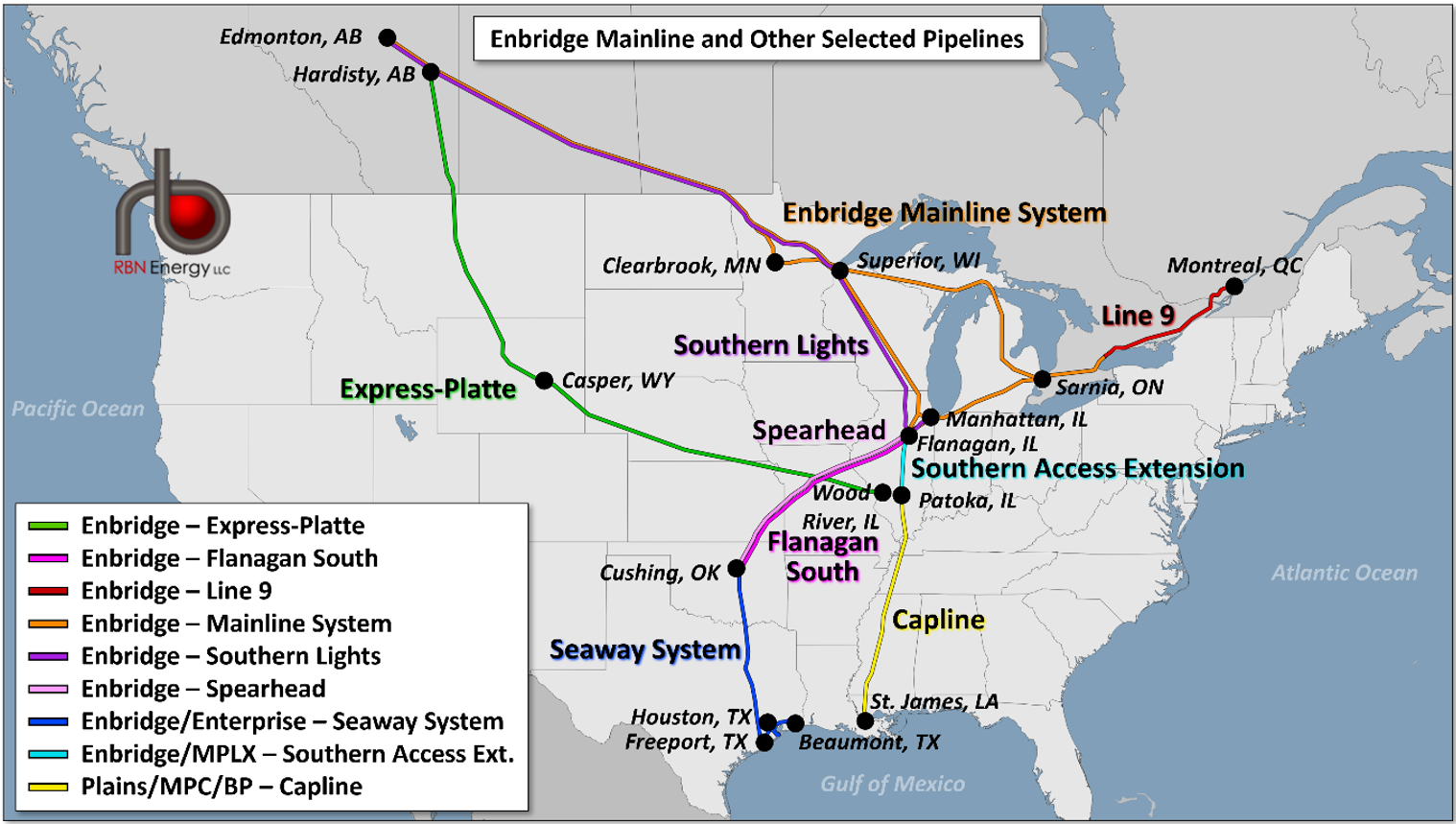
Figure 1: Enbridge Mainline and Other Selected Pipelines. Source: RBN

About the song
“Here, There and Everywhere” was written and sung by Paul McCartney and credited to Lennon-McCartney. It appears as the fifth song on side one of The Beatles’ seventh studio album, Revolver. McCartney said the inspiration for this song came from listening to Brian Wilson’s “God Only Knows,” which appeared on The Beach Boys’ masterpiece album, Pet Sounds. Ironically (or perhaps fittingly), Wilson claims he spent endless hours listening to The Beatles’ Rubber Soul album while writing “God Only Knows.” “Here, There and Everywhere” is noted for its use of multi-layered vocals, which McCartney, John Lennon and George Harrison spent a lot of time perfecting during their three days of recording the tune in June 1966. McCartney, Lennon and Beatles record producer George Martin (sometimes referred to as “the fifth Beatle”) named the song as one of their favorites in The Beatles catalog. Personnel on the recording were: Paul McCartney (lead vocals, rhythm guitar, bass, finger snaps), John Lennon (backing vocals, finger snaps), George Harrison (lead guitar, backing vocals, finger snaps), and Ringo Starr (drums, finger snaps).
Revolver was The Beatles’ final studio album before retiring from live performances to focus their efforts on recording only, which would result in their eighth studio album in 1967, the epic Sgt. Pepper’s Lonely Hearts Club Band. An interesting side note is that the album cover artwork for Revolver was done by a longtime friend from The Beatles’ early days in Hamburg — German bassist and artist Klaus Voormann.
The Beatles were an English rock band formed in Liverpool in 1962. Band members John Lennon, Paul McCartney, George Harrison and Ringo Starr led the band to become one of the most popular and influential groups in history. They made 13 studio albums, five live albums, 21 EPs, and 63 singles during their career, and are the best-selling band in history, selling over 800 million albums worldwide. The Beatles have won one Academy Award, four Brit Awards, 11 Grammy Awards, 15 Ivor Novello Awards, 17 NME Awards, and three World Music Awards, and they are members of the Rock and Roll Hall of Fame. John Lennon died in 1980, and George Harrison in 2001. Paul McCartney and Ringo Starr still record and tour as solo artists to this day.