All roads lead to Louisiana in the natural gas market, and those roads have become increasingly crowded as LNG demand sucks in gas from other states, increasing competition for supply and raising reliability concerns for downstream utility customers. Despite being home to most of the Haynesville, the country’s third-largest gas production basin, Louisiana has been bringing in more gas from the north as demand surges, an arrangement that will change drastically in just a few years. In today’s RBN blog, we’ll discuss Boardwalk Pipelines’ Kosci Junction project and how it will impact the gas market in Louisiana, Mississippi and beyond.
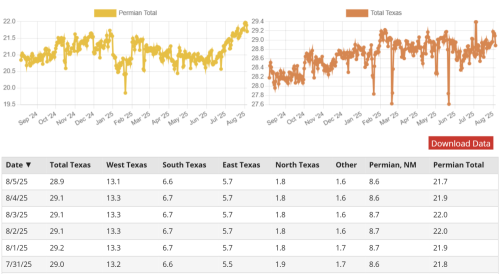
The NATGAS Production Tracker - Texas provides a DAILY update of natural gas production in Texas the New Mexico side of the Permian Basin. Quickly and easily view today’s supplies in the Lone Star state and download the full historical table when you need it.
Boardwalk announced more than a year ago that it had reached a final investment decision (FID) on the Kosciusko Junction Pipeline Project (known by the shortened form of “Kosci Junction,” in contrast to the typical gas-market spelling of “Kosi”). The project (dashed pink line in Figure 1 below) could be completed as early as 2028 and consists primarily of 103 miles of new 36-inch-diameter pipeline in Mississippi to connect Boardwalk’s Gulf South Pipeline system (yellow lines) to its existing Texas Gas Transmission pipeline (TGT; dark-green line) via the Greenville Lateral (light-green line), plus an 8-mile lateral to Columbia Gulf Transmission (CGT; light-blue line) at Inverness and multiple compressor stations. The Greenville Lateral, as well as the lateral to CGT, will be integrated into the Kosci Junction expansion. Kosci Junction is designed to help Southeastern markets reach farther back into the supply stack, reducing their reliance on constrained Gulf Coast pathways and mitigating head-to-head competition with LNG for the same molecules. In filling this supply to the Southeast, it will indirectly affect the way southern Louisiana is supplied.
About the song
“Crazy Train” was written by Ozzy Osbourne, Randy Rhoads, and Bob Daisley. It appears as the second song on side one of Ozzy Osbourne’s debut solo album, Blizzard of Ozz. Propelled by Randy Rhoads’ signature guitar riff, the song references the Cold War and the fear of worldwide obliteration. With the lyric: “I’m going off the rails on a crazy train,” it could refer to Osbourne’s wild lifestyle as well. The song is played at many major sporting events around the world. Released as the debut single from the album in September 1980, it went to #6 on the Billboard Hot Rock and #39 on the Billboard Hot 100 Singles charts. It has been certified 4x Platinum by the Recording Industry Association of America. Personnel on the record were: Ozzy Osbourne (vocals), Randy Rhoads (guitars), Bob Daisley (bass), and Lee Kerslake (drums, vibraslap).
Blizzard of Ozz was recorded during March and April 1980 at Ridge Farm Studio in Rusper, England, and produced by Ozzy Osbourne, Randy Rhoads, Bob Daisley and Lee Kerslake. Released on Don Arden’s (Sharon Osbourne’s father) Jet Records in September 1980, it went to #21 on the Billboard 200 Albums chart and has been certified 5x Platinum by the RIAA. Two singles were released from the LP.
Ozzy (John Michael) Osbourne was an English rock musician, songwriter and media personality who was a pioneer figure in heavy metal music. His impact on the genre cannot be understated. He was a founding member of Black Sabbath, which formed in Birmingham, England, in 1968, and was the progenitor of heavy metal music. Osbourne participated in nine Black Sabbath albums and released 13 studio albums, five live albums, seven compilation albums, five EPs, and 65 singles as a solo artist. He has sold more than 100 million records worldwide. He is a member of the Rock and Roll Hall of Fame as a member of Black Sabbath and as a solo artist, the UK Music Hall of Fame as a member of Black Sabbath and as a solo artist, has won a Grammy Award, and has a star on the Hollywood Walk of Fame. Osbourne died in Buckinghamshire, England, in July 2025 at 76, two weeks after he and Black Sabbath did their final show in Birmingham.
"About the Song" -- written by Mickey McMahan , RBN Director of Musicology