The decision by the U.S.’s largest independent propane wholesaler to exit the business serves as a reminder of the challenges and risks that companies like it face. The move also highlights the fact that at least some other independent wholesalers — including the presumed buyer of NGL Energy Partners’ propane-related assets — believe that by increasing their scale and scope they can compete more effectively with their two classes of competitors: affiliates of big midstream companies and affiliates of propane retailers. In today’s RBN blog, we discuss what the latest M&A activity in the propane space reveals.

Visualize the infrastructure behind U.S. NGL movement.
The U.S. NGLs Map provides a comprehensive view of the transport, processing, and export networks moving NGLs across the U.S.
It’s not often that you see the largest player in an energy-market segment determine that it’s time to hang up its cleats. But that’s what happened when NGL Energy Partners, a master limited partnership (MLP), announced on February 10 that it was “selling substantially all of our wholesale propane business” and had reached agreements to sell 17 of its 23 NGL terminals (red, green and red/green dots in Figure 1) for $75 million and (in a separate deal) its Green Bay, WI, NGL terminal (red star) for $3.8 million. The company has said that its terminals, all but two of which are located in the eastern half of the U.S. — one is in Washington state (not shown in map) and another is in Ontario (yellow dot) — have a combined storage capacity of more than 15 million gallons and an annual throughput of more than 500 million gallons.
The recently announced sales agreements would leave NGL Energy Partners with only a handful of NGL-related assets, including three NGL terminals (Chesapeake and West Point in Virginia and Port Hudson in Louisiana; white diamonds) and the Ambassador Pipeline (yellow line), a 255-mile, 8-inch-diameter propane conduit between Marysville and Kalkaska in Michigan’s Lower Peninsula.
NGL Energy Partners did not reveal the entity or entities buying 18 of its terminals, but RBN’s understanding is that they will be purchased by Alliance Energy Services — another top-tier independent propane wholesaler. Alliance, the prospective buyer, has four NGL terminals: one each in Kentucky, Maine, Minnesota and Wisconsin (blue dots). The four Alliance terminals have more than 5 million gallons of storage capacity.

Figure 1. NGL Energy Partners and Alliance Energy Services NGL Terminal Assets. Source: RBN
About the song
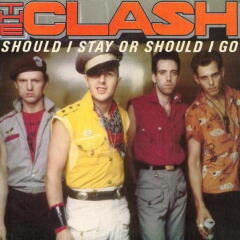
“Should I Stay or Should I Go” was written by Topper Headon, Mick Jones, Paul Simonon and Joe Strummer, and appears as the third track on side one of The Clash’s fifth studio album, Combat Rock. It was originally released as a single in May 1982, where it went to #45 on the Billboard Hot 100 Singles chart. After being featured in a Levi’s jean television commercial, the song was re-released in February 1991 and went to #1 on the U.K. singles chart and made the Top 10 on several European charts. The song borrowed heavily from the 1960s Righteous Brothers hit, “Little Latin Lupe Lu,” and featured the lead vocals of Mick Jones. The lyrics were rumored to have been written about Jones’s relationship with singer Ellen Foley. Personnel on the record were: Mick Jones (guitar, lead vocals), Joe Strummer (guitar, backing vocals), Paul Simonon (bass, backing vocals), Topper Headon (drums) and Joe Ely (backing vocals).
Combat Rock was recorded between September 1981 and April 1982 at Electric Lady Studios in New York City, Ear Studios in London, and Warnford Studio in Hampshire, England. Produced by The Clash with Glyn Johns, the album was released in May 1982. It went to #7 on the Billboard Top 200 Albums chart and has been certified 2X Platinum by the Recording Industry Association of America. Three singles were released from the LP.
The Clash was an English punk rock band formed in London in 1976 by Joe Strummer, Mick Jones, Paul Simonon and Topper Headon. Headon left the band in 1982 and Jones in 1983. The group continued with new members, but officially broke up in 1986. Ten members passed through The Clash after its inception. They released six studio albums, two live albums, nine compilation albums, two EPs, and 31 singles. The band was inducted into the Rock and Roll Hall of Fame in March 2003. Joe Strummer went on to form various solo projects, Mick Jones formed Big Audio Dynamite, and Paul Simonon formed Havana 3AM. Joe Strummer died in December 2002. In 2007, director Julien Temple released the Joe Strummer biopic Joe Strummer: The Future is Unwritten, along with a soundtrack to the film.