During the last two weeks of April, a barrel of propane in Mont Belvieu was more expensive than a barrel of WTI crude oil in Cushing. That’s never happened before. You might think that such an aberration could be blamed on the wacky April-May 2020 COVID crude market, but that is only part of the story. Propane production is falling and pre-COVID projections of continued supply growth are out the window. But new gas processing plants, pipelines, fractionation facilities, dock capacity and downstream demand have come online in recent years, in anticipation of those ill-fated additional supplies. Already we are seeing flows, price relationships and differentials convulsing in response to the new reality, and projections of future supply/demand imbalances suggest a previously unthinkable possibility: a market that can’t get enough propane supply, especially if the winter of 2020-21 is a cold one. In today’s blog, we will explore the evidence of these market developments that is already visible and look to what may be ahead for propane supply and demand.
As we discussed last month in One Thing Leads to Another, big changes are impacting the markets for all of the NGLs. Declining volumes of associated gas from crude-focused plays are cutting into NGL supplies. As for ethane, a tighter market has pushed its value up to 175% of the price of Henry Hub natural gas — higher than it has been since February 2019. Propane has been even more chaotic, with the per-barrel price blasting above crude for a couple of weeks last month. More proof that things are out of whack: the Conway, KS, price for propane is more than 4 cents per gallon (c/gal) above Mont Belvieu. That has not happened since November 2014, and never in May (a post-winter season month). Another development: U.S. propane exports surged to a record 1.7 MMb/d during the week of April 10, according to the Energy Information Administration (EIA), as India and other countries purchased LPG to meet stay-at-home demand. Export volumes have since dropped off somewhat, in part due to high U.S. propane prices, but have remained robust. And even though petchem cracking margins for propane are well below super-cheap naphtha margins, petchem demand for propane is hanging in there. These are chaotic times for propane markets, and there’s a lot more to come. Because as always, the #1 propane market variable is cold weather, something that we have not seen a lot of in the past couple of winters. But the potential for a polar vortex event is always out there. Thus, what we are seeing now is the tip of the iceberg of what could become a huge supply/demand imbalance, driven primarily by a decline in production from gas processing plants and refineries, but potentially exacerbated by powerful swings in demand.
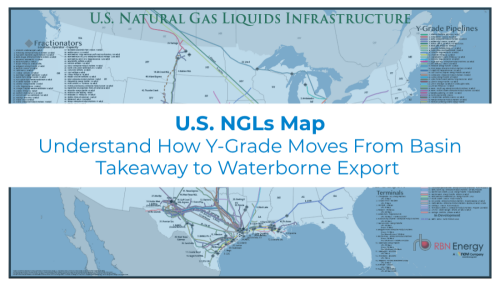
Visualize the infrastructure behind U.S. NGL movement.
The U.S. NGLs Map provides a comprehensive view of the transport, processing, and export networks moving NGLs across the U.S.
High-Priced Propane
Yesterday, the price of Mont Belvieu non-TET propane averaged 37.31 c/gal, according to OPIS (IHS Markit Oil Price Information Service). That might not seem like such a high price but given what has happened to the overall energy complex over the past two months, it is definitely a lofty number. One way to put the price of propane in perspective is to compare it against the price of crude oil. As shown in Figure 1’s Graph A, the price of propane as a percentage of crude over the past decade has varied from about 60% on the high end, down to less than 40% on the low end. Generally, a high ratio means that supply and demand — including exports — are roughly in balance. A low ratio means an oversupply imbalance, which during this period has usually been due to periodic constraints on export capacity. Too much supply and not enough export capacity crushed propane prices in 2012-16 and again in 2019. This year started in the same oversupply situation as last year, but that changed rapidly starting in March. More on that in a minute.
About the song
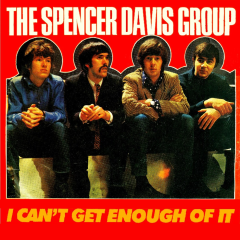
"Can't Get Enough of It" was written by Steve Winwood and Jimmy Miller, and was the third song of side two of The Spencer Davis Group’s second studio album, I'm a Man. The song would first appear as the B-side to the "I'm a Man" single, which was released in January 1967. The single would go to #10 on the Billboard Hot 100 Singles chart. Winwood and Miller also co-authored "I'm a Man." Personnel on the record were: Spencer Davis (guitar), Steve Winwood (keyboards, guitar, vocals), Muff Winwood (bass) and Pete York (drums).
The I'm a Man album was compiled of songs to back up the success of the single of the same name. Produced by Chris Blackwell and Jimmy Miller, it was the second studio album by The Spencer Davis Group. Brothers Steve and Muff Winwood had already left the band before the album's release in May 1967. Winwood has stated that the Afro-Caribbean rhythms featured in the song "I'm a Man" hinted at the direction that his next band, Traffic, would be taking.
The Spencer Davis Group was formed in Birmingham, England, in 1963 with Davis, the Winwood brothers and York as its original lineup The band released seven studio albums, one compilation album, three EPs and 15 singles. Spencer Davis still fronts a band with touring musicians doing live shows under The Spencer Davis Group banner. Steve Winwood, who was only 14 when Davis drafted him to join his band, went on to form Traffic and Blind Faith, and to have a successful career as a solo artist. He still records and tours. Jimmy Miller, the co-writer of "Can't Get Enough of It," went on to produce Traffic, Blind Faith, Spooky Tooth, Delaney & Bonnie, and Motorhead. He is best known for his production work with The Rolling Stones. Miller played the unforgettable cowbell opening on The Rolling Stones’ "Honky Tonk Women." He passed away in 1994.