Alberta, Canada’s energy powerhouse, accounts for the vast majority of the nation’s crude oil, natural gas, and NGL production. There is a lot of hydrogen locked up in all of those hydrocarbons and Alberta’s provincial government recently laid out a seven-part plan to expand the production and use of “blue” hydrogen — produced from natural gas via steam methane reforming with carbon capture and sequestration — as part of a broader effort to bolster its existing natural gas sector and energy transition cred. In today’s RBN blog, we explore Alberta’s proposed hydrogen strategy.
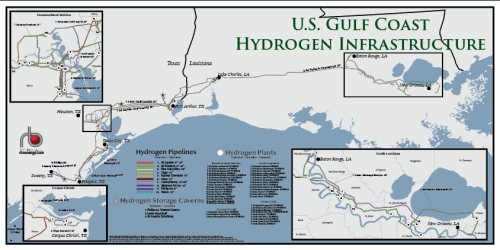
RBN’s U.S. Gulf Coast Hydrogen Infrastructure Map lays out the pipelines and merchant hydrogen plants that make up the gulf coast market, providing an unprecedented snapshot of the region’s hydrogen infrastructure network.
We have been expanding on the hydrogen theme in our RBN blogs for more than a year now. Since we began our initial excursion in our three-part Help! series in November 2020, we have considered the basics of the hydrogen market such as its size, end uses, and production economics. We followed that up by leveling the playing field in terms of understanding all of the energy and volume equivalent units for hydrogen (see I Did It), and have since explored various angles of this unique market, such as what is involved in the production of hydrogen (You Can Make It If You Try), low-carbon production of hydrogen (Start Me Up), and its use in transportation (Come Clean).
What has become clear from all of those blogs is that building an industry — let alone an economy — around hydrogen is going to be an immense challenge, and that a multi-faceted approach will be needed if hydrogen is to play a significant role in the energy transition. Expanding the scale of economic production of “blue” hydrogen in particular and ensuring that there is a concurrent expansion in hydrogen demand in both domestic use and potential exports will be key if it is to move beyond its current, relatively limited uses in the hydrocarbon and petrochemical industries.
About the song
“Rock and Roll Dreams Come Through” was written by Jim Steinman and first appeared on the extra EP that came with Steinman’s LP, Bad for Good. This collection of songs was originally intended to be the follow up to Meat Loaf’s hit album, Bat Out of Hell. According to Steinman, “Meat Loaf had lost his voice, his house, and was pretty much losing his mind,” so Steinman decided to put out a lot of the songs himself. It would be the only LP Steinman released. The song was later recorded by Meat Loaf and appears as the third song on Bat Out of Hell II: Back into Hell, the second of what was to become a trilogy of albums. Released as a single in January 1994, the song went to #13 on the Billboard Hot 100 Singles chart. Personnel on the record were: Meat Loaf (lead, backing vocals), Roy Bittan (piano, keyboards), Kenny Aronoff (drums), Steve Buslowe (bass), Tim Pierce (guitar), Lenny Pickett (sax), and Rory Dodd, Todd Rundgren, Kasim Sulton (backing vocals).
Bat Out of Hell II: Back into Hell was recorded between August 1991 and June 1993 at Ocean Way Recording in Hollywood, CA, and Power Station Studios in New York City. Produced by Jim Steinman (who also wrote the songs), it was released in September 1993. It went to #1 on the Billboard 200 Albums chart, has sold over 14 million copies worldwide, and has been certified 5x Platinum by the Recording Industry Association of America (RIAA). Five singles were released from the LP.
Meat Loaf (Michael Lee Aday) was an American rock singer and actor, best known for his powerful voice, theatrical live shows, and his Bat Out of Hell trilogy, which has sold more than 65 million records worldwide. Meat Loaf released his first album on Motown, a duo act under the name Stoney & Meatloaf. He also appeared in the Los Angeles and Broadway stage productions of Hair. After appearing in the L.A. stage production and then the movie of The Rocky Horror Picture Show he started working with Jim Steinman on what would become the first Bat Out of Hell LP. In 1976 Meat Loaf recorded lead vocals on five tracks of Ted Nugent's Free-for-All album. In October 1977, the Bat Out of Hell album was released. It went to #14 on the Billboard 200 Albums chart and has been certified 14x Platinum by the RIAA. Meat Loaf has released 12 studio albums, five live albums, seven compilation albums, one EP, and 39 singles and he has appeared in 46 films and 38 television shows.
Meat Loaf's longtime collaborator, Jim Steinman, died in April 2021. We here at RBN are saddened by the recent passing of Meat Loaf in Nashville at the age of 74. We wish to offer our condolences to his family, friends, and fans.