


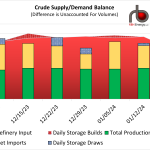
Last week's winter storm had a huge impact on the US crude market. Crude production in the Lower-48 dropped by 1 MMb/d, and about half of that loss came from the Bakken region. Refinery input also took a significant hit, decreasing by 1.4 MMb/d. In PADD 3 alone, it fell by 1 MMb/d. Imports from Canada were hit hard too, falling by 900 Mb/d, which resulted in 650 Mb/d less going into PADD 2. As a result, inventories in the Midcontinent saw a significant draw of 5.2 MMbbl. Interestingly, crude imports have been quite volatile lately, with two consecutive weeks of movement between 1.1-1.8 MMb/d. Surprisingly, the most stable part of the crude market remains the unaccounted-for volumes. It's worth noting that the market was closed on Monday due to the Martin Luther King Jr. holiday, but despite the heavy winter storm, prices remained relatively stable.
Featured Articles


The Rise and Fall of Crude Supply - Shale Crude Production, Inventories and Imports
It looks like a combination of shale crude oil production and inventory drawdowns have been backing out crude oil imports over the past two months. Gulf Coast refineries are leading the way to crank up utilization, increase diesel exports and pull crude oil inventories down from the stratosphere. A lot of this activity seems to be bypassing Cushing. Meanwhile the Gulf Coast is at the center of two big events this week – a tropical storm and a huge refinery fire. Today we continue our analysis of crude inventories.


Looks Like We Made It - Colonial Leak's Impact Minimized by Imports, Use of Line 2
The increase in waterborne flows to the East Coast in response to the recent Colonial Pipeline outage illustrated the flexibility of supply in the U.S. motor gasoline market. At the same time, the lack of a lasting impact from the loss of 8.3 million barrels of gasoline to a key U.S. demand region highlighted the degree of oversupply in the market. Today we look at how waterborne flows helped to mitigate the effects of the Colonial Pipeline outage, and how flexibility in the East Coast motor gasoline market enabled it to handle unexpected supply constraints with minimal disruption.


There's Floodin' Down in Texas - The Impact of Harvey on Crude Oil Markets
It has been a tragic week for the Gulf Coast, with months if not years of cleanup and rebuilding ahead of the region. But already, Houston, Corpus Christi, Port Arthur/Beaumont, Lake Charles and other affected areas are coming back online through the hard work of resilient Texans and Louisianans as well as aid coming in from across the country. And even though the energy industry is also moving quickly to put Hurricane Harvey in the rearview mirror, the damage and disruption have been extensive. It is still much too early to fully understand what has happened and how long the recovery is going to take. But with information that we can piece together from public statements, data analysis and conversations with knowledgeable market participants, it is possible to start developing an assessment of Harvey’s effects. That’s what we will tackle in today’s blog.
