


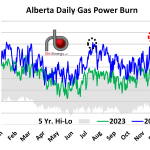
Alberta’s natural gas use for power generation (“power burn”) rose to a new single day record of 2.67 Bcf on November 22 based on estimates from RBN’s Canadian NatGas Billboard (red dashed oval in chart below). The arrival of wintry weather in the form of much colder temperatures, plenty of snow, very low to negligible winds reducing renewable wind generation, the elimination of coal-fired power generation earlier this year, and an expanded gas-fired power generation fleet drove the new demand record in Canada’s largest gas consuming province. Gas burn has been so strong in recent days that the second and third highest demand levels were recorded on November 21 (2.60 Bcf) and November 20 (2.58 Bcf), respectively.
Featured Articles
- Analyst Insight
Alberta’s Gas Power Burn Hits a New Record – In The Summer!
Alberta, the Canadian province with the largest installed gas fired power generation capacity in Canada, hit a new single day record for gas use in its power sector (power burn) of 2.53 Bcf on July 16. This is most unusual as the record was reached during the summer in a province well known for its winter time peaks in gas power burn.


- Blog
Out of This World – Latest Cold Blast Sets New Records for the Canadian Gas Market
In a part of the world where enduring a cold winter is often seen as a badge of honor, the latest cold blast that descended on Canada just before Christmas — and during Christmas in the U.S. — was another one for the natural gas record books. By almost every measure, the recent frigid temperatures, though not long-lasting, set new Canadian records for daily demand, storage withdrawals, and net exports to the U.S., and went well beyond the records set during Winter Storm Uri in February 2021. In today’s RBN blog, we delve into the latest record-busting Canadian gas data.


- Blog
Wind of Change - Reliability Efforts, Renewables Help ERCOT Tame Cold Snaps Three Years After Uri
Everyone in Texas remembers the infamous Winter Storm Uri of three years ago. What started out as a simple cold snap for many quickly turned into something far more serious: the biggest power outage in state history, with billions of dollars in property damage and hundreds of lives lost. Since then, the expected arrival of frigid temperatures has been met with some trepidation, but the critical failures of February 2021 have so far been avoided in subsequent storms. In today’s RBN blog, we look at the steps the state has taken in recent years to weatherize its power grid, show why January’s cold snap turned out to be no big deal, and explain why renewables are playing an increasingly important role in grid reliability during extreme weather conditions.
