


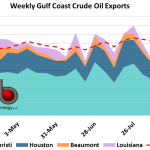
U.S. crude oil loadings in the week ended September 6 decreased by 0.9 MMb/d from the prior week to 2.9 MMb/d and 24 tankers received crude oil cargoes for export, down by eight on the week. The four-week moving average (dashed red line in Figure 1 below) now stands at 3.6 MMb/d.
Featured Articles
- Analyst Insight
U.S. Crude Oil Exports Slide, Mixed Short-Term Global Demand Signals
U.S. crude oil loadings dropped to 3.6 MMb/d last week, a decrease of 0.8 MMb/d from the previous week.
- Analyst Insight
U.S. Gulf Coast Crude Oil Exports Drop to Lowest Level in Over a Year, Partly Driven by Hurricane Francine
U.S. crude oil loadings from the Gulf Coast dipped by 153 Mb/d week-on-week to 2.8 MMb/d, marking the lowest level since mid- 2023.


- Blog
You Really Got Me - Crude Oil Export Volumes Hold Up Despite a Barrage of Storms
Last week, Hurricane Delta became the latest of a string of hurricanes and tropical storms that have assaulted the Gulf Coast this year and disrupted energy production in the Gulf of Mexico — and energy exports. A number of major storms made direct hits or glancing blows to crude export centers like Corpus Christi, Houston, Beaumont, and Louisiana, forcing marine terminals to either slow down their carrier-loading operations or shut down for a few days at a time. That led to a yo-yoing of weekly export volumes: way down one week, way up the next. Despite the short-term dislocations, however, total export volumes since the hurricane season started on June 1 are actually up slightly from the first five months of 2020, a testament to the resilience not only of the export market but to the marine terminals themselves. Today, we discuss how hurricanes and tropical storms have been affecting export-terminal activity.
