


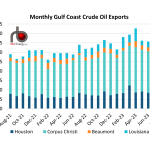
Recent data from the Crude Voyager report shows that U.S. Gulf Coast export terminals loaded 3.7 MMb/d in August — the fourth-highest monthly volume since the ban on most U.S. crude oil exports was lifted in December 2015. More outgoing cargoes were noted from the Houston and Louisiana regions at 944 Mb/d and 513 Mb/d, respectively. Corpus Christi area terminals also loaded an additional 2 Mb/d during August, leaving Beaumont as the only area that exported fewer volumes than in July.
Featured Articles


- Blog
One Week - A Record Seven Days for Gulf Coast Crude Exports, and a Lot More
The level of activity at crude oil export terminals from Corpus Christi to the Louisiana Offshore Oil Port (LOOP) is nothing short of extraordinary — a record 4.8 MMb/d was loaded the week ended August 25, according to RBN’s Crude Voyager report, and Houston-area terminals loaded an all-time high of 1.4 MMb/d. But there’s a lot more to the crude exports story. When you live this stuff day-in, day-out, you see subtle changes that often extend into trends and, if you’re lucky, you sometimes get signals that things you’d been predicting are actually happening. In today’s RBN blog, we discuss highlights from the latest Crude Voyager and what the weekly report’s data and analysis reveal about the global oil market.


- Blog
Can't You See - Big Changes Happening Below the Surface in U.S. Crude Export Markets
Massive shifts are occurring in the U.S. crude oil export market, but you wouldn’t know it from the steady-as-she-goes pace of activity. The volumes being loaded along the Gulf Coast have stayed within a relatively tight range — 2.5 MMb/d to 3.2 MMb/d — for 12 consecutive quarters now, and the export pace for each of the past three quarters has remained within a few thousand barrels of 3 MMb/d. So, what’s changed? For one thing, Corpus Christi is now by far the dominant point of export, with Houston, Louisiana, and Beaumont/Nederland trailing. Another is that Europe, heavily impacted by the sharp decline in imports from Russia, is now the leading destination for U.S. barrels. There are other changes, too, including increased use of Very Large Crude Carriers (VLCCs) and terminal expansion projects. In today’s RBN blog, we discuss highlights from our recently published Crude Voyager Quarterly Report.


- Blog
How Much More Can She Stand, Part 4 - Crude Export Volumes Key to Balancing Market
U.S. refinery demand for crude oil is off sharply due to COVID-related impacts on automobile and jet travel, and crude production is being slashed. Crude storage is filling up fast, both on land and on tankers at sea, and may be maxed out by June. That leaves imports and exports as the market-balancing agents, at least until demand for motor gasoline and jet fuel starts to rebound. And with significant volumes of imported heavy and medium crudes still needed by complex refineries, exports are likely to rise from their current, near-record levels this spring and summer. Longer term, though, we expect export volumes to decline, setting up a battle for barrels among export terminals. Today, we continue our series on Gulf Coast crude export terminals with a look at the three facilities in the Beaumont/Nederland area.
