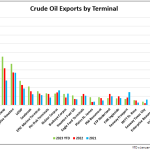
Since the ban of most U.S. crude oil exports was lifted in December 2015, shipments across the U.S. Gulf Coast have soared, from 1.2 MMb/d at the beginning of 2018 to 3.7 MMb/d in 2023 so far. Exports have accelerated since Russia invaded Ukraine about 19 months ago and the European Union’s (EU’s) sanctions on imports of Russian crude oil and products, along with a price cap. After the sanctions were implemented, several nations, especially in Europe, which depended on the Middle East and Russia for oil have begun to procure barrels from the U.S., creating new trade routes and vessel movement patterns. Since the beginning of this year, the compounded impact of the ban and the price cap has been noticeable as several terminals along the U.S. Gulf Coast loaded record volumes of crude oil for export.
Data from the Crude Voyager report shows that the Enbridge Ingleside Energy Center (EIEC) has continued its run as the top exporter of crude oil at 898 Mb/d so far this year, accounting for 24% of all volumes from the Gulf Coast, up 160 Mb/d from the volumes loaded in 2022. South Texas Gateway (STG), which loaded the third-highest volume in 2021, is the second-highest exporter with loadings at 552 Mb/d (15%), ahead of Enterprise’s Houston terminal (EHT), which has loaded 472 Mb/d (13%).