


TalusAg had been selected by the U.S. Department of Agriculture (USDA) to receive about $99.8 million in proposed federal funding to develop a network of green ammonia plants. The funding would help support the construction of 20 modular manufacturing units at 11 locations across seven states, with expected combined production of approximately 130,000 tons of green ammonia annually.
As detailed in this week’s Hydrogen Billboard, TalusAg’s project was among eight selected under the USDA’s Fertilizer Investment & Expansion for Long-Term Domestic Supply (FIELDS) Program, which was launched in July. For TalusAg, the federal contribution would cover roughly 37% of the announced project cost of $270.2 million, leaving approximately $170.4 million to be financed through other sources. TalusAg’s modular, containerized equipment allows production near fertilizer customers, potentially reducing transportation costs, supply disruptions and exposure to international ammonia markets.
The 11 locations would be distributed across Illinois, Iowa, Kentucky, Minnesota, Nebraska, South Dakota and Tennessee. The USDA did not identify every community or provide a site-by-site allocation of units. TalusAg had previously proposed locations in Nebraska and Minnesota (#93 and #94 in map below), but the USDA’s funding announcement did not say how they would fit into the newly selected 11-site network. (Note: Red circles in map below are for projects tracked in our database but which have been canceled.)
Green hydrogen, produced by splitting water through electrolysis powered by renewable electricity, is combined with nitrogen separated from air through the Haber-Bosch process to make green ammonia, replacing hydrogen typically derived from natural gas.
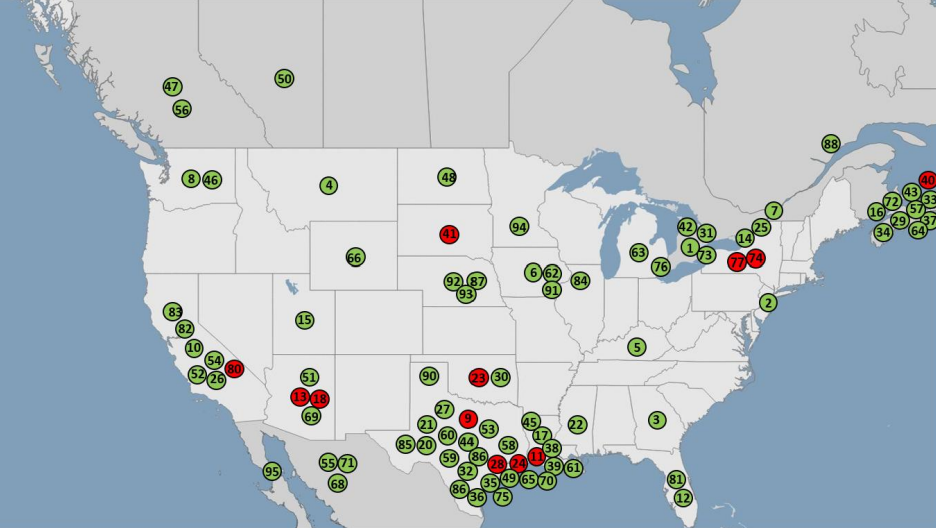
North American Green Hydrogen and Ammonia Projects
Source: Hydrogen Billboard

