


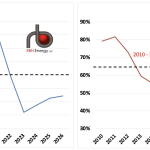
Mont Belvieu propane and normal butane prices are on pace this year to record annual historic lows relative to WTI crude oil. As shown on the the left hand chart below, propane’s price relative to WTI for the year is projected at 36%, which is 14% below the 2010-2023 average level. Normal butane (right hand chart) is looking even worse with prices at 45% of WTI or 19% below the long-term average. And if you believe the forward curves, it isn't going to get much better in the next couple of years. The propane forward curve has prices at 42% of WTI in 2026 while normal butane is projected to inch up to 47% of WTI.
Featured Articles
- Analyst Insight
Propane Back on Sale as Prices Fall Below 40% of WTI Crude Oil
Propane is on sale again! U.S. propane prices have weakened relative to WTI crude oil over the last few months, falling below the 5-year minimum to 38.9% as of May 1.


- Blog
The Top 10 Energy Prognostications for 2025 - Year of the Snake - Don't Get Bit!
Are you ready for Trumpian turmoil? Regardless of your opinion of the president-elect, you’ve got to acknowledge he’ll be shaking things up. In fact, with talk of a tariff blitz poised to disrupt global trade, mass deportations on deck, notions like reclaiming the Panama Canal, buying Greenland and even annexing Canada, the turmoil is already well underway. And of course, energy markets will be front and center, with “Drill, baby, drill” the stated oil and gas policy du jour. With so much uncertainty ahead, it’s impossible to predict what will happen in 2025, right? Nah. All we need to do is stick out our collective RBN necks one more time, peer into our crystal ball, and see what the new year has in store for us.


- Blog
Jumpin' Jack Flash, It's a Gas: Propane - Propane Markets Writhe Due to Supply/Demand Uncertainty
So far in April, there was an unexpected run-up in propane prices early in the month, followed by a 21% swoon in the past 15 days of trading. The forward curve suggests smooth sailing from now through next winter season, but that seems unlikely, given recent market developments. Propane inventories, which are supposed to be building this time of year, actually fell last week, putting stocks at 16.9 MMbbl below this point in 2020, according to EIA statistics released last week. The data also showed that weekly exports spiked to the second-highest peak of all time at 1.7 MMb/d, while production declined two out of the past three weeks. And just over the horizon, there’s the potential for a big increase in Chinese propane demand as new petrochemical plant capacity comes online over the next three years. Today, we look at how these issues are likely to shape the propane market over the next few months and suggest that you consider attending our upcoming virtual conference, where we will pose these questions to industry leaders from production, midstream, exports, and retail market segments.
