


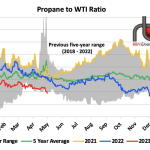
Propane is on sale again! U.S. propane prices have weakened relative to WTI crude oil over the last few months, falling below the 5-year minimum to 38.9% as of May 1. The chart below shows the ratio of the price of Mont Belvieu non-TET propane and WTI crude oil as a simple percentage. You can see that over the last five years (green line), propane’s value has generally averaged between 50 and 60 percent of WTI crude oil. The propane-to-crude ratio is a key industry metric that can provide a lot of insight into the state of propane market fundamentals. In general, if propane is oversupplied and inventories are high, its value will be depressed relative to crude oil. This year (red line), with ample propane supplies and high inventories, propane’s value to crude has trended well below the five-year average.
Featured Articles


Are we Headed Over the Frac Spread Cliff?
The values of the crude-to-gas ratio and the Frac spread have fallen fifty percent from their highs this year. Frac spreads represent the difference between the value of natural gas and natural gas liquids (NGLs), which are heavily influenced by the price of crude. Thus the Frac spread is in effect tied to the gas-to crude ratio. Current forward curves suggest that the crude-to-gas ratio will fall another 50 percent over the next few years. Today we ask whether the Frac spread will continue it’s fall next year and beyond.


Higher - Mont Belvieu Propane Prices Top $1 a Gallon; How High Will They Need to Go?
Propane prices at Mont Belvieu soared above $1/gallon on Wednesday — the first time that’s happened in the month of June since 2014. This buck-and-change price doesn’t come as much of a surprise for industry insiders, however. U.S. propane inventories have been very skinny lately, sitting at 56.2 MMbbl — or only 587 Mbbl above the five-year minimum based on yesterday’s EIA data. At the same time, propane exports have been riding high, averaging 1.3 MMb/d so far this year, up nearly 90 Mb/d from the same time frame in 2020, while production has remained virtually flat over the past 18 months. Surprise or not, the spike past $1/gal raises an important question: How high will U.S. propane prices have to go before exports are reined in so U.S. inventories can increase? Today, we discuss the key drivers behind the current price level and our propane market outlook for the second half of the year.


Jumpin' Jack Flash, It's a Gas: Propane - Propane Markets Writhe Due to Supply/Demand Uncertainty
So far in April, there was an unexpected run-up in propane prices early in the month, followed by a 21% swoon in the past 15 days of trading. The forward curve suggests smooth sailing from now through next winter season, but that seems unlikely, given recent market developments. Propane inventories, which are supposed to be building this time of year, actually fell last week, putting stocks at 16.9 MMbbl below this point in 2020, according to EIA statistics released last week. The data also showed that weekly exports spiked to the second-highest peak of all time at 1.7 MMb/d, while production declined two out of the past three weeks. And just over the horizon, there’s the potential for a big increase in Chinese propane demand as new petrochemical plant capacity comes online over the next three years. Today, we look at how these issues are likely to shape the propane market over the next few months and suggest that you consider attending our upcoming virtual conference, where we will pose these questions to industry leaders from production, midstream, exports, and retail market segments.
