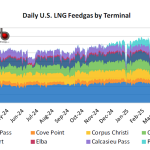
U.S. LNG feedgas demand dropped again last week, driven by lower intake at Sabine Pass and Corpus Christi.
Feedgas deliveries to Sabine Pass were volatile, and flows to the terminal dipped below 4 Bcf/d on April 21st and 23rd. The drops came from Kinder Morgan Louisiana, though the pipeline had no reported maintenance during that time. Now, flows to Sabine Pass are back to about 4.5 Bcf/d, which is in line with the terminal’s typical operating levels.
At Corpus Christi, feedgas volumes were below average, initially because of planned work on the Corpus Christi Pipeline from April 21 to 24. But even after the maintenance wrapped up, gas deliveries to the terminal didn’t bounce back-instead, they dropped. Cheniere, the terminal’s owner, has confirmed the pipeline work is done, but the ongoing low intake suggests there might be maintenance happening at the LNG terminal itself. Cheniere doesn’t share detailed maintenance schedules for its LNG plants. Right now, feedgas is around 1.65 Bcf/d, which could mean one of the production trains isn’t running.
Feedgas intake at Cameron, Cove Point and Calcasieu Pass all indicate the terminals are performing at peak levels, while Freeport and Elba Island are operating at full levels.
Last week, commissioning volumes at Plaquemines LNG were around 2 Bcf/d. Venture Global received FERC authorization to commission Liquefaction Block 10 and Block 11 last week. The new terminal has 18 blocks in total, 11 of which are now authorized to produce LNG. It is likely the feedgas at the terminal will begin to ramp up again soon, after being around 2 Bcf/d since mid-March. For more information on U.S. LNG, check out the LNG Voyager.