U.S. LNG feedgas demand rose by 0.24 Bdf/d last week driven by higher intake at Freeport and the new Plaquemines terminal, setting new records since it began operations.
Flows to Freeport increased after being down unexpectedly the previous week. The terminal was operating at full capacity on May 10 but experienced reductions from May 15 to 17 before rebounding again on May 18. The cause of the disruption was unclear and no new incidents were reported to state regulators.
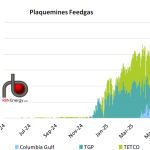
Feedgas deliveries to the new Plaquemines LNG terminal hit record highs last week, averaging 2.34 Bcf/d (see chart below). Venture Global received FERC authorization on May 8 to introduce hazardous fluids and begin Liquefaction Block 13.
The project is ramping up quickly, and once complete, it will consist of 18 liquefaction blocks requiring about 3 Bcf/d of feedgas. Venture Global has said the blocks are performing above expectations and has increased the terminal’s projected peak output from 3.2 Bcf/d to 3.6 Bcf/d.
Cove Point and Calcasieu Pass performed above their long-term contracted levels and Sabine Pass and Elba Island operated at full capacity last week. Maintenance appears to be ongoing at Cameron, although the operator, Sempra, has not confirmed this. One train is likely offline. Additionally, pipeline maintenance on the terminal’s header system is scheduled to continue through the end of the month. Feedgas deliveries to Corpus Christi were lower from May 12 to 16 but have since rebounded. For more insights on U.S. LNG Feedgas, check out the LNG Voyager.